Category Archives: ISO 27001
Information security policy compliance, business processes and human behaviour
This article aims to review the literature on information security policy compliance issues and their relation to core business processes in the company and users’ behaviour. It also provides an insight into particular implementation examples of the ISO 27001 Standard, and methods of analysis of the effectiveness of such implementations.
Information security
Information security issues in organisations have been brought up long before the rapid development of technology. Companies have always been concerned with protecting their confidential information, including their intellectual property and trade secrets. There are many possible approaches to addressing information security. Wood [30] points out that security is a broad subject including financial controls, human resource policies, physical protection and safety measures. However, Ruighaver et al. [23] state that information security is usually viewed as a purely technical concern and is expected to have the same technical solution. On the other hand, Schneier [25], Lampson [17], and Sasse and Flechais [24] emphasise the people aspect of security, and people play crucial role as they use and implement security controls.
As stated by Anderson [3], it is essential to properly define information security in order to pay merit to all these aspects.
The Standard for Information Security Management ISO 27001 [32] defines information security as “the protection of information from a wide range of threats in order to ensure business continuity, minimize business risk, and maximise return on investments and business opportunities.”
Dhillon [10] states security issues in organisations can arise due to absence of an information security policy. One of the ways to implement such a security policy is to take ISO 27001 standard as a framework.
ISO 27001 Standard
ISO 27001 Standard which is a member of the ISO 27000 standards family evolved from British national standard BS7799 [31]. It aims to provide guidance on managing the risk associated with threats to confidentiality, integrity and availability of organisation’s assets. Such assets, as defined in ISO 27001 [32] include people, software, hardware, services, etc.
Doherty and Fulford [11], Von Solms [28], and Canavan [8] all came to the conclusion that well-established standards such as ISO 27001 might be a stepping-stone to implementing good information security programs in organisations.
However, Anttila and Kajava in their study [4] identify the following issues with ISO 27001 Standard:
– The standard is high-level and basic concepts are not presented consistently in the standard.
– It is hard to measure business benefits from implementing this standard.
– Presented process management is not fully supporting current business practices.
– The standard struggles to recommend solutions to contemporary business environments.
Neubauer et al. [19] in their research states that the main problem with security standards, including ISO 27001 is their “abstract control definition, which leaves space for interpretation”. Furthermore, the authors suggest that companies focus on obtaining formal certification and often do not to assess and put in place the adequate security controls according their main business goals. Ittner et al. [14] support this point, adding that organisation also fail to estimate the effectiveness of the investments in such initiatives.
According to Sharma and Dash [26], ISO 27001 does not provide detailed guidance requires substantial level of expertise to implement. Moreover, the authors claim that “If risk assessment is flawed, don’t have sufficient security and risk assessment expertise, or do not have the management and organizational commitment to implement security then it is perfectly possible to be fully compliant with the standard, but be insecure.” Results of their study suggest that the organizations, which participated in the study implemented information security mainly to comply with legal and regulatory requirements. The consequence of that was low cost-effectiveness of such implementations. However, the researcher don’t analyse the level of users’ acceptance of implemented controls. The authors also fail to recommend an approach which would support security manager’s decision-making process in implementing ISO 27001 Standard controls.
Karabacak and Sogukpinar in in their paper [16] present a flexible and low-cost ISO 17799 compliance check tool. The authors use qualitative techniques to collect and analyse data and sate that “the success of our method depends on the answers of surveyors. Accurately answered questions lead to accurate compliance results.” However, the researchers stop short of analysing the impact of compliance with security policy on users’ behaviour. The authors do not consider the issue that a security manager’s decisions regarding a particular implementation of security policy affects that organisation as a whole and may introduce additional cognitive burdens to users. These issues in extreme cases (e.g. obstructing core business processes) may result in non-compliance as users prioritise their primary task.
Vuppala et al. their study [29] discuss their experience from implementing ISO27001 information security management systems. One of the most important lessons learnt was developing an understanding of the role of users’ behaviour in this process. The authors recommend to “not make drastic changes to the current processes; this will only infuriate the users. Remember, users are an important, if not the most important, part of the overall security system.”
Human behaviour
Johnson and Goetz in [15] conducted a series of interviews with security managers to identify main challenges of influencing employees’ behaviour. The results of this study revealed that security managers rely extensively on information security policies, not only as a means of ensuring compliance with legal and regulatory requirements, but also to guide and direct users’ behaviour.
To explore the question of the impact on users’ behaviour while implementing security policies, the following theories were researched:
1. Theory of Rational Choice – a framework, which provides insight into social and economic behaviour. It implies that users tend to maximise their personal benefits [13]. Beautement et al. in their paper [6] uses this theory to build a foundation explaining how people make decisions about whether to comply or not to comply with any particular information security policy.
Herley [12] suggests that it is rational for users not to comply with security policy, because of the perceived risk reduction is lower than the effort needed.
2. Protection Motivation Theory – a theory which describes four factors that individuals consider when trying to protect themselves [22]:
– perceived severity
– probability of the adverse event
– efficiency of the preventive behaviour
– self-efficiency
Siponen builds on this theory to gain an understanding of the attitude of individuals towards compliance with security policies. Siponen refers to it in order to study the impact of the punishment on the actual compliance and on intention to comply [27], [20].
3. The Theory of General Deterrence – this suggests that users will not comply with the rules if they are not concerned with punishment [1].
4. Theory of Planned Behaviour – this suggests that subjective norms and perceived behavioural controls influence individuals’ behaviour [2]. Siponen [27] and Pahnila [20] discovered that social norms play a significant role in users’ intention to comply.
These theories suggest that to effectively protect a company’s assets, the security manager should develop and implement security policies not only to ensure formal compliance with legal and regulatory requirements, but also to make sure that users are considered as a part of the system. Policies should be designed in a way that reduces the mental and physical workload of users [1], [6].
Business process visualisation and compliance
It is important to consider information security compliance and users’ behaviour in the context of a company. Users in organisations involved into activities, which could be presented as business processes.
Business process is defined as a set of logically related tasks (or activities) to achieve a defined business outcome [9].
The continuous monitoring of their business processes is essential for any organisation. This can be achieved by visualisation of business processes [21]. However, they are usually complex, due to number of different users or user roles in large companies [7]. Barrett [5] also argues that it is essential to create a “vision of the process” to successfully reengineer it.
Namiri and Stojanovic in their paper [18] present a scenario demonstrating a particular business process and implement controls necessary to achieve compliance with regulatory requirements. The authors separate business and control objectives, introducing two roles: a business process expert, who is motivated solely by business objectives, and a compliance expert, who is concerned with ensuring compliance of a given business process.
References
[1] Adams, A. and Sasse, M.A. 1999. Users are not the enemy. Commun. ACM. 42, 12 (Dec. 1999).
[2] Ajzen, I. 1991. The theory of planned behavior. Organizational Behavior and Human Decision Processes. 50, 2 (Dec. 1991).
[3] Anderson, J.M. 2003. Why we need a new definition of information security. Computers & Security. 22, 4 (May 2003).
[4] Anttila, J. and Kajava, J. 2010. Challenging IS and ISM Standardization for Business Benefits. ARES ’10 International Conference on Availability, Reliability, and Security, 2010 (2010).
[5] Barrett, J.L. 1994. Process Visualisation: Getting the Vision Right Is Key. Information Systems Management. 11, 2 (1994).
[6] Beautement, A. et al. 2008. The compliance budget: managing security behaviour in organisations. Proceedings of the 2008 workshop on New security paradigms (New York, NY, USA, 2008).
[7] Bobrik, R. et al. 2005. Requirements for the visualization of system-spanning business processes. Sixteenth International Workshop on Database and Expert Systems Applications, 2005. Proceedings (2005), 948–954.
[8] Canavan, S. 2003. An information security policy development guide for large companies. SANS Institute. (2003).
[9] Davenport, T.H. and Short, J.E. 2003. Information technology and business process redesign. Operations management: critical perspectives on business and management. 1, (2003), 1–27.
[10] Dhillon, G. 2007. Principles of information systems security: text and cases. John Wiley & Sons.
[11] Doherty, N.F. and Fulford, H. 2005. Do Information Security Policies Reduce the Incidence of Security Breaches: An Exploratory Analysis. Information Resources Management Journal. 18, 4 (34 2005).
[12] Herley, C. 2009. So long, and no thanks for the externalities: the rational rejection of security advice by users. Proceedings of the 2009 workshop on New security paradigms workshop (New York, NY, USA, 2009).
[13] Herrnstein, R.J. 1990. Rational choice theory: Necessary but not sufficient. American Psychologist. 45, 3 (1990).
[14] Ittner, C.D. and Larcker, D.F. 2003. Coming up short on nonfinancial performance measurement. Harvard business review. 81, 11 (2003), 88–95.
[15] Johnson, M.E. and Goetz, E. 2007. Embedding Information Security into the Organization. IEEE Security Privacy. 5, 3 (2007).
[16] Karabacak, B. and Sogukpinar, I. 2006. A quantitative method for ISO 17799 gap analysis. Computers & Security. 25, 6 (Sep. 2006).
[17] Lampson, B.W. 2004. Computer security in the real world. Computer. 37, 6 (2004), 37–46.
[18] Namiri, K. and Stojanovic, N. 2007. Pattern-based design and validation of business process compliance. On the Move to Meaningful Internet Systems 2007: CoopIS, DOA, ODBASE, GADA, and IS. Springer. 59–76.
[19] Neubauer, T. et al. 2008. Interactive Selection of ISO 27001 Controls under Multiple Objectives. Proceedings of The Ifip Tc 11 23rd International Information Security Conference. S. Jajodia et al., eds. Springer US. 477–492.
[20] Pahnila, S. et al. 2007. Employees’ Behavior towards IS Security Policy Compliance. 40th Annual Hawaii International Conference on System Sciences, 2007. HICSS 2007 (2007).
[21] Rinderle, S.B. et al. 2006. Business process visualization-use cases, challenges, solutions. (2006).
[22] Rogers, R.W. 1975. A Protection Motivation Theory of Fear Appeals and Attitude Change1. The Journal of Psychology. 91, 1 (1975).
[23] Ruighaver, A.B. et al. 2007. Organisational security culture: Extending the end-user perspective. Computers & Security. 26, 1 (Feb. 2007).
[24] Sasse, M.A. and Flechais, I. 2005. Usable Security: Why Do We Need It? How Do We Get It? Security and Usability: Designing secure systems that people can use. L.F. Cranor and S. Garfinkel, eds. O’Reilly.
[25] Schneier, B. 2003. Beyond Fear: Thinking Sensibly About Security in an Uncertain World. Springer.
[26] Sharma, D.N. and Dash, P.K. 2012. Effectiveness Of Iso 27001, As An Information Security Management System: An Analytical Study Of Financial Aspects. Far East Journal of Psychology and Business. 9, 5 (2012), 57–71.
[27] Siponen, M. et al. 2010. Compliance with Information Security Policies: An Empirical Investigation. Computer. 43, 2 (2010).
[28] Solms, R. von 1999. Information security management: why standards are important. Information Management & Computer Security. 7, 1 (Mar. 1999).
[29] Vuppala, V. et al. Securing a Control System: Experiences from ISO 27001 Implementation.
[30] Wood, M.B. 1982. Introducing Computer Security. National Computing Centre.
[31] BS, BS7799 – Information Technology – Code of practice for information security management, London: BS, 1995.
[32] ISO/IEC, ISO/IEC 27001 – Information technology – Security techniques – Information security management systems – Requirements, Geneva: ISO/IEC, 2005 and Draft for the new revision ISO/IEC JTC 1/SC 27 N10641, 2011.
Security policy compliance behaviour case study
ISO 27001 Standard is high-level and provides only basic recommendations on implementation of security controls. This fact gives a security manager in a company a lot of flexibility in choosing particular information security policies.
When making a decision on the how to introduce new security controls to achieve compliance with the ISO 27001 standard, security managers lack a clear process and rely mostly on their past experience.
Such lack of a clear process and guidance from ISO 27001 may result in arbitrary implementation of information security controls, which will collide with the core business activities of users in the company.
This article presents a scenario of such implementation and provides specific examples of how those controls may affect users’ behaviour.
The company
Scrooge Bank is a global financial services firm, offering a range of solutions, including asset management, strategic advice, money lending, and risk management to clients in more than 100 countries.
From the organisational structure standpoint, Scrooge Bank consists of three departments in the business unit and three departments in the support unit.

The Chief Information Security Officer (CISO) reports directly to the Compliance and Risk Manager, and is responsible for ensuring legal and regulatory compliance, data loss prevention activities, and security incident management.
A decision taken by the CISO affects the whole organisation, including the analyst in the Investment Banking Department.
The business process
An analyst is a typical role in Scrooge Bank. He is involved in various business activities during the week.

On a weekly basis the analyst receives information from the client. There are several ways he can obtain this data: it might be copying information on a USB stick during a face-to-face meeting, or via e-mail as an attachment.
There are instances when the information received was exported from the client’s proprietary software products, which are not directly compatible with the widely used packages, such as Microsoft Excel, used by the analyst. Hence, the analyst was forced to use special data extracting software to access the data.
On a regular basis, the analyst needs search for additional information on the Internet to prepare a report for the client.
Once a week he runs data analysis software to analyse the potential risk for the client. This software is very powerful and commonly used in Scrooge Bank. However, it analyses vast amounts of data and consumes a lot of CPU time and memory.
When a report is finalised, the analyst exports it on a USB stick in order to present it to the Client.
Compliance requirements, controls implementation and impact on users’ behaviour
In order to more effectively protect against malicious code, Scrooge Bank decided to implement the ISO 27001 Standard. According to chapter 10.4.1 of the standard, “Controls against malicious code”, “detection, prevention, and recovery controls to protect against malicious code and appropriate user awareness procedures should be implemented.”
The ISO 27001 Standard suggests that “Precautions are required to prevent and detect the introduction of malicious code and unauthorized mobile code. Software and information processing facilities are vulnerable to the introduction of malicious code, such as computer viruses, network worms, Trojan horses, and logic bombs. Users should be made aware of the dangers of malicious code. Managers should, where appropriate, introduce controls to prevent, detect, and remove malicious code and control mobile code.”
The Standard also recommends the particular security controls to be implemented in order to protect against malicious code. In order to address the described issues and ensure formal compliance with the Standard, the security manger decides on the following implementation of the security controls. The following table also shows examples of how users in various departments of the company could potentially violate security policy, because it prevented them from perform their main business tasks
| ISO 27001 control implementation guidance | Context | Behavioral impact |
| Establishing a formal policy prohibiting the use of unauthorized software | Scrooge Bank’s CISO came up with a policy document, outlining a list of authorized software, which can be installed on users’ workstations according to principle of least privilege – users should only have access they require to perform their day-to-day activities and no more.Each department contributed to the policy, submitting a list of software which is essential to carrying out tasks by employees in this department.After finalizing this list, all users were denied access to install any new software without written permission from CISO. | John is performing an analysis of the company for the client. The deadline is fast approaching but there is still a lot of work to be done.The night before the deadline, John realizes that in order to finalize his analysis he requires a special data analysis tool, which was not included in the list of authorised software. He’s also unable to install it on his workstation, because he doesn’t have the required privileges to install new software.Getting the formal written approval from the CISO is not feasible, because it is going to take too long.John decides to copy sensitive information required for the analysis on his personal laptop using a USB flash drive to finish the analysis at home, where he can install any software he wants.
John understands the risk but he also wants to get the job done in order to avoid missing the deadline and get good performance review at the end of the year. Unfortunately he leaves his bag with the USB stick in the taxi on the way back home. He never tells anyone about this incident to avoid embarrassment. |
| Establishing a formal policy to protect against risks associated with obtaining files and software either from or via external networks, or on any other medium, indicating what protective measures should be taken | In order to prevent obtaining files and software either from or via external networks, or on any other medium, CISO established a policy restricting use of file sharing websites and limited access to CD/DVD and USB flash drives.According to the policy, if a user wants to obtain a specific file from the internet or from an external device, he has to file a written request to his manager, who will decide if this file is essential to perform his duty. After management’s approval, the Information Security Department employee will process this request, downloading this file or copying it from the external medium, using a special isolated PC with thorough antivirus checks. | Mary works closely with a client to finalise her report on risk analysis for an international energy company.She works directly with the CFO of this company who is very impatient and busy with other tasks.Mary doesn’t want to annoy him, because he may complain directly to her line manager and she can be disciplined, because this is a very important client, which brings millions to the company.The client is not aware of the new policy which was recently implemented by the CISO of Scrooge Bank and uploads important pieces of information to the file sharing website in form of the encrypted archive, because it is too big to transfer over the corporate e-mail.
He communicates the password to Mary over the phone and sends her the link. Mary was scared to explain the new policy to the client and right now she is unable to access this file to finalise her report. She decided to go to internet café during her lunch break and download the important file from there, understanding the risk, but realising that getting all necessary approvals may take way too long. At the internet café she not only downloads the encrypted file but also opens it on the local machine to check its integrity to avoid returning back, because she won’t have any breaks later in a day. Because the internet café is far from the office and she didn’t have her lunch yet, she hurries and forgets to delete the decrypted file from the machine in the internet café. She realizes her mistake when she’s back in the office but thinks that it is not a big deal and nothing bad can happen. |
| Conducting regular reviews of the software and data content of systems supporting critical business processes; the presence of any unapproved files or unauthorized amendments should be formally investigated | The CISO established a procedure of monthly checks of users’ workstations for presence of unauthorized data and software.If such data or software were be found, the employee would be given a warning. After three warnings he would be fired because of non-compliance with the security policies of the company. | Juliet uses data and files in her analysis, which she obtained from various sources, and she is not sure if it is approved or not. She’s afraid to clarify this situation with the CISO, because she’s afraid to be fired.In order to avoid being caught using such files, she decided to store this information on her personal laptop.But after a while she realised that it takes too long to copy and delete data from her corporate PC to personal laptop and vice versa, hence she decided to process all the information, including sensitive, on her personal computer.As always, she took her laptop with her on holiday, but it was stolen in a public place |
| Installation and regular update of malicious code detection and repair software to scan computers and media as a precautionary control, or on a routine basis; the checks carried out should include:1) checking any files on electronic or optical media, and files received over networks, for malicious code before use;2) checking electronic mail attachments and downloads for malicious code before use; this check should be carried out at different places, e.g. at electronic mail servers, desk top computers and when entering the network of the organization;3) checking web pages for malicious code; | The CISO implemented antivirus software on each workstation and configured automatic daily full machine scans to ensure that no malicious code was present on workstations.The CISO also established a formal policy, which requires every employee to run manual antivirus checks before opening e-mail attachments and using electronic or optical media. | Robin is a derivatives trader. Time and efficiency are critical success factors for him.Robin carries out thousands of deals per day using the electronic terminal on his PC.Introducing a new antivirus software slowed down his workstation performance, especially during full machine scans. This directly affects his job performance – he is unable to act as fast as before and misses many valuable opportunities.Robin understands the risk of malicious software but he is also frustrated by his inability to work as efficiently as before.
He finds a way to manually disable the antivirus agent on his PC. During the search for information on the internet he accidentally accesses a spoofed website and introduces a Trojan on his workstation. With no antivirus software to prevent malware from stealing sensitive information from his PC, it becomes a victim. |
| Defining management procedures and responsibilities to deal with malicious code protection on systems, training in their use, reporting and recovering from malicious code attacks | The CISO developed a set of procedures to prevent malicious code.According to these procedures, each head of a department is responsible for preventing malicious code attacks in his/her department.The CISO wants to raise awareness, train and educate users how to record, prevent and recover from malicious code attacks. He decided to run regular monthly workshops to achieve these goals. | Employees of the organization not showing up for the workshops and not paying attention, because CISO’s efforts driven mainly by corporate directives, rather than security needs. Moreover, programme is the same for everyone, regardless of roles and responsibilities and it doesn’t change year after year. |
| Preparing appropriate business continuity plans for recovering from malicious code attacks, including all necessary data and software back-up and recovery arrangements | The CISO developed appropriate plans identifying critical information assets, and gathering input from asset owners.The CISO also performs data back-ups on a regular basis and maintains recovery arrangements. | Scrooge Bank recently acquired a small company and all its IT infrastructure.Because the CISO failed to update the business continuity plan in a timely manner to include recent changes, the company was very inefficient to recover from a malicious code attack.Furthermore, employees weren’t familiar with what they should do in this situation due to a lack of education and involvement during plan testing. |
| Implementing procedures to regularly collect information, such as subscribing to mailing lists and/or checking web sites giving information about new malicious code | The CISO assigned regular collection of information about new malicious code to a member of Information Security Department in addition to the other tasks he performs. | An employee of Information Security Department receives too much information daily from antivirus vendors’ websites and mailing lists, so he started to ignore it and focus more on his main tasks (i.e. handling information security incidents) |
| Implementing procedures to verify information relating to malicious code, and ensure that warning bulletins are accurate and informative; managers should ensure that qualified sources, e.g. reputable journals, reliable Internet sites or suppliers producing software protecting against malicious code, are used to differentiate between hoaxes and real malicious code; all users should be made aware of the problem of hoaxes and what to do on receipt of them | The CISO wants to raise awareness of the employees on the issue of hoaxes.He decided to run regular monthly workshops to achieve this goal. | People don’t attend information security awareness training workshops, because they scheduled at the same day as an important meeting with the client. |
The table shows examples that regardless of the fact that the CISO developed a set of information security polices and implemented controls to ensure compliance with ISO 27001 Standard, users managed to find workarounds which negatively affected the company as a whole. In each and every case users violated security policy in in order to accomplish their main business tasks.
Additional security controls, which were added by the CISO, not only introduced additional cognitive burdens on the analyst, but also placed obstacles preventing him from performing his core business tasks.
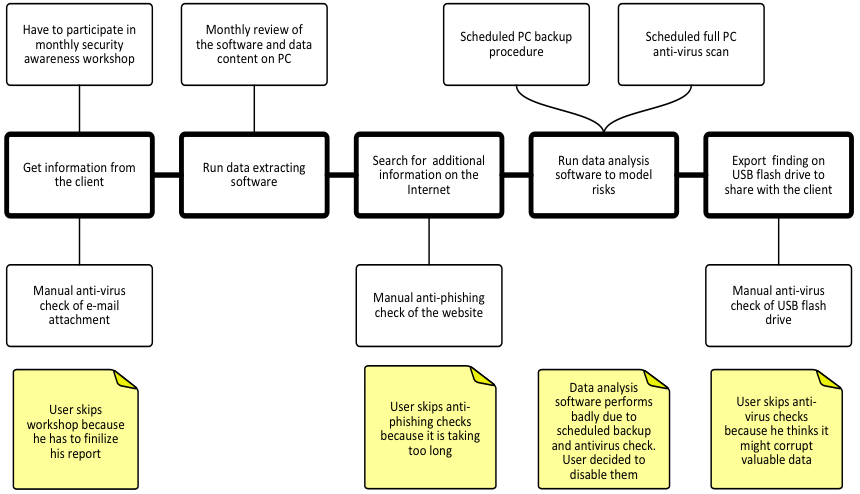
For example, the information security awareness training workshop was scheduled at the same day that the analyst has an important meeting with the client and he have to skip it in order to meet his deadline. Additionally, he managed to shut down the antivirus agent on his workstation because scheduled manual antivirus checks consume too many resources, which are needed to run his risk simulation and analysis software. The analyst also skips manual antivirus and anti-phishing checks either because they are too time consuming or because he is worried about the integrity of the data.
This chapter presented a scenario of a particular realistic implementation of security controls, which can lead to in huge numbers of collisions between security and business tasks.
This scenario emphasises the importance of making users part of the system when implementing security controls.
Information security e-learning
The Internet gives us unlimited opportunities to educate ourselves. Here I want to share with you some free resources, which can help you understand information security concepts better.
1. For those of you who want to familiarize yourself with ISO 27001 standard I recommend free e-learning course
“The purpose of this course is to enable information security practitioners to successfully implement an ISO 27001 compatible information security management system in their respective organizations. This course is made freely available to interested candidates and is modeled on ISO 27001 Lead Implementer courses.” (c) ISQ

2. Designing and Executing Information Security Strategies course provides you with opportunities to integrate and apply your information security knowledge. Following the case-study approach, you will be introduced to current, real-world cases developed and presented by the practitioner community. You will design and execute information assurance strategies to solve these cases. A term-long capstone project leads you through an actual consulting engagement with a local organisation adding experience to your resume before you even complete the program.
3. Stanford University provides free online cryptography courses.
– Basic
“This course explains the inner workings of cryptographic primitives and how to correctly use them. Students will learn how to reason about the security of cryptographic constructions and how to apply this knowledge to real-world applications. The course begins with a detailed discussion of how two parties who have a shared secret key can communicate securely when a powerful adversary eavesdrops and tampers with traffic. We will examine many deployed protocols and analyze mistakes in existing systems. The second half of the course discusses public-key techniques that let two or more parties generate a shared secret key. We will cover the relevant number theory and discuss public-key encryption and basic key-exchange. Throughout the course students will be exposed to many exciting open problems in the field.” (c) Dan Boneh
– Advanced
“The course begins with constructions for digital signatures and their applications. We will then discuss protocols for user authentication and zero-knowledge protocols. Next we will turn to privacy applications of cryptography supporting anonymous credentials and private database lookup. We will conclude with more advanced topics including multi-party computation and elliptic curve cryptography” (c) Dan Boneh
4. One-hour seminar by Xeno Kovah (Mitre) on rootkits highlights the few weaknesses in detection methodologies and many weaknesses in tools
5. Using buffer overflows
– Understanding the Stack – The beginning of this video explain Intel x86 function-call conventions when C code is compile
– Buffer Overflow Exploitation Megaprimer for Linux video series
6. Series of videos introducing wireless networking and the application of penetration testing tools to WLANs

