Adapting to EU regulatory changes: navigating compliance and building resilience

I had the privilege of joining a panel discussion on the rapidly evolving regulatory landscape and its impact on businesses worldwide. With cyber threats, operational disruptions, and AI risks on the rise, governments are strengthening regulations to drive security, resilience and accountability across industries.

In Europe, major frameworks like DORA (Digital Operational Resilience Act), NIS2 (Network and Information Security Directive) and the EU AI Act are reshaping how organisations approach cybersecurity, operational resilience, and responsible AI governance. But this shift isn’t limited to the EU – regulatory scrutiny is increasing globally, from the U.S. to APAC, with frameworks reinforcing risk management, third-party oversight and AI transparency.

A huge thank you to my fellow panelists and engaged audience members for an insightful discussion.

Volunteering with ISACA

It’s been fantastic to have an opportunity to give back to the community and volunteer with ISACA this year.

The Sydney Chapter hosted a number of professional development events for cyber, risk, governance and IT professionals with a common objective of building digital trust and securing our interconnected world. I had a chance to support these initiatives, ranging from fundraising for a mental health charity to helping organise conferences.

I found this experience incredibly rewarding and made some good friends along the way.

How to achieve SOC 2 Type 2 attestation

As a CISO who recently led an organisation through successful SOC 2 Type 1 and Type 2 audits, I’d like to share some insights and steps to help others on their journey toward SOC 2 attestation.

SOC 2 may not be for everyone (refer to my blog on compliance frameworks), but it can be useful for organisations dealing with sensitive customer data, particularly in SaaS, as it demonstrates a commitment to security, privacy, and data integrity. The journey toward SOC 2 attestation can be complex, but with careful planning and the right strategies, it’s achievable.

More

How to adopt NIST CSF 2.0

CSF 2.0 Functions. Source: NIST

NIST released a new version of the Cybersecurity Framework with a few key changes:

  • It now can be applied beyond critical infrastructure, making it more versatile and straightforward to adopt.
  • It introduces a new core “Govern” function that includes categories from other sections, with increased focus on supply chain risk management and accountability.
  • It highlights synergies with the NIST Privacy Framework.

I often use this framework to develop and deliver information security strategy. Although, other methodologies exist, I find its layout and functions facilitate effective communication with various stakeholder groups, including the Board.

More

What is the best security framework for your business?

I’m often asked what security control framework is the best. Spoiler alert – I don’t think there is one! No single framework is a silver bullet – they all have pros and cons. Some frameworks are highly-prescriptive and have a narrow scope – cardholder and account data for PCI DSS, for example.

SOC 2, on the other hand is more principled-based and doesn’t mandate specific controls but rather a Trust Services Criteria.

ISO 27001 is another popular choice: it’s a risk-based framework, although also has a set of example controls in the standard that many people chose to adopt.

NIST Cybersecurity Framework and its functions (Identify, Protect, Detect, Respond and Recover) can aid communication with business stakeholders but it has its limitations too.

Your particular industry may have other specialised sets of requirements, like NERC CIP for electric power grid in North America. The list goes on.

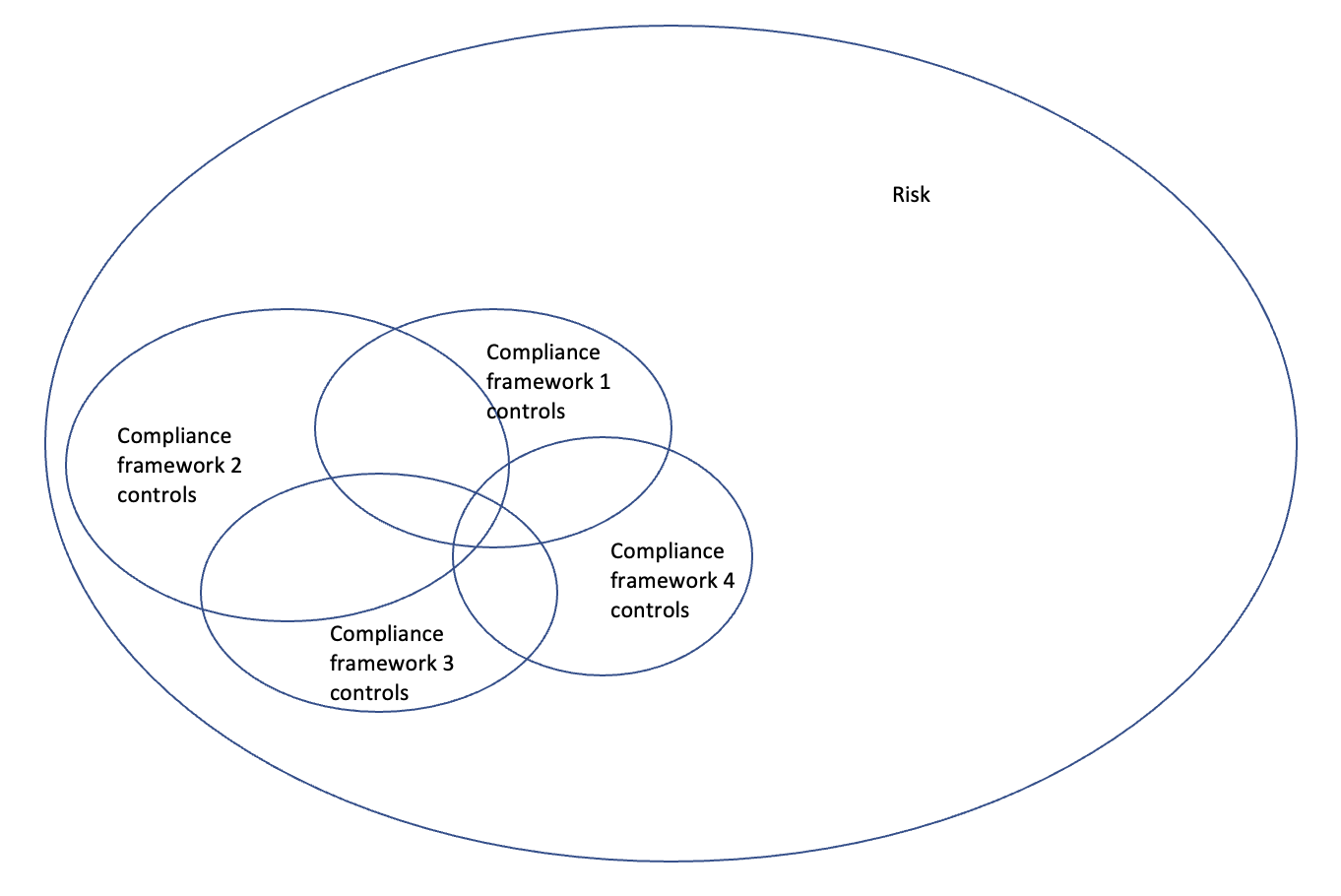
Many organisations are subject to multiple regulation and legislation simultaneously, having to adopt multiple frameworks and compliance regimes. If not managed appropriately, this can be labour-intensive to maintain and demonstrate compliance. It helps to recognise that often, although worded differently, controls from different frameworks aim to achieve the same objective, so it pays to maintain cross-framework control mapping to streamline your compliance program.

While achieving compliance with a security framework is often a necessary step in establishing a baseline level of security, it’s often not sufficient to mitigate modern threats.

Compliance frameworks were developed with a specific objective in mind – to reduce risk. And they can get you part of the way there, just not all the way. An organisation can be compliant but still insecure. Security leaders should go beyond compliance and move towards actively identifying and managing risks, focusing on the overall security posture and risk reduction to survive and thrive in the digital world.

Supply chain security

Asset management is often regarded as the foundation of a security programme. You can’t protect something that you don’t know you have. This extends beyond internal systems to your organisation’s partners. Depending on the line of business, supply chains can get increasingly complex. They include vendors, manufacturers, retailers and distributors in multiple geographies and regulatory regimes. Securing such a network is no easy task and should start with visibility and careful risk management.

More

The Psychology of Information Security – Resolving conflicts between security compliance and human behaviour

ITGP

In today’s corporations, information security professionals have a lot on their plate. In the face of constantly evolving cyber threats they must comply with numerous laws and regulations, protect their company’s assets and mitigate risks to the furthest extent possible.

Security professionals can often be ignorant of the impact that implementing security policies in a vacuum can have on the end users’ core business activities. These end users are, in turn, often unaware of the risk they are exposing the organisation to. They may even feel justified in finding workarounds because they believe that the organisation values productivity over security. The end result is a conflict between the security team and the rest of the business, and increased, rather than reduced, risk.

This can be addressed by factoring in an individual’s perspective, knowledge and awareness, and a modern, flexible and adaptable information security approach. The aim of the security practice should be to correct employee misconceptions by understanding their motivations and working with the users rather than against them – after all, people are a company’s best assets.

I just finished writing a book with IT Governance Publishing on this topic. This book draws on the experience of industry experts and related academic research to:

  • Gain insight into information security issues related to human behaviour, from both end users’ and security professionals’ perspectives.
  • Provide a set of recommendations to support the security professional’s decision-making process, and to improve the culture and find the balance between security and productivity.
  • Give advice on aligning a security programme with wider organisational objectives.
  • Manage and communicate these changes within an organisation.

Based on insights gained from academic research as well as interviews with UK-based security professionals from various sectors, The Psychology of Information Security – Resolving conflicts between security compliance and human behaviour explains the importance of careful risk management and how to align a security programme with wider business objectives, providing methods and techniques to engage stakeholders and encourage buy-in.

The Psychology of Information Security redresses the balance by considering information security from both viewpoints in order to gain insight into security issues relating to human behaviour , helping security professionals understand how a security culture that puts risk into context promotes compliance.

It’s now available for pre-order on the UK, EU or US websites.

Cake and Security

There is no doubt that security is necessary, but why is it so unpleasant to follow a security policy? Reminding yourself to stick to the rules feels like your partner telling you…. to eat your salad. You know they are right, but anticipating that bland taste and mindless chewing that awaits you simply puts you off. You decide to leave it for tomorrow, so much so that you never get to it.

Cakes, on the other hand, are yummy and require no effort whatsoever to indulge in our cravings for them. Nobody needs to force us to eat a piece.

In our day-to-day lives we prefer to do “cake” tasks without giving it a second’s thought. Things like storing confidential files on Dropbox or emailing them to our personal accounts…. you know, taking a little bite here and there. It’s “only for today”, “no biggie”… This one-time thing is so harmless, it’s like a comfort snack. We might later feel guilty that we bypassed a few “salad” controls. Maybe we used our personal USB drive instead of a company-issued encrypted one, but at the end of the day… who cares? Who will notice? As long as there is no dramatic impact on our health, a bite here or a bite there won’t cause any harm.

reward

And one day we realise that it’s not all rosy. The result of our laziness or lack of willpower eventually rears its ugly head when the doctor makes us stand on the scales and has a look at our blood pressure. So to add to your partner’s words of wisdom, is the doctor’s warning of an unhealthy present and a bleak future; something that would sound very similar during the company’s security audit.

“You have got to eat more salad and lay off the cakes!”

To make matters worse, even with our best intentions to have the salad at the office cafeteria, we discover that the one available is practically inedible. Pretty much like finding that the company’s secure shared drive doesn’t have the necessary space to store our files or that the encrypted pen drive is not compatible with the client’s Mac.

So if there are chefs coming up with ways to make salads more appealing, what can security professionals do to help us, the employees, maintain our “security diet”?

They could aim at making security more like a cake – effortless, even attractive, but still keep it as healthy as a salad. Sound simple? Perhaps not so much, but they should invest in usability studies to make sure that the secure solution is the easiest to use. It might involve discovering an entirely new culinary art on how to make a cake-tasting salad altogether. But if they fail to realise just how unpalatable the salads are to begin with, we should let them know. Security professionals need employees’ support.

Organisations are like families: everyone has to stay healthy, otherwise when a single member gets sick, the whole family is at risk of getting sick as well, whether it be catching an infectious disease or adopting an unhealthy lifestyle. It’s like having the slimmest, fittest family member refrain from adding biscuits to the grocery list in order not to tempt the couch-potatoes. It’s a team effort. In order for a company to stay healthy, everyone has to keep a healthy lifestyle of eating salad regularly, even when it is not that pleasant.

unpleasant but necessary measures

The whole company needs to know that security is important for achieving its goals -not as something that gets in the way-, just as we should all know that having a healthy diet of greens will guarantee a sound body. Employees contribute to the efficient operation of the business when they comply with security policies. Not only does security ensure confidentiality and the integrity of information, but it also guarantees that the resources are available for employees to complete their primary tasks.

We need to realise that we contribute to security; and we can inflict serious damage on a company when we don’t comply with security policies, no matter how insignificant or harmless they may seem. As employees, we are individually responsible for the organisation’s exposure to security risks just as we are responsible for exposing ourselves to illness. Our behaviour and daily regime significantly shape our quality of life, and our practices shape the quality of our business.

The health of the company is everyone’s business. Let’s all eat our salad while helping the security specialists to come up with better tasting ones.