The purpose of this post is to provide a comprehensive analysis of the data collected from the survey and semi-structured interviews to compare views on information security activities from security managers’ and users’ viewpoints.
Survey
A survey was developed to collect information from a broad sample on attitudes of the users’ towards information security policies in their organisations in general, and how compliance with information security policies affects their behaviour in particular. It was quantitatively analysed.
Method
The main goal of the survey was to assess the attitude of the end-users towards information security policies in their companies and measure the level of dissatisfaction with security tasks. Prior to the questions, all participants were shown a page with the explanation of the purpose of the study, approximate time to complete the survey, the researcher’s contact information, and their rights to withdraw their answers at any time. After getting participants’ consent by clicking the “Next” button, they were asked to answer the eleven multiple-choice questions. The first four questions were designed to gather demographic information about the participants for future analysis: participants were asked to provide information on their gender, age, the number of years of work experience, and the industry sector. The subsequent seven questions were aimed at gathering insight on users’ attitude towards information security policies in their companies and the way they make their compliance decisions. Participants were asked to:
- Indicate their attitude towards security policy in their company.
- Assess the effectiveness of implementation of the security policy in their company.
- Estimate the approximate time they spend weekly on various security activities, such as password changes, antivirus checks, anti-phishing checks, awareness training, encryption, etc.
- Indicate their attitude towards the impact which security activities have on their overall performance: respondents were presented with a statement “I believe security activities negatively affect my overall performance” and were asked to choose one of the following four answers: “strongly agree”, “agree”, “disagree”, and “strongly disagree”.
- Assess the degree of concern of the security manager in their company with users’ main business goals and tasks.
- Assess the frequency of the prevention of security controls from accomplishing their main business tasks.
- Indicate their attitude towards the possibility of violation of the security policy if it prevented them from accomplishing their main business activities.
The survey was advertised on social networks (LinkedIn, Facebook) to recruit participants for the survey. A sample of specific interest was created to include people with relevant job experience.
Results
This section presents detailed end-users’ survey findings. Results are described in the order of their appearance in the survey. 64 responses were collected.
End-users’ demographic characteristics
Results show that the majority of the sample (40 out of 64 participants) were male. They also illustrate that 32 out of 64 participants are in the 18 to 24 age group, and that 29 out of 64 are in the 25 to 34 age group. A relatively small number of participants (only 3 people) are older than 35 years. The members of the most populated group (22 out of 64 participants) are in the beginning of their careers and have less than one year worth of work experience. The following figure presents the distribution of respondents by industry sector.

Distribution of respondents by industry sector
Attitude towards security policy in the company
The results of the survey show that 51% of participants share a positive outlook towards information security in the company (6 have chosen “very positive” option and 27 “positive”). 29 respondents share a neutral attitude towards information security in the organisation. Only 2 participants indicated a negative attitude.
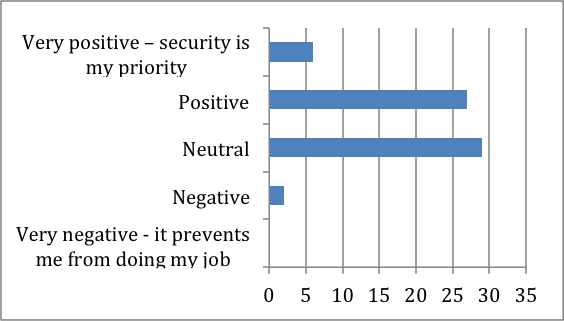
Attitude towards security policy
View on the implementation of the security policy in the organisation
50% of participants think that information security policy is effectively implemented in their compamy. However, 34% of the population struggled to provide an opinion on this matter.
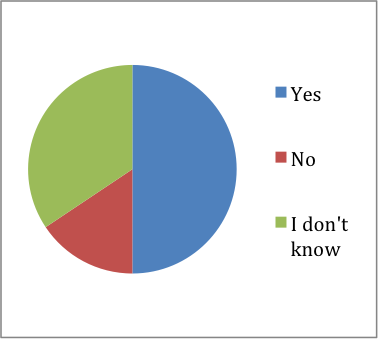
Effectiveness of implementation of the security policy
Time spent by users on security activities
A large majority (80%) feel that they spend less than 30 minutes per week in total on security tasks. However, there are 4 respondents that share the perception that they have spent over an hour on security activities in the course of the past week.

Time spent by users on security activities
Impact on users’ overall performance
37 participants disagree with the statement that security negatively impacts their overall performance and 12 participants strongly disagree with it, although, there is 1 respondent who strongly agrees.

Impact on users’ overall performance
Assessing the degree of concern of the security manager in the company with users’ main business goals and tasks
Most of the participants (27 out of 64) believe that their security manager is rather neutral towards users’ business activities. 19 participants feel that their security manager is aware of their day-to-day tasks.
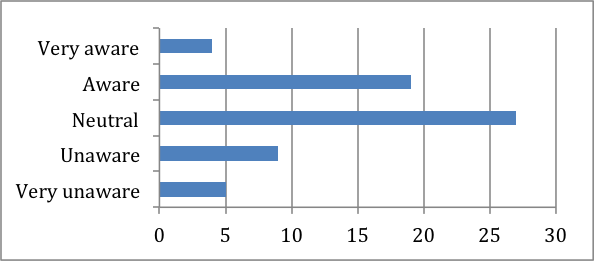
Degree of concern of the security manager in the company with users’ main business goals and tasks
Instances of obstructing core business processes
30 respondents cannot recall any instances in which security controls obstructed their business activities. On the other hand, the results of the survey show more than 50% experienced problems at least once a year, and in many cases more regularly because of the security policy.

Instances of obstructing core business processes
Information security policy violations
Results show an almost equal split between people when faced with the statement “I would violate security policy if it prevents me from accomplishing my main business tasks” who are willing to violate security policy in order to get their job done and those who make the decision to comply even in this case.

Information security policy violations
Discussion
Individual response analysis shows that some people can’t recall situations whereby security policy prevented them from accomplishing their core business activities, however they still perceive security as something that hinders their performance. Other participants also didn’t indicate such instances more frequently than approximately once every three months

Frequency of collisions in relation to perception of negative impact on users’ performance
Individual response analysis also allowed revealing the fact that there is a person, who strongly agrees that security tasks affect his/her performance. This individual’s answer of the question on the perceived number of instances when security policy prevented him/her from accomplishing their main business task shows that he/she experiences difficulty performing business activities on a daily basis. The anonymous nature of the survey didn’t allow the researcher to conduct a follow up interview to gain an insight on this particular case. Moreover, high number of responses “I don’t know” to the question regardless the effectiveness of implementation of the security policy may indicate that the criteria for effectiveness were not clearly defined. Furthermore, using social networks as a sample to survey users negatively affected the researcher’s ability to generalise the results. The presented sample contains mostly young people with relatively small amount of work experience. This fact makes it difficult to drive conclusions, because perception of the employees towards security task may change with time in the job. Given the limitations, results show that more than 23% of participants believe that security tasks negatively affect their overall performance. This outlines the major concern for the organisations, because it directly affects company’s ability to generate revenue. According to the survey results, 20% of participants responded that they spend approximately one hour per week on various security tasks.
Interviews
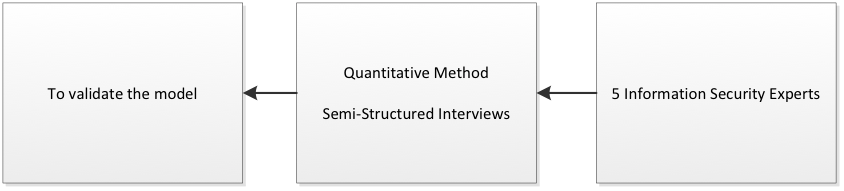
The second stage was conducted as an exploratory study with five information security experts. This section presents a descriptive analysis of the semi-structured interviews with information security experts.
Method
The main goal of the semi-structured interviews was to gather an insight on information security manager’s awareness of the fact that his decisions on particular implementation of security controls affect organisation as a whole, and that his actions may negatively impact users’ performance in core business activities. The interview questions were designed to gather information on security manager’s ability to distinguish between instances of malicious non-compliance and instances when security controls obstruct users’ main business tasks was gathered. All information security experts selected to participate in the study have seven or more years of work experience in the field of information security and are currently holding managerial positions in their companies. Materials and feedback from the two pilot interviews, which were not included in the current project, were then used to refine the questions and procedures for the following interviews, so that they focus more on relevant topics and group them into categories. When patterns started to emerge, the data were then evaluated. The Grounded Theory analysis revealed that the most common codes: – Security manager’s decision-making process on particular implementation of security controls – Relation between business and security goals – Detection of instances of non-compliance – Reaction to instances of non-compliance – Security manager’s awareness of how security policy implementation affects users’ behavior – Difficulties in measuring impact of users’ behaviour. – Security manager’s awareness of users’ typical business activities – Effect of understanding of users’ business activities on security manager’s decision-making process
Results
Results are grouped into codes, which were developed in line with the Grounded Theory: – Security manager’s decision-making process on particular implementation of security controls: Interview results suggest that 4 out of 5 interviewed security managers use their past experience when implementing security policy. One security manager suggested that security policy was already implemented in his organisation. – Relation between business and security goals: all security managers understand the role of information security as a supporting process. – Detection of instances of non-compliance: all interviewed experts rely on both formal and informal channels of detecting instances of non-compliance. – Reaction to instances of non-compliance Interview results suggest that 4 out of 5 interviewed security managers tend to try to understand the root cause of the problem first. One security manager indicated that he is not directly involved into investigation of such incidents. – Security manager’s awareness of how security policy implementation affects users’ behaviour: 4 out of 5 security managers believe that they aware of the impact of security controls on users’ behaviour. One security manager suggested that he doesn’t have resources for that. – Difficulties in measuring the impact of users’ behaviour: all experts experience some difficulties in assessing the impact on users’ behaviour. – Security manager’s awareness of users’ typical business activities: 4 out of 5 security managers indicated their awareness of users’ day-to-day tasks. One security manager mentioned that he doesn’t have enough time for this. – Effect of understanding of users’ business activities on security manager’s decision-making process: all of the interviewed experts agree that it is beneficial to understand users’ business tasks.
Discussion
This section presents a discussion of interview findings.
Security manager’s decision-making process on particular implementation of security controls
Interview data reconfirms that security managers mostly use their own judgment and past experience when making a decision on particular implementation of information security controls. As explained in a quote: “When I’m making a decision to implement ISO 27001 standard in my organization, half of that decision is what the particular policies would actually look like. Because ISO 27001 is very high-level and it is by all means not a policy in itself, it just gives you one or two criteria or one or two suggestions how your security policies should look like. Because of this freedom of implementation, you actually have to write these policies yourself.”
Relation between business and security goals
Interviewed security experts also understand the role of involving the business management in the process of implementing security controls. For example, one security manager mentioned: “If there is no benefit to the business – you don’t do it.” Another expert reinforces his point by saying: “Get the people who these controls directly affect. You should start with the business. Get their buy-in; although they might view it as an additional workload, hence most people involved in this security initiative might produce sub-standard work.“ Interviewed security managers also think that business objectives should always be the priority. For example, one expert commented: “Many security managers think that security is the most important thing. I personally don’t think so. Paying shareholders is the most important. Inhibiting those activities or encouraging dangerous activities because of what you are doing you are making the situation worse.” The results illustrate that interviewed security managers understand that their decisions affect the whole organisation.
Detection of instances of non-compliance
Participants of the interview are aware of various methods to detecting non-compliance. For example, one expert mentioned: “I walk around this building on occasion and I wiggle doors and I check workstations for locked screens. The other way you find out is by rumours or chatting with people.” The results revealed that security experts rely on both formal (e.g. periodic security reviews) and informal (e.g. rumours, complains) channels of detecting non-compliance.
Reaction to instances of non-compliance
Most interviewed security managers agree that you should not punish users for non-compliance right away. You have to first understand the root cause of the problem. For instance, one expert suggested: “You don’t react on non-compliance with anger. You try to find out why it happened, rather than the fact that it has failed. Moreover, you can use it as a possibility for education and awareness and possibility for improvement.” Another expert reinforces this point saying: “At the end of the day it failed because with high probability you implemented it badly, because you forced some particular way of working or method which they can’t use, so they worked around it.” According to the results, understanding the reason behind the non-compliance is important for most of the interviewed experts.
Security manager’s awareness of how security policy implementation affects users’ behaviour
Most of the interviewed security experts believe that they are to a certain degree aware of the impact of the security policy on users’ behavior. One security manager said: “Yes, I think I’m aware of that, because when it affects it in a negative way – we hear about it. There are lots of complains.” Some participants backed-up their statements with examples. One security manager mentioned: “When users want to look at Excel spreadsheet or use an application using iPad but they can’t, because security controls don’t allow access to the business applications via an iPad. So they have to use a laptop rather than device of their own choice. So yes, we are aware of that tension, but we tend to enable people to do what they need to do.” Interview results suggest that such awareness is in the direct relation to the number of users’ complains. However, nobody mentioned proactive way of assessing this impact.
Difficulties in measuring impact of users’ behaviour.
Several security experts stated that it is difficult to assess the impact of security controls on users’ behaviour. For example, one mentioned: “We never measured it. We don’t have a way of measuring it. So we don’t know.” Another expert agrees with him: “One thing is putting controls in place and the other is measuring effectiveness. Around users it is very difficult. Because they are not like a server, where you can say here is CPU optimisation.” However, one security expert strongly disagrees with the fact that he should take behavioural impact into consideration. He said that: “Why should I care? Why this is relevant to my job – caring about users is not part of my job responsibilities. I have limited resources to ensure compliance – how am I going to stretch that to areas outside of my direct responsibility?”
Security manager’s awareness of users’ typical business activities
Some security experts, who participated in the interviews, mentioned that they are aware of the users’ business task to the degree which is required to successfully manage projects. Once a security manager stated that: “At a high level we are aware. At the detailed process level really only when we are doing a project in that department. When we need to understand the process within the project.” Another expert provides an example supporting the same argument: “When we do a particular project on a new system. Say, for instance, it’s a new credit card system being implemented we work through the user’s role, we work through the general data storage, so we become familiar with that particular department’s user activities.” The results show that some interviewed security managers believe that they are capable of understanding of users’ day-to-day business activities and that they make their decisions on the particular implementation of security controls according to this knowledge.
Effect of understanding of users’ business activities on security manager’s decision-making process
All of the interviewed experts agree that knowledge of what users in their company are doing can help them in better implementation of information security policy. One security manager shared an example of that: “For instance we worked with our studio manager and looked at the process of data transfer to the client. We have chosen one particular brand of encrypted USB keys, we believe that adoption would be very high, because they are great looking devices. It feels good for our creative workers to give it to the client with our logo on it, rather than sharing data using cheap plastic USB stick – there is no story, there is no sort of emotional attachment, which is so particularly important for creative workers. But in order for us to come with such a decision we actually spend some time observing and understanding our users.”
Conclusion
The results show that the majority of security managers, who participated in the survey, understand the importance of making the user part of the system and assessing possible impact on users’ behaviour when deciding on implementation of particular security controls. However, they agree on that their awareness of users’ business activities is reactive and based mainly on the users’ complains. Small number of interviewed security experts makes it problematic to generalise the results. Moreover, all of the interviewed security managers have substantial amount of work experience (they were chosen to have minimum seven, however some of them have more than twenty years of experience), which may affects the results. Those security experts tend to work in the companies with mature information security processes in place. Interviewing expects with less amount of experience may yield different results.
Discussion
Results of this section provide an insight on how security managers and users view the importance of compliance behaviour in organisations. Analysis of the interview and survey results show that presented method is capable of identifying the existence of the problem: there is a huge gap between perception of security policy by users and security managers, which negatively impacts the organisation as a whole. Most of the interviewed security managers think that they consider users part of the system and aware of the impact of their action on users’ behaviour. However, survey results indicate that more that 23% users believe that security negatively affects their performance. Moreover, 20% of participants spend approximately one hour weekly on various security activities. Current interview and survey data suggests a difference in the perception of the users and security managers exists due to the differing opinions presented, but doesn’t prove this is the case and the information comes from different contexts. Running the study inside an organisation would overcome this limitation. The issue the difference in the perception of the users and security managers should be studied more thoroughly. The study should be conducted in one company to directly compare the view of managers and users from the same organisation, which is critical to showing if a difference in opinion really exists. Moreover, the research should be conducted with a broader and better-quality sample to ensure that the results could be generalised. More participants from various backgrounds should form the sample.





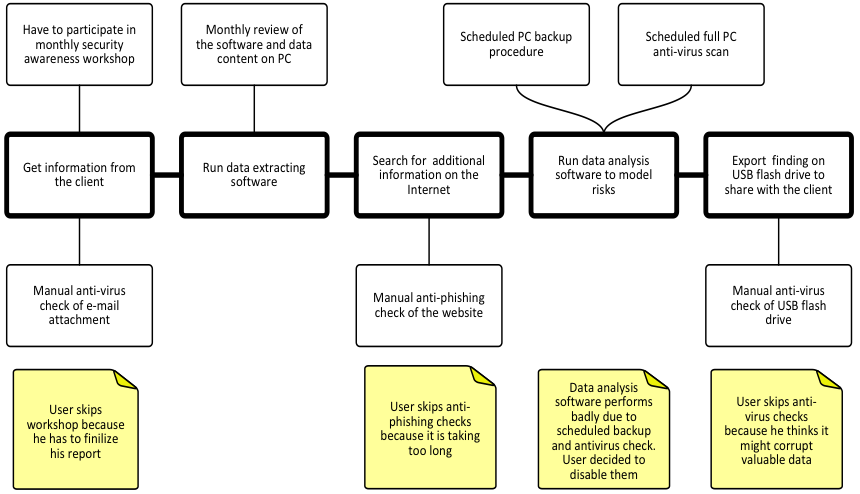





 Cyber Security Leadership