Playing Information Security

Conducting an awareness training or explaining complex information security concepts can be simplified and made fun through gamification. It is possible to learn more about information security simply by playing card games. Please see below for the three games you can download for free, print and start playing today.

1. Playing with application vulnerabilities

cards

OWASP Cornucopia is a mechanism in the form of a card game to assist software development teams identify security requirements in Agile, conventional and formal development processes. It is language, platform and technology agnostic.

Download for free

2. Playing with threat modelling
EoP_game_screen_shot
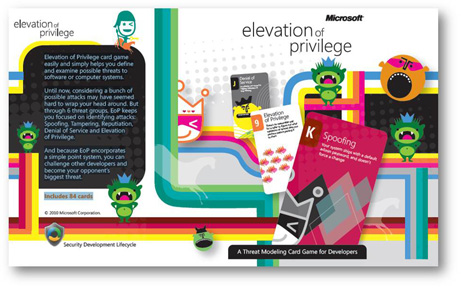
Elevation of Privilege (EoP) is the easy way to get started threat modelling, which is a core component of the design phase in the Microsoft Security Development Lifecycle (SDL).

The EoP card game helps clarify the details of threat modelling and examines possible threats to software and computer systems.
The EoP game focuses on the following threats:

  • Spoofing
  • Tampering
  • Repudiation
  • Information Disclosure
  • Denial of Service
  • Elevation of Privilege

An academic-style paper explains the rules motivation and lessons learned in creating the game

Download for free

3. Playing with privacy
privacy-card-back3-copy-1

The VOME project created a card game to support the discussion and teaching of issues of online privacy and consent. Players make decisions about what information characters might reveal to others and what they keep to themselves.

According to the authors, the main idea behind the game is to use the rules to model the way that information flows around the online environment. In real life, these flows are complex and often hidden. In the game it is possible simplify the relationships and decisions, and provide immediate feedback on the effects of those decisions


Download for free

Information security e-learning

The Internet gives us unlimited opportunities to educate ourselves. Here I want to share with you some free resources, which can help you understand information security concepts better.

1. For those of you who want to familiarize yourself with ISO 27001 standard  I recommend free e-learning course

“The purpose of this course is to enable information security practitioners to successfully implement an ISO 27001 compatible information security management system in their respective organizations. This course is made freely available to interested candidates and is modeled on ISO 27001 Lead Implementer courses.” (c) ISQ

2. Designing and Executing Information Security Strategies course provides you with opportunities to integrate and apply your information security knowledge. Following the case-study approach, you will be introduced to current, real-world cases developed and presented by the practitioner community. You will design and execute information assurance strategies to solve these cases. A term-long capstone project leads you through an actual consulting engagement with a local organisation  adding experience to your resume before you even complete the program.

3. Stanford University provides free online cryptography courses.

– Basic

“This course explains the inner workings of cryptographic primitives and how to correctly use them. Students will learn how to reason about the security of cryptographic constructions and how to apply this knowledge to real-world applications. The course begins with a detailed discussion of how two parties who have a shared secret key can communicate securely when a powerful adversary eavesdrops and tampers with traffic. We will examine many deployed protocols and analyze mistakes in existing systems. The second half of the course discusses public-key techniques that let two or more parties generate a shared secret key. We will cover the relevant number theory and discuss public-key encryption and basic key-exchange. Throughout the course students will be exposed to many exciting open problems in the field.” (c) Dan Boneh

– Advanced

“The course begins with constructions for digital signatures and their applications.   We will then discuss protocols for user authentication and zero-knowledge protocols.    Next we will turn to privacy applications of cryptography supporting anonymous credentials and private database lookup.  We will conclude with more advanced topics including multi-party computation and elliptic curve cryptography” (c) Dan Boneh

4. One-hour seminar by Xeno Kovah (Mitre) on rootkits highlights the few weaknesses in detection methodologies and many weaknesses in tools

5. Using buffer overflows

– Understanding the Stack – The beginning of this video explain Intel x86 function-call conventions when C code is compile

– Buffer Overflow Exploitation Megaprimer for Linux video series

6. Series of videos introducing wireless networking and the application of penetration testing tools to WLANs