I am excited to be recognised as one of the Top 10 Cybersecurity Leaders in Australia driving innovation and demonstrating business value. Although relatively new to Australia, I had the opportunity to use my global experience to address key cybersecurity challenges within the Financial Services sector.
A massive thank you to my team – it’s a privilege to lead such high performing and dedicated individuals and be able to build a cutting-edge cyber capability. Congratulations to all the award winners!
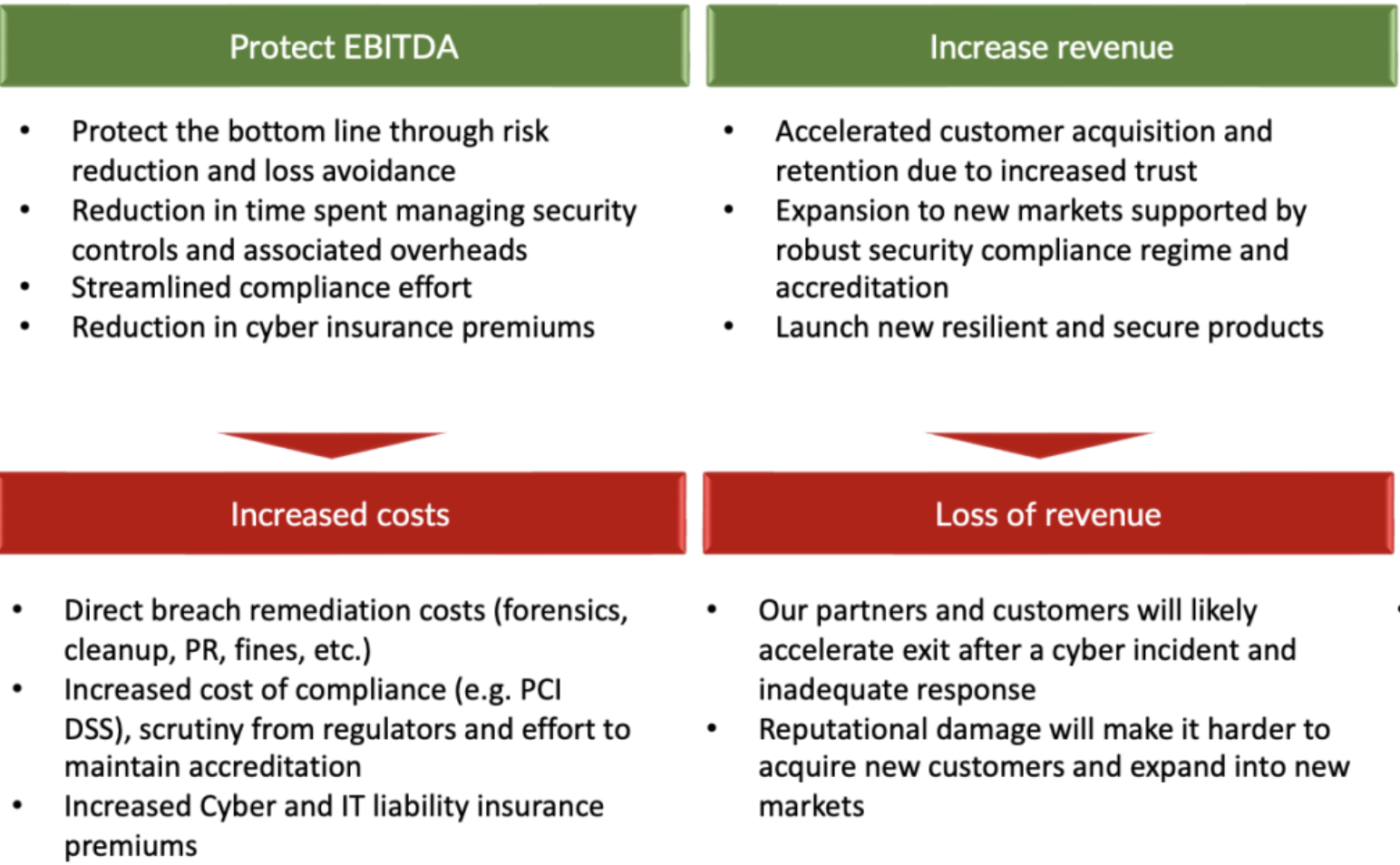
How can security support the business? To answer this question in financial terms, I outline two sides of the story. On one hand, CISOs can demonstrate positive impact on the EBITDA through elevating security capabilities. On the other hand, we can list potential downsides of poor security practices from both revenue and cost perspectives.
It’s not about carrots and sticks, it’s about seeing the full picture of opportunity and risk.
I previously wrote about building security culture in the organisation, in this blog, I look at the security team itself and share some tips for CISOs to develop a culture of performance for their teams.
The CISO role can be stressful at times, so it’s important to have the right support network around you. The cyber security industry is still relatively small and some great communities have emerged around professional certification bodies and special interest groups.
Wherever you are in the world, it’s likely there will be a security meetup around you. And if there isn’t you should definitely start one! These social gatherings don’t have to be face-to-face – online and fully remote options also exist.
Over the years I’ve been fortunate to be a member of some outstanding security leadership communities. It’s very rewarding to be able to share your experience and also learn from your peers. Feel free to reach out if you’d like an introduction.
Asset management is often regarded as the foundation of a security programme. You can’t protect something that you don’t know you have. This extends beyond internal systems to your organisation’s partners. Depending on the line of business, supply chains can get increasingly complex. They include vendors, manufacturers, retailers and distributors in multiple geographies and regulatory regimes. Securing such a network is no easy task and should start with visibility and careful risk management.
I previously wrote about the complexity of communication and the multi-faceted nature of the CISO role. Combining these perspectives, I would like to give an overview of what a communication strategy might look like for a security leader.
NISTIR 7756 Contextual Description of the CAESARS System
Knowing your existing assets, threats and countermeasures is a necessary step in establishing a starting point to begin prioritising cyber risk management activities. Indeed, when driving the improvement of the security posture in an organisation, security leaders often begin with getting a view of the effectiveness of security controls.
A common approach is to perform a security assessment that involves interviewing stakeholders and reviewing policies in line with a security framework (e.g. NIST CSF).
A report is then produced presenting the current state and highlighting the gaps. It can then be used to gain wider leadership support for a remediation programme, justifying the investment for security uplift initiatives. I wrote a number of these reports myself while working as a consultant and also internally in the first few weeks of being a CISO.
These reports have a lot of merits but they also have limitations. They are, by definition, point-in-time: the document is out of date the day after it’s produced, or even sooner. The threat landscape has already shifted, state of assets and controls changed and business context and priorities are no longer the same.
The worst time to write a security incident response plan is during an incident itself. Anticipating adverse events and preparing playbooks for likely scenarios and testing them in advance are important facets of a wider cyber resilience strategy.
Incident response, however, is not only about technology, logs and forensic investigation – managing communication is equally important. It is often a compliance requirement to notify the relevant regulator and customers about a data breach or a cyber incident, so having a plan, as well as an internal and external communication strategy, is key.
Security incidents can quickly escalate into a crisis depending on their scale and impact. There are lessons we can learn from other disciplines when it comes to crisis communication.
One of the best example is offered by the Centers for Disease Control and Prevention (CDC). The resources, tools and training materials they have created and made available online for free have been tested in emergency situations around the world, including the latest Covid-19 pandemic.
CDC’s Crisis and Emergency Risk Communication (CERC) manuals and templates emphasise the six core principles of crisis communication:
1. Be first. Quickly sharing information about an incident can help stop the spread, and prevent or reduce impact. Even if the cause is unknown, share facts that are available.
2. Be right. Accuracy establishes credibility. Information should include what is known, what is not known, and what is being done to fill in the information gaps.
3. Be credible. Honesty, timeliness, and scientific evidence encourage the public to trust your information and guidance. Acknowledge when you do not have enough information to answer a question and then work with the appropriate experts to get an answer.
4. Express empathy. Acknowledging what people are feeling and their challenges shows that you are considering their perspectives when you give recommendations.
5. Promote action. Keep action messages simple, short, and easy to remember.
6. Show respect. Respectful communication is particularly important when people feel vulnerable. Respectful communication promotes cooperation and rapport.
Cyber security professionals can adopt the above principles in crisis situations during a cyber incident, demonstrating commitment and competence and communicating with transparency and empathy both inside and outside of the organisation.
Building on my previous blogs on CISO responsibilities, initial priorities and developing information security strategy, I wanted to share an example of what a security dashboard might look like. It is important to communicate regularly with your stakeholders and sharing a status update like this might be one way of doing it. The dashboard incorporates a high-level view of a threat landscape, top risks and security capabilities to address these risks (with maturity and projected progression for each). Feel free to use this as a starting point and adjust to your needs.
The dashboard above aligns to the NIST Cybersecurity Framework functions as structuring your security programme activities in this way, in my experience, allows for better communication with business stakeholders. However, capabilities can be adjusted to align with any other framework or your control set of choice. Some of the elements can be deliberately simplified further depending on your target audience.
Managing change and improving security culture should start with understanding the organisation, the people in it and what drives them.
In the case of cyber security, this begins with understanding why current security practices might not be effective and why people often find workarounds rather than follow security processes.







 Cyber Security Leadership