How to manage vulnerabilities in your open source packages. Part 1: Using Snyk

We rely on open source libraries when we write code because it saves a lot of time (modern applications rely on hundreds of them), but these dependencies can also introduce vulnerabilities that are tricky to manage and easy to exploit by attackers.

One way of addressing this challenge is to check the open source packages you use for known vulnerabilities.

In this blog I would like to discuss how to do this using an open source tool called Snyk

Snyk

The first thing you want to do after creating an account is to integrate Snyk with your development environment. It supports a fair amount of systems, but here I would like to talk about GitHub as an example. The process of getting the rest of the integrations are pretty similar.

Snyk’s browser version has an intuitive interface and all you need to do is go to the Integrations tab, select GitHub and follow the instructions.

After granting the necessary permissions and selecting the code repositories you want tested (don’t forget the private ones too), they will be immediately scanned.

You will be able to see the results in the Projects tab with issues conveniently ordered by severity so you can easily prioritise what to tackle first. You can also see the dependency tree there which can be quite handy.

Project.png

A detailed description of the vulnerability and some recommendations on how to remediate it are also provided.

Most vulnerabilities can be fixed through either an upgrade or a patch and that’s what you should really do, or ask someone (perhaps by creating a ticket) if you don’t own the codebase. Make sure you test it first though as you don’t want the update to break your application.

Some fancy reporting (and checking license compliance) is only available in the paid plan but the basic version does a decent job too.

You can set up periodic tests with desired frequency (daily or weekly) which technically counts as continuous monitoring but it’s only the second best option compared to performing tests in your deployment pipeline. Integrating Snyk in your CI/CD workflow allows to prevent issues in your code before it even gets deployed. This is especially useful in organisations where code gets deployed multiple times a day with new (potentially vulnerable) libraries being introduced. And that’s something we are going to discuss in my next blog.


How to respond to a security incident

In this blog I would like to outline a process of responding to a security incident, including a breach of personal data. It is intended to be high-level in nature to allow for adaptation to different types of incidents and specific needs of your organisation.

There are many definitions of a security incident out there. I prefer this one: a security incident is an attempted or successful unauthorised access, use, theft, disclosure, modification or destruction of information, or interference with or misuse of information processing infrastructure, applications and data. A personal data breach is one of the types of a security incident which occurs when personal information is subject to loss or unauthorised access, use, disclosure, copying or modification.

More

Cyber security in divestments

3197813348_6786c9aae5_z

A company may divest its assets for a number of reasons: political, social or purely financial in order to free up resources to focus on core business. Regulators may also demand a divestment to prevent one company holding a monopoly. When such a decision is made, the security function can support the business by managing risks during this process. These risks not only include the obvious legal and regulatory compliance ones, but also risks related to business disruption and leaks of intellectual property or other sensitive information. Security teams can also help the business identify value adding opportunities through, for instance, saving costs on software licenses.

The scale of divestments vary and depend on the nature of the organisation: they can range from a single subsidiary to a whole division. Information usually accompanies physical assets, which opens up potential challenges with data governance when these assets change hands. The magnitude of such risks differ depending on specific conditions of the deal, for example:

  • Number of assets is scope
  • Criticality of assets
  • Location of assets and applicable jurisdictions

In my experience, divestments are almost always associated with aggressive timelines for completion usually in the form of legally binding agreements. Therefore, as a security professional, the last thing you want to do is to slow down the process and prevent the business from meeting these timelines.

You need to balance this, however, with the risk exposure. It helps when the security team gets involved early to support the process from the start. All too often, however, the business can be asking for security sign-off after the finalisation of the deal. This can be disappointing, particularly when a number of data transfer requirements have already been violated.

So if you’re one of the lucky ones, and the business is asking for your advice on divesting securely, what should you tell them? What areas do you consider? Here are some examples to get you started:

  • Information asset inventories and data maps. These might include data, software and infrastructure assets. You can’t help securely transfer something you don’t know exists. Start with establishing visibility and interdependencies.
  • Access control. Who has access to what? Do they need that access? Will they need that access in the future? Segregation of duties and least privilege principles are not just abstract philosophical concepts – they have real applications when it comes to divestments.
  • Consider legal and regulatory requirements when it comes to data asset transfer, retention and disposal. Involve your legal team, but don’t forget about technical controls, like encryption and secure data wipes.
  • Availability of skilled resource and mature IT function on the ‘buy’ side. Remember, whoever is buying the assets must have their infrastructure ready to support the acquisition and integration of new assets. Despite being perceived as a ‘buyer’s problem’, risks like that can negatively impact the overall project and should be considered.

All in all, the divestment process can be challenging but the early integration of security professionals ensures the appropriate oversight is given to all relevant areas for a smooth transfer to the buyer.

Image by Jason Kuffer.

What can a US Army General teach us about security?

General

General Douglas MacMarthur said “never give an order that can’t be obeyed”. This is sound advice, as doing so can diminish the commander’s authority. If people want to do what you are asking them to do, but can’t, they would doubt your judgement in the future.

Despite the fact that most of us operate in commercial organisations rather than the US Army, there are some lessons to be learned from this.

Security professionals don’t need to rally their troops and rarely operate in command-and-control environments. Their role has largely shifted to the one of an advisor to the business when it comes to managing cyber risk. Yet all too often advice they give is misguided. In an effort to protect the business they sometimes fail to grasp the wider context in which it operates. More importantly, they rarely consider their colleagues who will have to follow their guidance.

Angela Sasse gives a brilliant example of this when she talks about phishing. Security professionals expect people to be able to identify a phishing email in order to keep the company secure. Through numerous awareness sessions they tell them how dangerous it is to click on a link in a phishing email.

Although it makes sense to some extent, it’s not helpful to expect people to be able to recognise a phishing email 100% of the times. In fact, a lot of information security professionals might struggle to make that distinction themselves, especially when it comes to more sophisticated cases of spear phishing. So how can we expect people who are not information security specialists to measure up?

To make matters worse, most of modern enterprises depend on email with links to be productive. It is considered normal and part of business as usual to receive an email and click on the link in it. I heard of a scenario where a company hired an external agency and paid good money for surveying their employees. Despite advance warnings, the level of engagement with this survey was reduced as people were reporting these external emails as “phishing attempts”. The communications team was not pleased and that certainly didn’t help establish the productive relationship with the security team.

The bottom line is that if your defences depend on people not clicking on links, you can do better than that. The aim is not to punish people when they make a mistake, but to build trust. The security team should therefore be there to support people and recognise their challenges rather than police them.

After all, when someone does eventually click on a malicious link, it’s much better if they pick up the phone to the security team and admit their mistake rather than hope it doesn’t get noticed. Not only does this speed-up incident response, it fosters the role of the security professional as a business enabler, rather than a commander who keeps giving orders that can’t be obeyed.

Time for something new

IMG-6141

After six years with KPMG’s Cyber Security practice I decided it was time to take on a new challenge. It was a great pleasure helping clients from various industry sectors solve their security issues and I certainly learned a lot and met many fantastic people.

A digital venture incubation firm has partnered with a world leader in visas and identity management to found a new London-based venture that is creating a frictionless travel experience. 

I joined this tech startup as the Head of Information Security and couldn’t pass on this opportunity to be one of the early members of the leadership team. 

I’ll be driving the security and compliance agenda, adjusting to the needs of the dynamic and growing business. I can’t wait to put the skills I learned in consulting into practice and contribute to this company.

I’ll have an opportunity to help create a trusted, seamless, user centred visa application process for consumers and businesses alike, through automation and a cutting edge technology. And that’s exciting!

ISACA young professionals

I’ve been interviewed for the launch of the ISACA Young Professionals portal that contains a wealth of information for starting and accelerating your career in IT audit and cybersecurity.

I decided to contribute because ISACA played a role in my career development too.

I started attending ISACA London chapter events while I was studying for my Master’s degree in London. Although the university provided a great theoretical foundation on information security, I wanted to know about the real-world challenges that practitioners in the industry were facing.

At the time I had just finished writing my thesis after doing some great research at the university and I wanted to share my findings and the research of my colleagues with the community. The organisers were supportive, so we agreed a day and I delivered a talk on resolving conflicts between security compliance and human behaviour.

It was a rewarding experience as the participants provided some valuable insights and feedback; they helped to bridge the gap between academia and real practical experience. I already had a solid foundation from my postgraduate degree but I was missing was some anecdotes and real life stories about how this could apply in practice. This laid the foundation for my book The Psychology of Information Security.

It worked out for me, but should you get involved in broader activities beyond developing your technical skills? I would say yes.

The value of technical skills and knowledge can’t be overestimated. But there’s another side to this story. Prospective employers are not only looking for technical experts, they want people who are good team players, who can collaborate and communicate effectively with others, who can organise and get things done, who can lead. Getting involved with the community and volunteering gives you the chance to develop and demonstrate these non-technical skills and grow your professional network.

Regardless of where you are on your journey, ISACA provides great opportunities to advance your career through courses, networking and certification programmes, so I highly recommend getting involved!

Read my story on ISACA Blog.

Developing an information security strategy

I wrote previously on how to assess your threat landscape and what your priorities should be when you start developing a security programme in a new company.

In this blog, I would like to dig deeper and talk about how you actually develop a security strategy with some illustrative examples. You can then use these to further refine your security architecture.

As always, we would start with a Why. Why is security important for your business? Well, you will need to help your stakeholders understand that security can help build customer trust and become a brand differentiator.

And how can this be achieved? To keep this simple, let’s zoom in on three priorities:

  • Support the business. Embed security into the business by ensuring alignment to business strategy
  • Risk-based approach. Pragmatic and prioritised security controls, advice, guidance and information security expertise for the business
  • Focus. Centre on protecting the most important assets and understanding the threats

The aim could be to arrive to a state where security underpins all products and services to offer customers a frictionless experience.

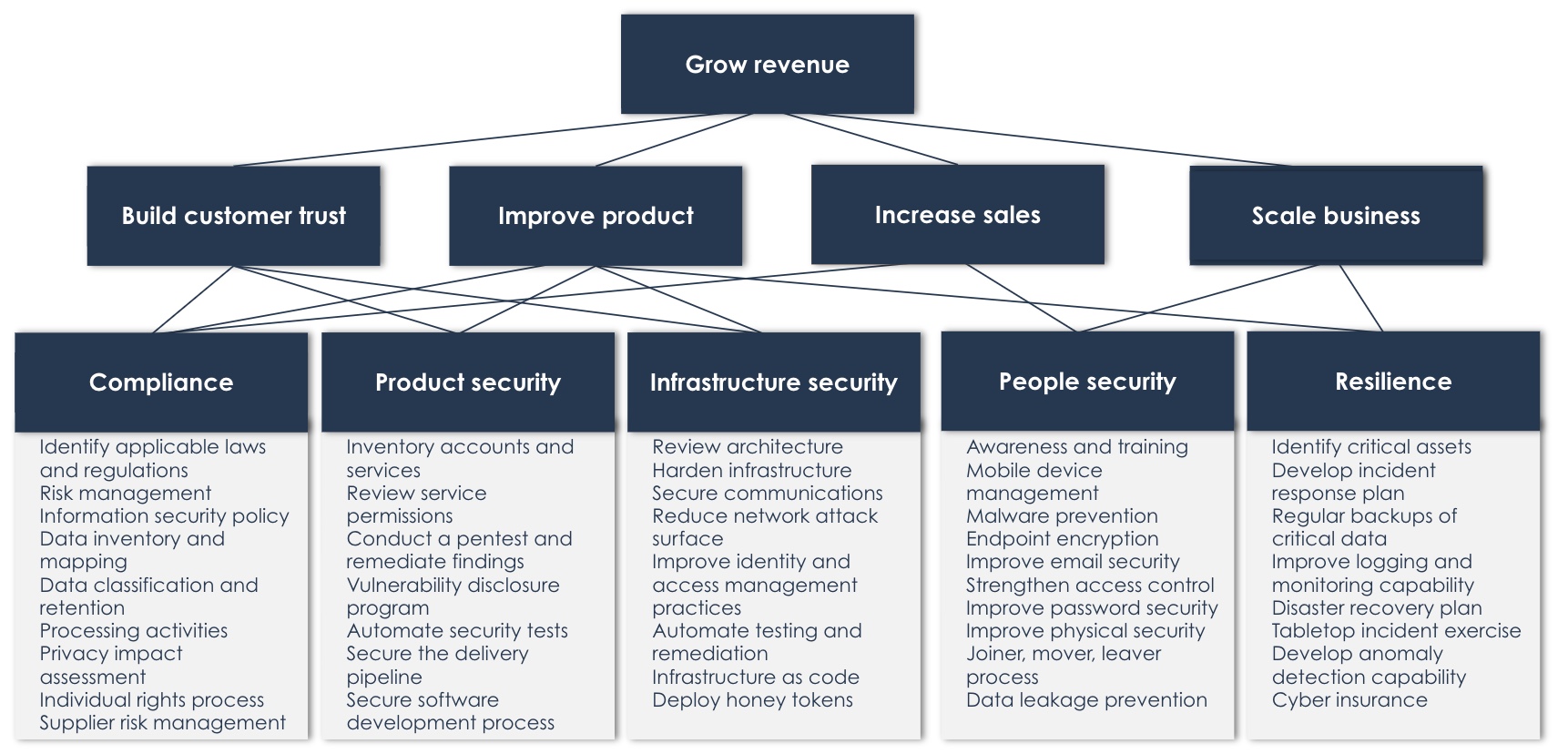
Talking to your business stakeholders will help you understand your company’s wider goals and strategy. Let’s imagine for a second that these conversations revealed that your organisation, like many others, ultimately want to grow their revenue. They also identified that the way they are going to grow their revenue is through increasing sales, building customer trust, improving products and services and scaling operations to better meet customers’ needs.

Vulnerable product, misconfigured infrastructure, insecure operations, inadequate compliance regime and inability to withstand incidents all prevent the business from achieving its objectives.

Strategy

You can now prioritise your security activities to align with these objectives, for example by grouping them into product, infrastructure and people security, as well as wider compliance and resilience objectives.

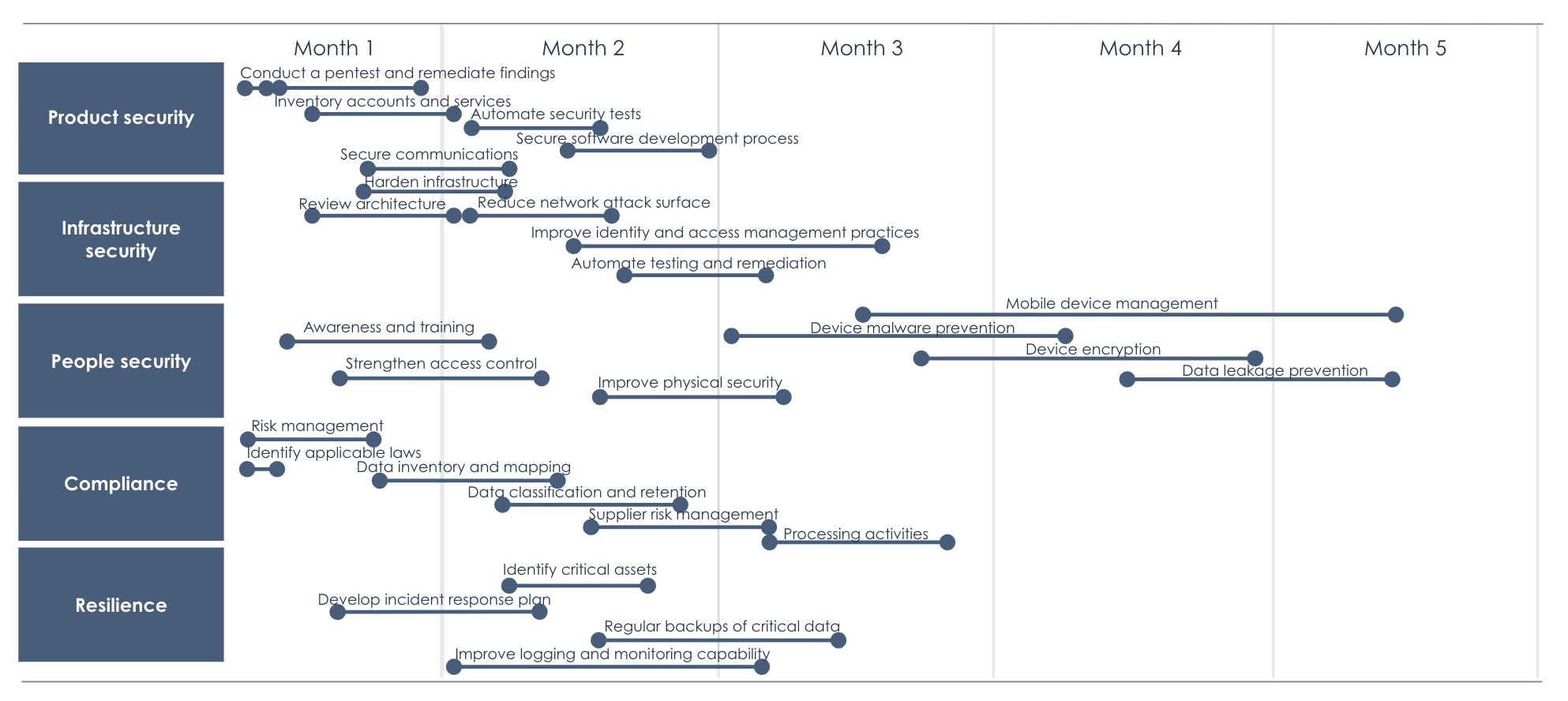
Timeline

Remember, the above is just an indicative timeline. The reality will very much depend on your organisation’s priorities, maturity and resource availability.

The first 100 days as a CISO

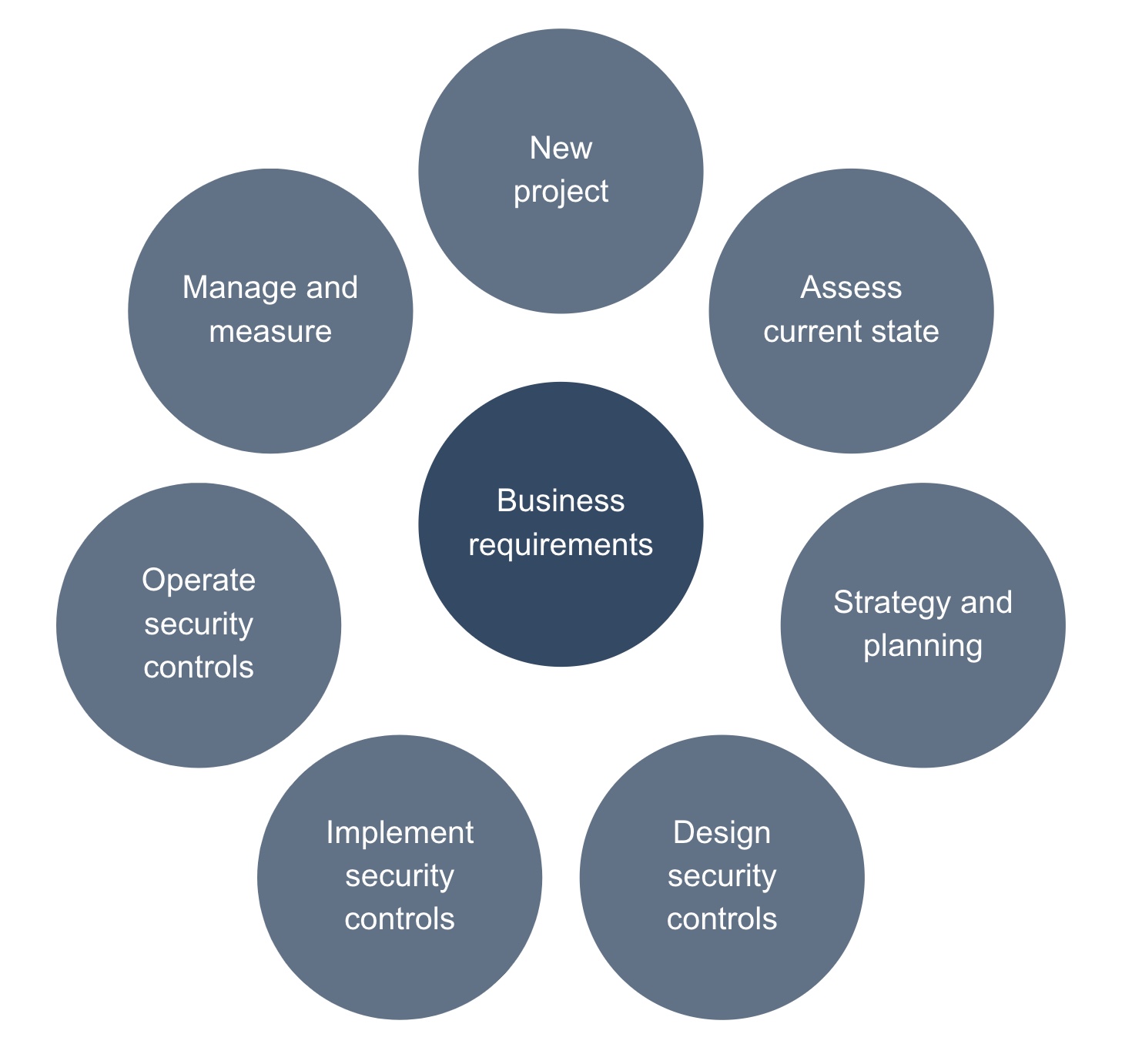
Lifecycle

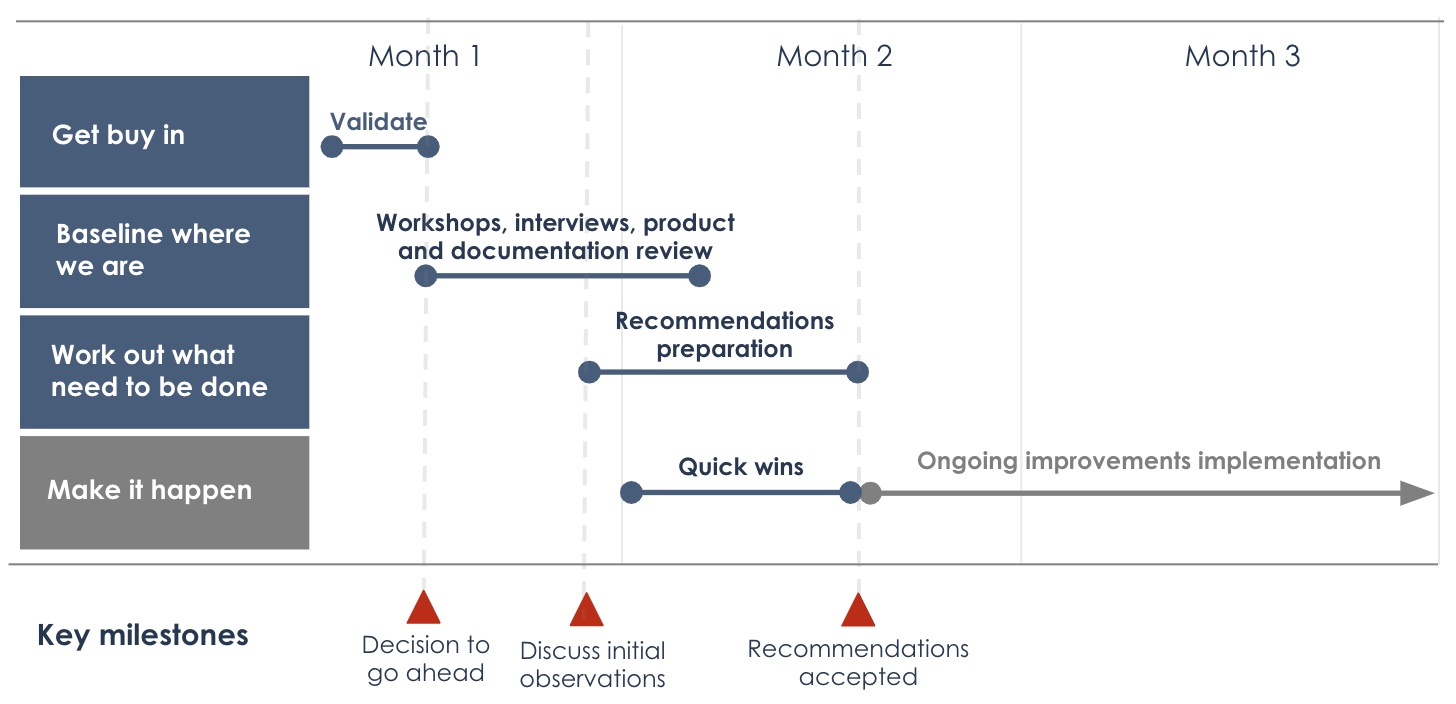
What should you do in your 100 days in a new company? In short, you should find a way to support the business and present it in a way that is understood and accepted. Communicate broadly and often to ensure constant alignment. Measure your progress in a meaningful way to demonstrate the value to the business.

Roadmap

  • Get buy in

Validate top assets, threats and risks. Obtain leadership support on next steps.

  • Baseline where you are

Understand business requirements, technological and regulatory landscape. Perform interviews and review existing product and documentation.

  • Work out what needs to be done

Recommend security improvements to address risks and align with business strategic priorities.

  • Make it happen

Preparing people, establishing good practice and implementing the right technologies and processes.

Timeline.jpeg

Transparency in security

Transparent

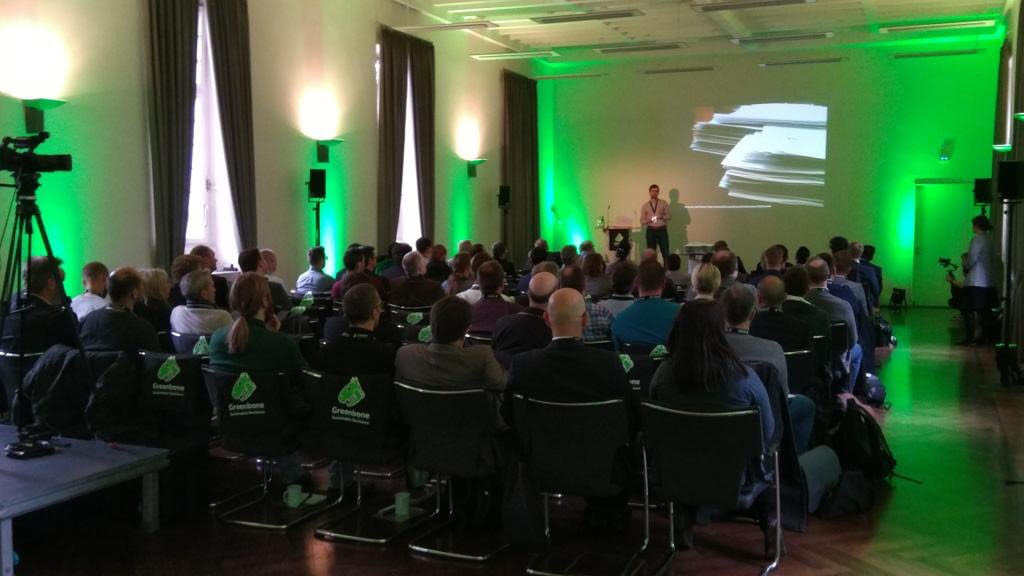
I was asked to deliver a keynote in Germany at the Security Transparent conference. Of course, I agreed. Transparency in security is one of the topics that is very close to my heart and I wish professionals in the industry not only talked about it more, but also applied it in practice.

Back in the old days, security through obscurity was one of the many defence layers security professionals were employing to protect against attackers. On the surface, it’s hard to argue with such a logic: the less the adversary knows about our systems, the less likely they are to find a vulnerability that can be exploited.

There are some disadvantages to this approach, however. For one, you now need to tightly control the access to the restricted information about the system to limit the possibility of leaking sensitive information about its design. But this also limits the scope for testing: if only a handful of people are allowed to inspect the system for security flaws, the chances of actually discovering them are greatly reduced, especially when it comes to complex systems. Cryptographers were among the first to realise this. One of Kerckhoff’s principles states that “a cryptosystem should be secure even if everything about the system, except the key, is public knowledge”.

Modern encryption algorithms are not only completely open to public, exposing them to intense scrutiny, but they have often been developed by the public, as is the case, for example, with Advanced Encryption Standard (AES). If a vendor is boasting using their own proprietary encryption algorithm, I suggest giving them a wide berth.

Cryptography aside, you can approach transparency from many different angles: the way you handle personal data, respond to a security incident or work with your partners and suppliers. All of these and many more deserve attention of the security community. We need to move away from ambiguous privacy policies and the desire to save face by not disclosing a security breach affecting our customers or downplaying its impact.

The way you communicate internally and externally while enacting these changes within an organisation matters a lot, which is why I focused on this communication element while presenting at Security Transparent 2019. I also talked about friction between security and productivity and the need for better alignment between security and the business.

I shared some stories from behavioural economics, criminology and social psychology to demonstrate that challenges we are facing in information security are not always unique – we can often look at other seemingly unrelated fields to borrow and adjust what works for them. Applying lessons learned from other disciplines when it comes to transparency and understanding people is essential when designing security that works, especially if your aim is to move beyond compliance and be an enabler to the business.

Remember, people are employed to do a particular job: unless you’re hired as an information security specialist, your job is not to be an expert in security. In fact, badly designed and implemented security controls can prevent you from doing your job effectively by reducing your productivity.

After all, even Kerckhoff recognised the importance of context and fatigue that security can place on people. One of his lesser known principles states that “given the circumstances in which it is to be used, the system must be easy to use and should not be stressful to use or require its users to know and comply with a long list of rules”. He was a wise man indeed.

Understanding your threat landscape

Identifying applicable threats is a good step to take before defining security controls your organisation should put in place. There are various techniques to help you with threat modelling but I wanted to give you some high-level pointers in this blog to get you started. Of course, all of these should be tailored to your specific business.

I find it useful to think about potential attacks as three broad categories:

1. Commoditised attacks. Usually not targeted and involve off-the-shelf-malware. Examples include:

2. Tailored attacks. As the name suggests, these are tailored and can vary in degree of sophistication. Examples include:

3. Accidental. Not every data breach is triggered by a malicious actor. Therefore, it is important to recognise that mistakes happen. Unfortunately sometimes they lead to undesired consequences, like the below:

Information security professionals can use the above examples in communications with their business stakeholders not to spread fear, but to present certain security challenges in context.

It’s often helpful to make it a bit more personal, defining specific threat actors, their target, motivation and impact on the business. Again, the below table serves as an example and can be used as a starting point for you define your own.

Threat actor Description Motivation Target Impact on business
Organised crime International hacking groups Financial gain Commercial data, personal data for identity fraud Reputational damage, regulatory fines, loss of customer trust
Insider Intentional or unintentional Human error, grudge, financial gain Intellectual property, commercial data Destruction or alteration of information, theft of information, reputational damage, regulatory fines
Competitors Espionage and sabotage Competitive advantage Intellectual property, commercial information Disruption or destruction, theft of information, reputational damage, loss of customer
State-sponsored Espionage Political Intellectual property, commercial data, personal data Theft of information, reputational damage

You can then use your understanding of assets and threats relevant to your company to identify security risks. For instance:

  • Failure to comply with relevant regulation – revenue loss and reputational damage due to fines and unwanted media attention as a result of non-compliance with GDPR, PCI DSS, etc.
  • Breach of personal data – regulatory fines, potential litigation and loss of customer trust due to accidental mishandling, external system compromise or insider threat leading to exposure of personal data of customers
  • Disruption of operations – decreased productivity or inability to trade due to compromise of IT systems by malicious actor, denial of service attacks, sabotage or employee error

Again, feel free to use these as examples, but always tailor them based on what’s important you your business. It’s also worth remembering that this is not a one-off exercise. Tracking your assets, threats and risks should be part of your security management function and be incorporated in operational risk management and continuous improvement cycles.

This will allow you to demonstrate the value of security through pragmatic and prioritised security controls, focusing on protecting the most important assets, ensuring alignment to business strategy and embedding security into the business.