Sharing thoughts on Zero Trust

I’ve been featured in an eBook by Thales sharing my thoughts on challenges organisations face on their Zero Trust journey and how to overcome them. It’s a huge topic that can be approached from different angles and it’s certainly difficult to capture it in a single quote. However, asset management should be an important consideration regardless of an implementation model.

Security dashboard

Building on my previous blogs on CISO responsibilities, initial priorities and developing information security strategy, I wanted to share an example of what a security dashboard might look like. It is important to communicate regularly with your stakeholders and sharing a status update like this might be one way of doing it. The dashboard incorporates a high-level view of a threat landscape, top risks and security capabilities to address these risks (with maturity and projected progression for each). Feel free to use this as a starting point and adjust to your needs.

The dashboard above aligns to the NIST Cybersecurity Framework functions as structuring your security programme activities in this way, in my experience, allows for better communication with business stakeholders. However, capabilities can be adjusted to align with any other framework or your control set of choice. Some of the elements can be deliberately simplified further depending on your target audience.

Feel free to refer to my previous blogs on developing security metrics and KPIs and maturity assessment for more information.

Cyber security metrics and KPIs

Security professionals have access to the amounts of data never seen before. Antivirus software, firewalls, data loss prevention solutions – they all generate a staggering amount of alerts.

Security operation centres and the underlying SIEM technology allow us to aggregate, correlate and make sense of these vast troves of data. We can create dashboards and metrics that might look slick and even be useful to security teams but do such data add value to business stakeholders? Do they tell a story to the Board?

More

How to assess security risks using the bow tie method

Bow tie risk diagrams are used in safety critical environments, like aviation, chemicals and oil and gas. They visualise potential causes and consequences of hazardous events and allow for preventative and recovery controls to be highlighted.

You don’t have to be a gas engineer or work for a rail operator to benefit from this tool, however. Cyber security professionals can use simplified bow tie diagrams to communicate security risks to non-technical audiences as they succinctly capture business consequences and their precursors on a single slide.

If you work for one of the safety critical industries already, using this technique to represent cyber risks has an added benefit of aligning to the risk assessment patterns your engineers likely already use, increasing the adoption and harmonising the terminology.

There are templates available online and, depending on the purpose of the exercise, they can vary in complexity. However, if you are new to the technique and want to focus on improving your business communication when talking about cyber risk, I suggest starting with a simple PowerPoint slide

Feel free to refer to my example diagram above where I walk through a sensitive data exposure scenario. For example, it can occur through either a phishing attempt or a credential stuffing attack (supply chain and web application/infrastructure exposure being another vector) leading to a variety of business consequences ranging from a loss of funds to reputational damage. The figure also incorporates potential preventative barriers and recovery controls that are applicable before and after the incident respectively. 

Business alignment framework for security

In my previous blogs on the role of the CISO, CISO’s first 100 days and developing security strategy and architecture, I described some of the points a security leader should consider initially while formulating an approach to supporting an organisation. I wanted to build on this and summarise some of the business parameters in a high-level framework that can be used as a guide to learn about the company in order to tailor a security strategy accordingly.

This framework can also be used as a due diligence cheat sheet while deciding on or prioritising potential opportunities – feel free to adapt it to your needs.

More

The role of a CISO

I’m often asked what the responsibilities of a CISO or Head of Information Security are. Regardless of the title, the remit of a security leadership role varies from organisation to organisation. At its core, however, they have one thing in common – they enable the businesses to operate securely. Protecting the company brand, managing risk and building customer trust through safeguarding the data they entrusted you with are key.

There are various frameworks out there that can help structure a security programme but it is a job of a security leader to understand the business context and prioritise activities accordingly. I put the below diagram together (inspired by Rafeeq Rehman) to give an idea of some of the key initiatives and responsibilities you could consider. Feel free to adapt and tailor to the needs of your organisation.

You might also find my previous blogs on the first 100 days as a CISO and developing an information security strategy useful.

More

How to select cyber insurance

I wrote previously about how cyber insurance can be a useful addition to your risk management program.

Unlike more established insurance products, cyber doesn’t have the same amount of historical data, so approaches to underwriting this risk can vary. Models to quantify it usually rely on a number of high-level factors (the industry your organisation is in, geography, applicable regulation, annual revenue, number of customers and employees, etc.) and questions aimed at evaluating your security capabilities.

You are usually asked to complete a self-assessment questionnaire to help the underwriter quantify the risk and come up with an appropriate policy. Make sure the responses you provide are accurate as discrepancies in the answers can invalidate the policy. It’s also a good idea to involve your Legal team to review the wording. 

While you can’t do much about the wider organisational factors, you could potentially reduce the premium, if you are able to demonstrate the level of security hygiene in your company that correlates with risk reduction.

To achieve this, consider implementing measures aimed at mitigating some of the more costly cyber risks. What can you do to prevent and recover from a ransomware attack, for example? Developing and testing business continuity and disaster recovery plans, enabling multi factor authentication, patching your systems and training your staff all make good sense from the security perspective. They can also save your business money when it comes to buying cyber insurance.

If possible, offer to take the underwriter through your security measures in more detail and play around with excess and deductibles. Additionally, higher cover limits will also mean higher premiums and these are not always necessary. Know what drives your business to get cyber cover in the first place. Perhaps, your organisation can’t afford to hire a full time incident response manager to coordinate the activities in the event of a breach or manage internal and external communication. These are often included in cyber insurance products, so taking advantage of them doesn’t necessarily mean you need to pay for a high limit. While it is tempting to seek insurance against theft of funds and compensation for business interruption, these can drive the premium up significantly. 

It’s worth balancing the cost of the insurance with the opportunity cost of investing this sum in improving cyber security posture. You might not be able to hire additional security staff but you may be able to formulate a crisis communication plan, including various notification templates and better prepare with an incident simulation exercise, if you haven’t already. These are not mutually exclusive, however, and best used in conjunction. 

Remember, risk ownership cannot be transferred: cyber insurance is not a substitute for security controls, so even the best cover should be treated as an emergency recovery measure.
The foundation of the Zero Trust architecture

Zero Trust is a relatively new term for a concept that’s been around for a while. The shift to remote working and wider adoption of cloud services has accelerated the transition away from the traditional well understood and controlled network perimeter.

Security professionals should help organisations balance the productivity of their employees with appropriate security measures to manage cyber security risks arising from the new ways of working.

When people talk about Zero Trust, however, they might refer to new technologies marketed by security vendors. But in my opinion, it is as much (if not more) about the communication and foundational IT controls. Effective implementation of the Zero Trust model depends on close cross departmental collaboration between IT, Security, Risk, HR and Procurement when it comes to access control, joiner-mover-leaver process, managing identities, detecting threats and more.

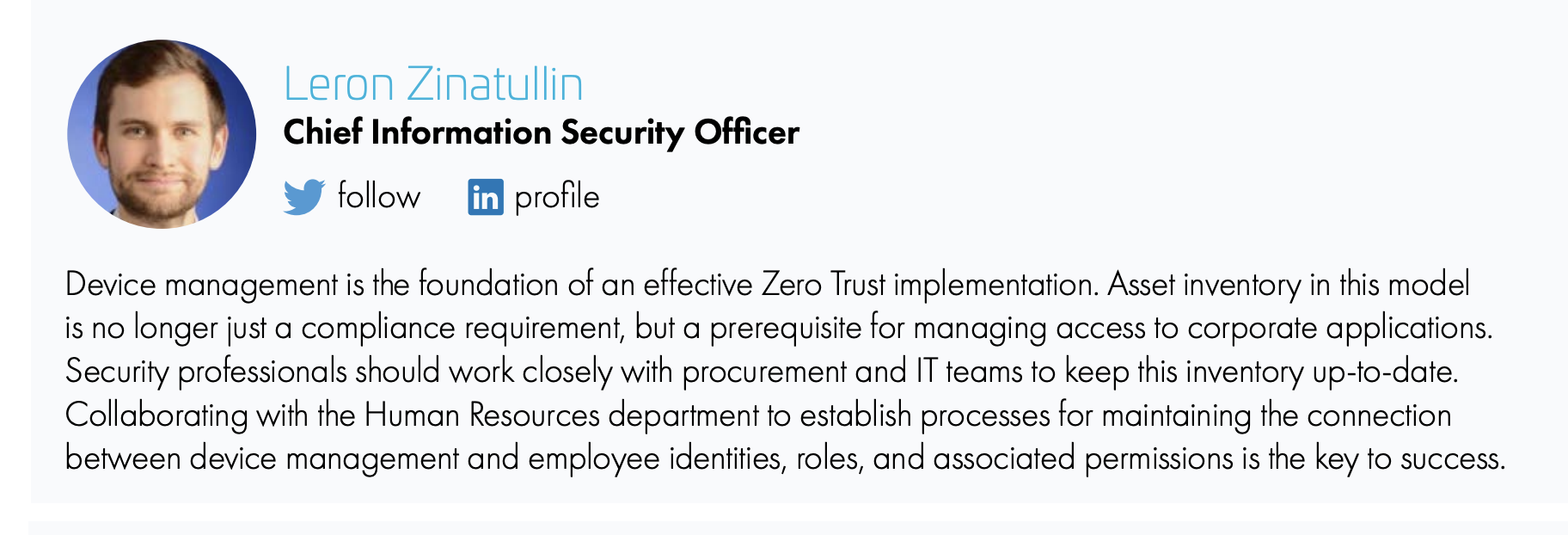
Device management is the foundation of an effective Zero Trust implementation. Asset inventory in this model is no longer just a compliance requirement but a prerequisite for managing access to corporate applications. Security professionals should work closely with procurement and IT teams to keep this inventory up-to-date. Controlling the lifecycle of the device from procuring and uniquely identifying it through tracking and managing changes, to decommissioning should be closely linked with user identities.

People change roles within the company, new employees join and some leave. Collaborating with HR to establish processes for maintaining the connection between device management and employee identities, roles and associated permissions is key to success.

As an example, check out Google’s implementation of the Zero Trust model in their BeyondCorp initiative.

Webinar: A CISO panel on weaving security into the business strategy

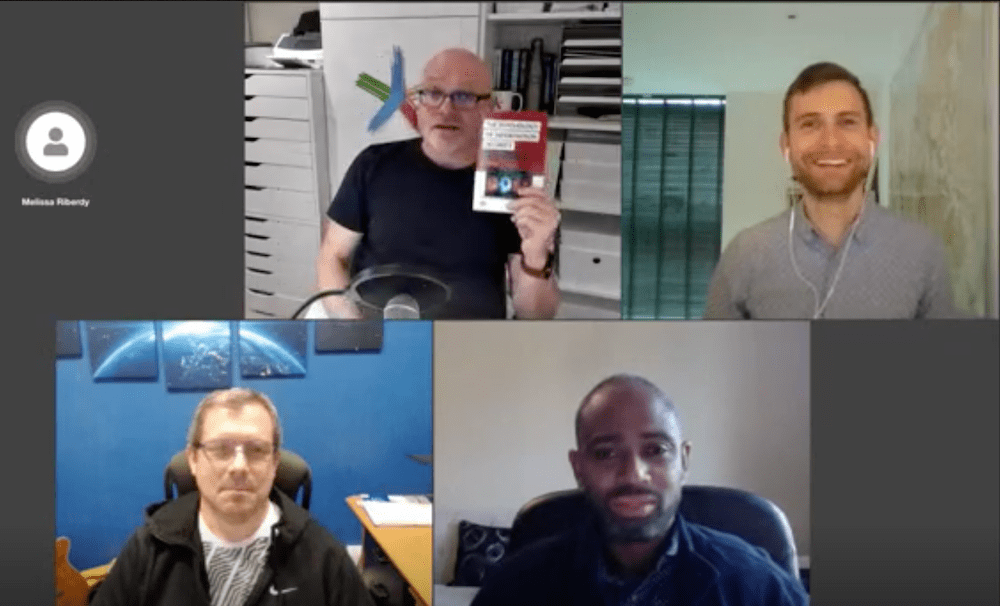
I had a lot of fun participating in a panel discussion with fellow CISOs exploring the link between cyber security and business strategy. It’s a subject that is very close to my heart and I don’t think it gets enough attention.

In the course of the debate we covered a number of topics, ranging from leveraging KPIs and metrics to aligning with the Board’s risk appetite. We didn’t always agree on everything but I believe that made the conversation more interesting.

As an added bonus, my book The Psychology of Information Security was highlighted as an example of things to consider while tackling this challenge and to improve communication.

You can watch the recording on BrightTalk.