Security architecture: how to

When building a house you would not consider starting the planning, and certainly not the build itself, without the guidance of an architect. Throughout this process you would use a number of experts such as plumbers, electricians and carpenters.  If each individual expert was given a blank piece of paper to design and implement their aspect of the property with no collaboration with the other specialists and no architectural blueprint, then it’s likely the house would be difficult and costly to maintain, look unattractive and not be easy to live in.  It’s highly probable that the installation of such aspects would not be in time with each other, therefore causing problems at a later stage when, for example, the plastering has been completed before the wiring is complete.

This analogy can be applied  to security architecture, with many companies implementing different systems at different times with little consideration of how other experts will implement their ideas, often without realising they are doing it.  This, like the house build, will impact on the overarching effectiveness of the security strategy and will in turn impact employees, clients and the success of the company.

For both of the above, an understanding of the baseline requirements, how these may change in the future and overall framework is essential for a successful project. Over time, building regulations and practices have evolved to help the house building process and we see the same in the security domain; with industry standards being developed and shared to help overcome some of these challenges.

The approach I use when helping clients with their security architecture is outlined below.

Approach

I begin by understanding the business, gathering requirements and analysing risks. Defining current and target states leads to assessing the gaps between them and developing the roadmap that aims to close these gaps.

I prefer to start the security architecture development cycle from the top by defining security strategy and outlining how lower levels of the architecture support it, linking them to business objectives. But this approach is adjusted based on the specific needs.

More

SABSA architecture and design case study

Let’s talk about applying the SABSA framework to design an architecture that would solve a specific business problem.  In this blog post I’ll be using a fictitious example of a public sector entity aiming to roll-out an accommodation booking service for tourists visiting the country.

To ensure that security meets the needs of the business we’re going to go through the layers of the SABSA architecture from top to bottom.
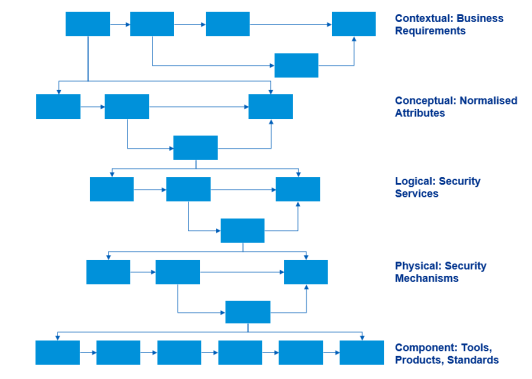
layers

Start by reading your company’s business strategy, goals and values, have a look at the annual report. Getting the business level attributes from these documents should be straightforward. There’s no need to invent anything new – business stakeholders have already defined what’s important to them.

Contextual architecture

Every single word in these documents has been reviewed and changed potentially hundreds of times. Therefore, there’s usually a good level of buy-in on the vision. Simply use the same language for your business level attributes.

After analysing the strategy of my fictitious public sector client I’m going to settle for the following attributes: Stable, Respected, Trusted, Reputable, Sustainable, Competitive. Detailed definitions for these attributes are agreed with the business stakeholders.

Conceptual architecture

Next step is to link these to the broader objectives for technology. Your CIO or CTO might be able to assist with these. In my example, the Technology department has already done the hard job of translating high-level business requirements into a set of IT objectives. Your task is just distill these into attributes:
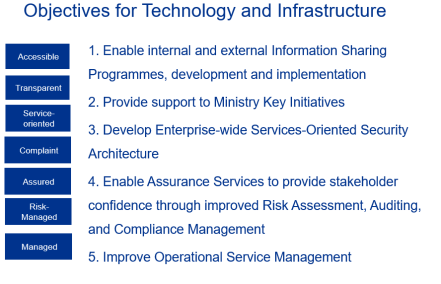
Objectives

Now it’s up to you to define security attributes based on the Technology and Infrastructure attributes above. The examples might be attributes like Available, Confidential, Access-Controlled and so on.

Requirements traceability

The next step would be to highlight or define relationships between attributes on each level:
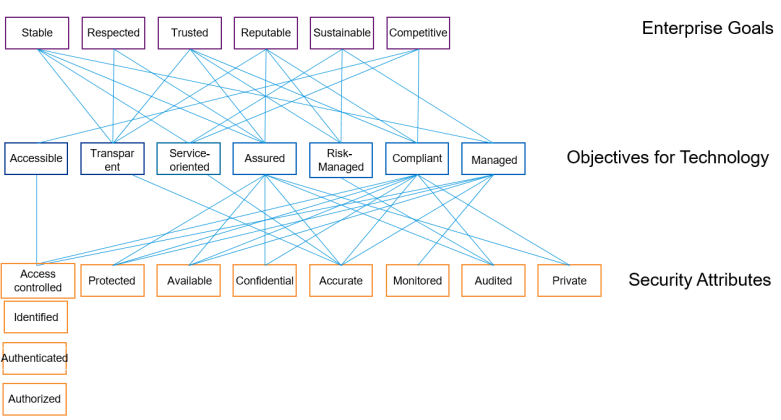
Attributes

These attributes show how security supports the business and allows for two-way traceability of requirements. It can be used for risk management, assurance and architecture projects.

Back to our case study. Let’s consider a specific example of developing a hotel booking application for a public sector client we’ve started out with. To simplify the scenario, we will limit the application functionality requirements to the following list:

ID Name Purpose
P001 Register Accommodation Enable the registration of temporary accommodations available
P002 Update Availability Enable accommodation managers to update availability status
P003 Search Availability Allow international travellers to search and identify available accommodation
P004 Book Accommodation Allow international travellers to book accommodation
P005 Link to other departments Allow international travellers to link to other departments and agencies such as the immigration or security services (re-direct)

And here is how the process map would look like:
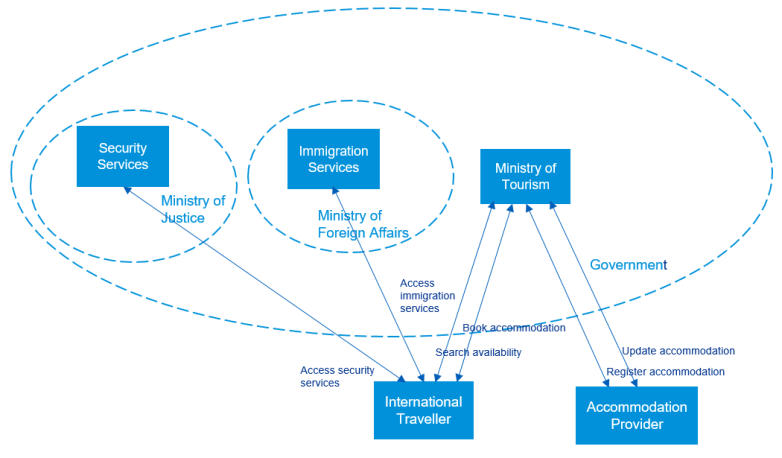
Process map

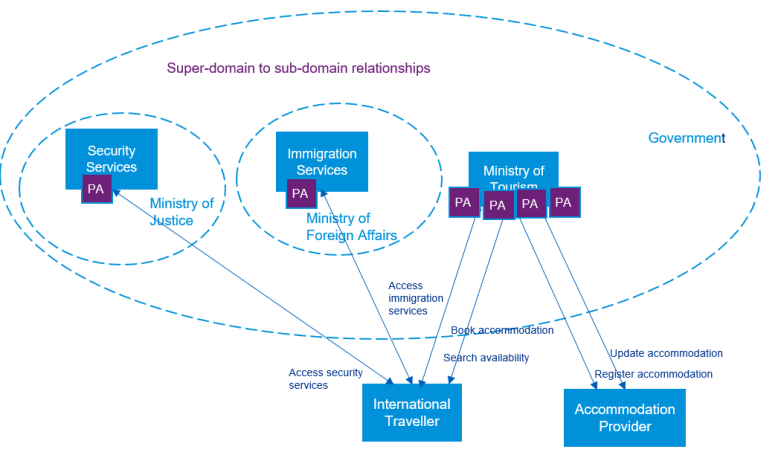
There are a number of stakeholders involved within the government serving international travellers’ requests. Tourists can access Immigration Services to get information on visa requirements and Security Services for safety advice. The application itself is owned by the Ministry of Tourism which acts as the “face” of this interaction and provides access to Tourist Board approved options. External accommodation (e.g. hotel chains) register and update their offers on the government’s website.

The infrastructure is outsourced to an external cloud service provider and there are mobile applications available, but these details are irrelevant for the current abstraction level.

Trust modelling

From the Trust Modelling perspective, the relationship will look like this:
Trust

Subdomain policy is derived from, and compliant with, super domain but has specialised local interpretation authorised by super domain authority. The government bodies act as Policy Authorities (PA) owning the overall risk of the interaction.

At this stage we might want to re-visit some of the attributes we defined previously to potentially narrow them down to only the ones applicable to the process flows in scope. We will focus on making sure the transactions are trusted:
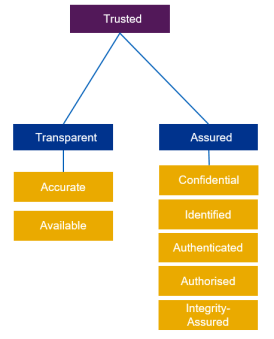
New attributes

Let’s overlay applicable attributes over process flows to understand requirements for security:
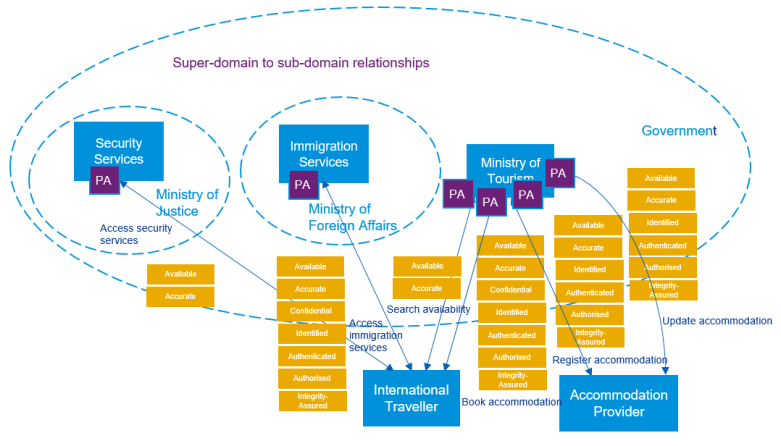
Flows and attributes

Logical Architecture

Now it’s time to go down a level and step into more detailed Designer’s View. Remember requirement “P004 – Book Accommodation” I’ve mentioned above? Below is the information flow for this transaction. In most cases, someone else would’ve drawn these for you.
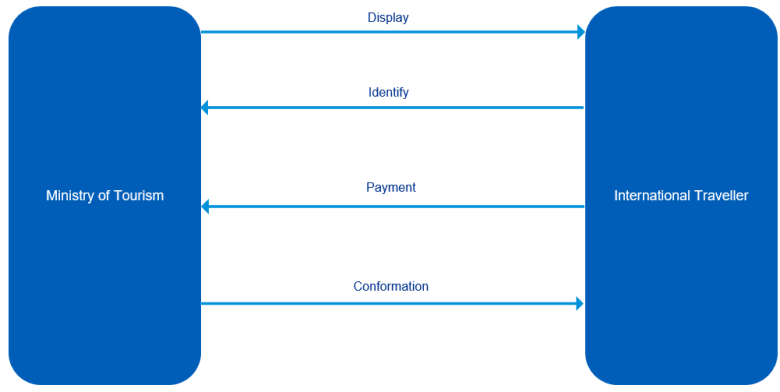
Flow 1

With security attributes applied (the direction of orange arrows define the expectation of a particular attribute being met):
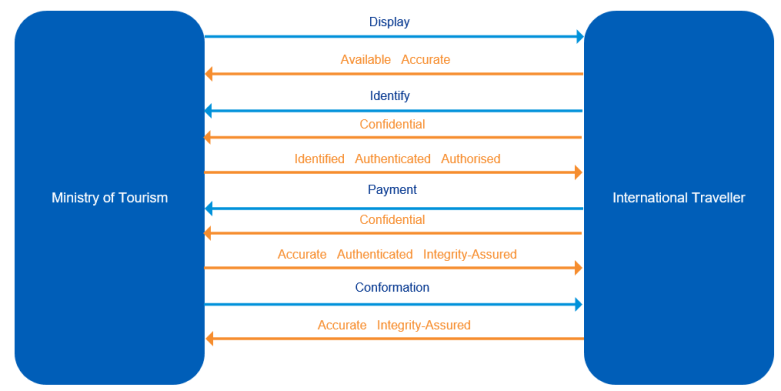
Flow 2

These are the exact attributes we identified as relevant for this transaction on the business process map above. It’s ok if you uncover additional security attributes at this stage. If that’s the case, feel free to add them retrospectively to your business process map at the Conceptual Architecture level.

Physical architecture

After the exercise above is completed for each interaction, it’s time to go down to the Physical Architecture level and define specific security services for each attribute for every transaction:
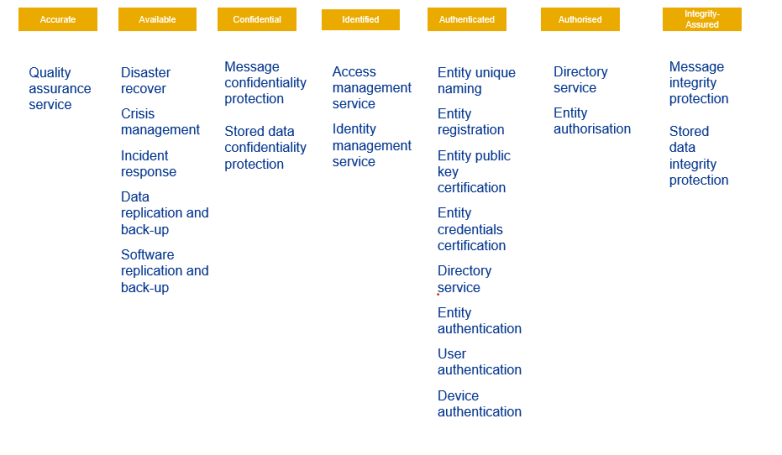
Security services

Component architecture

At the Component Architecture level, it’s important to define solution-specific mechanisms, components and activities for each security service above. Here is a simplified example for confidentiality and integrity protection for data at rest and in-transit:

Service Physical mechanism Component brands, tools, products or technical standards Service Management activities required to manage the solution through-life
Message confidentiality protection Message encryption IPSec VPN Key management, Configuration Management, Change management
Stored data confidentiality protection Data encryption AES 256 Disk Encryption Key management, Configuration Management, Change management
Message integrity protection Checksum SHA 256 Hash Key management, Configuration Management, Change management
Stored data integrity protection Checksum SHA 256 Hash Key management, Configuration Management, Change management

As you can see, every specific security mechanism and component is now directly and traceable linked to business requirements. And that’s one of the ways you demonstrate the value of security using the SABSA framework.

Passed my AWS Certified Solutions Architect exam – here’s how you can too


Solutions badge

I’ve recently passed my AWS Certified Solutions Architect – Associate exam. In this blog I would like to share some preparation tips that would help you ace it.

  1. Practice

Not only practice makes perfect, some hands-on experience is also a prerequisite for the exam. So there is really no way around that! But what if you didn’t have a chance to use your skills on a real-world project yet? No problem! AWS gives you a opportunity to learn how their cloud components work through AWS Free Tier.  For one year, you can use Amazon EC2 Amazon S3Amazon RDSAWS IoT and many more free of charge,

You want more guidance? Qwiklabs developed a set of labs that specifically designed to help you prepare for this exam. For a small price, you can complete exercises without  even requiring an AWS account or signing up for Free Tier.

  1. Read

I recommend studying AWS Whitepapers to broaden your technical understanding. If you are short on time, focus on these:

  1. Watch

AWS developed a free self-paced Cloud Practitioner Essential course, to help you develop an overall understanding of the AWS Cloud. You will learn basic cloud concepts and AWS services, security, architecture, pricing, and support.

There is also a YouTube channel with free introductory videos and other noteworthy material.

Exam sample questions can help you check your knowledge and highlight areas requiring more study.

Remember, the best preparation for the exam is practical experience: AWS recommend 1+  years of hands-on experience with their technologies.

When you’re ready, go ahead and schedule an exam here.

Good luck!

Helping clients in Saudi Arabia


I’ve recently completed an assignment for one of the largest companies in Saudi Arabia where I had the pleasure of helping my clients improve their cyber security posture. During my time there I had the opportunity to explore this beautiful country, learn about its rich history and make a few friends.

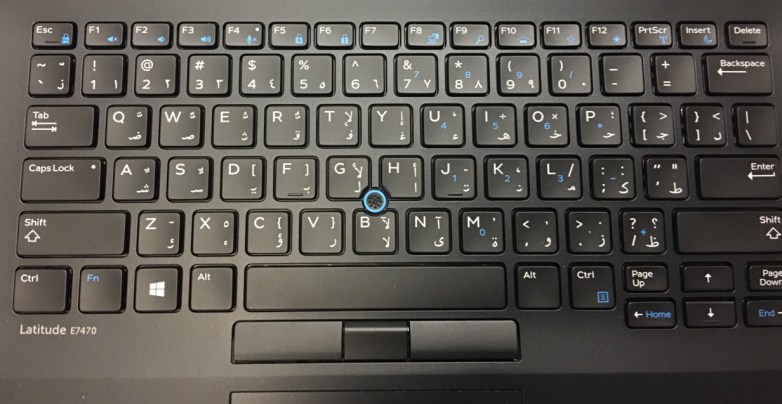
And in case you are wondering how an Arabic keyboard looks like, here you go:

jvGavCsCSG6MP5VGAobf6g_thumb_3cf0

Using SABSA for application security

Aligning OWASP Application Security Verification Standard and SABSA Architecture framework.

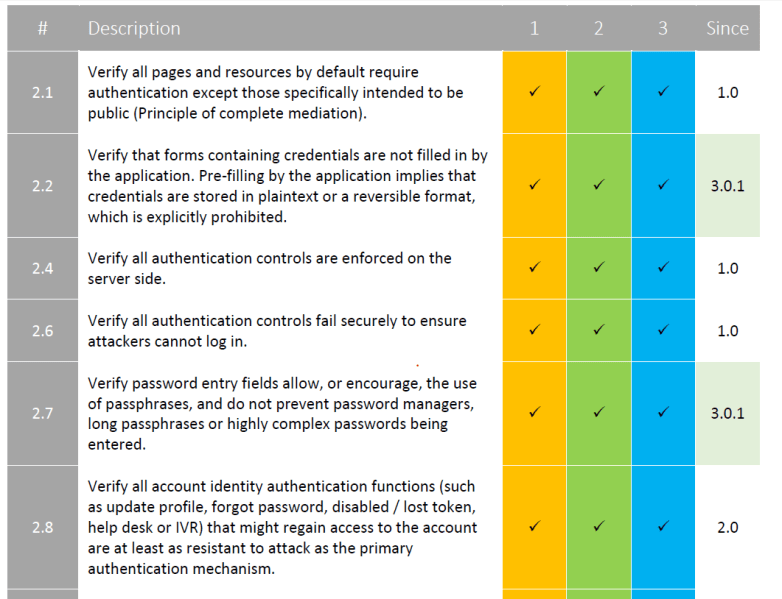
OWASP Application Security Verification Standard (Standard) is used at one of my clients to help develop and maintain secure applications. It has been used it as blueprint create a secure coding checklist specific to the organisation and applications used.

Below is an excerpt from the Standard related to the authentication verification requirements:

OWASP

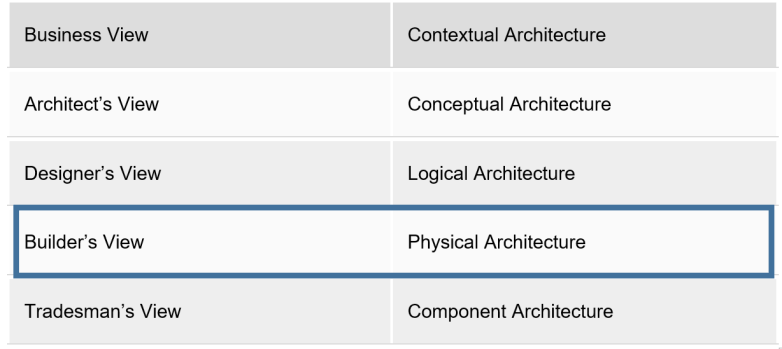
The Standard provides guidance on specific security requirements corresponding to the Physical layer of the SABSA architecture.

SABSA views

More

Industrial Control Systems Security: Information Exchange

There are a number of global information exchanges related to industrial control systems security. They offer useful guidelines and standards to help protect the environment.

The UK Centre for the Protection of National Infrastructure (CPNI) provides good practice and technical guidance as well as advice on securing industrial control systems.
Secure move to IP-based Networks (SCADA):

They also highlight the risks of wireless connectivity of physical security systems

Similar information exchange centres were established in Japan and Spain,

For the introduction to Industrial Control Systems Security see my previous blogs (Part I, Part II, Part II) or ICS Security Library

Third-party security assessments: applying SABSA

Organisations around the world are increasingly relying on third-party vendors to provide them with competitive advantage. Many companies in a race to optimise processes and reduce costs begin to outsource core functions. This leads to increased risk profile and new challenges of supplier oversight.

Dealing with third-parties has grown bigger than being just a procurement issue. Suppliers companies increasingly rely on, pose not only legal but also reputational risks that cannot be fully transferred. Security and privacy related incidents related to third-party providers are presenting new management challenges. Moreover, regulators are increasingly demanding the management of the third-party risk.

Suppliers, however, have their own challenges. Constant squeeze on costs from their clients reduces the profit margins making it increasingly difficult for vendors to prioritise security requirements implementation.

How do we make sure the suppliers we work with are trustworthy? How do we minimise the risk exposure from a potential incident? What level of assurance is required for a supplier?

These are the questions I’m going to answer in this blog.

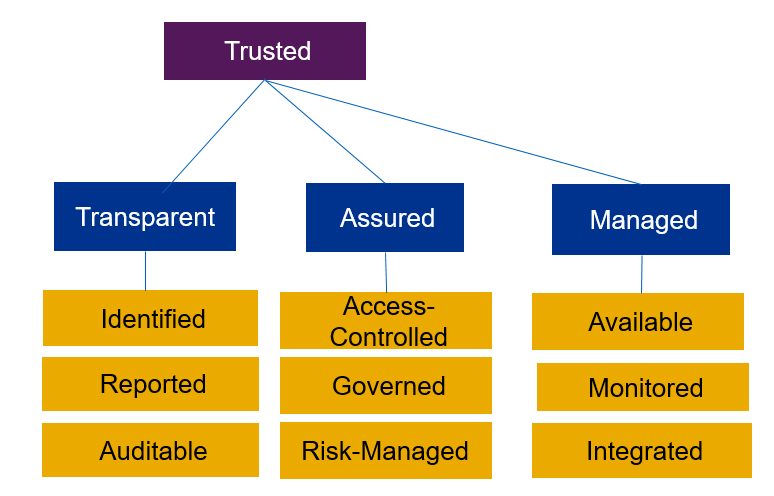
Understanding business drivers and goals is essential for developing a third-party risk management approach. By analysing company’s corporate strategy I was able to derive multiple business attributes relevant to the shareholders. One of them stands out: Trusted. I’m going to disregard other attributes and focus on this one for the purposes of this case study. Not only it is important for the company to be trusted by its customers, but trustworthiness is also something I’m going to explore in this blog from the third-party relationship standpoint.

After a workshop with the CIO and IT managers in various business units, I’ve defined the following IT attributes supporting the main business attribute (Trusted): Transparent, Assured and Managed.

How does the security function support the wider IT objectives and corresponding attributes? After a number of workshops and analysing the security strategy document I’ve managed to create a number of security attributes. Below is a simplified example correlating to the business and IT attributes in scope:

1

Dealing with customers and managing relationships with them is one of the core activities of the company.  As discussed above, being trusted by the customers is one of the main values of the organisation. IT department through the implementation of their technology strategy supported the business stakeholders in Sales and Marketing to outsource customer relationship management platform to a third party provider. A cloud-based solution has been chosen to fulfill this requirement.

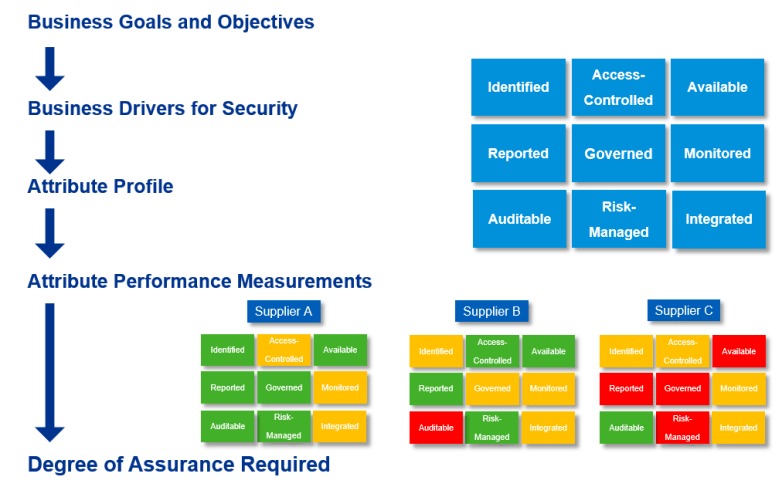
A combination of attribute profiling, trust modelling and risk analysis is used to assess the degree of assurance required and compare third-party providers. Below is a recommended approach based on the attributes defined.

2

Security attributes mapping

Based on the internal security policy the following questionnaire has been developed to assess the supplier. Responses from the supplier have been omitted to preserve confidentiality. Below is a short excerpt from one of the sections of the questionnaire related to cloud services.

Are terms of services and liabilities clearly defined in service agreements? Governed
Are escrow arrangements in supplier contract agreement and cloud service agreements registered with procurement and documented in cloud service register. Identified
Are physical security and environmental controls present in the data centre that contains company data? Integrated
Are procedures for user authentication, authorization and access termination documented? Access-Controlled
Has the Business Continuity Plan been reviewed and approved by the executive management? Governed
How often is the Business Continuity Plans and Disaster Recovery Plans tested? Available
Is there a specific Recovery Time Objective(s) (RTO) and Recovery Point Objective(s) (RPO)? If yes, specify the RTO and RPO for the company services. Available
Are default settings customized to implement strong encryption for authentication and transmission? Access-Controlled

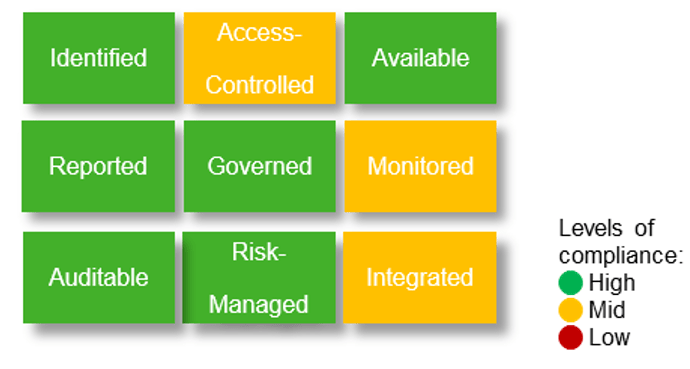
Attribute compliance is assessed based on the questionnaire answers, as every question is mapped to a specific attribute. Where a specific combination of an attribute corresponds to multiple questions, all answers are rated separately then an average rating for that attribute weight is calculated. Exceptions apply where certain specific questions are identified to have priority (higher level of impact on attribute compliance) over the other questions mapped to the same attribute. Expert judgement is applied to analyse such situations.

Attributes are evaluated with three main levels:

  • High level of compliance with policy (Green),
  • Medium level of compliance with policy (Amber),
  • Low level of compliance with policy (Red)

3


Secure by design

V4tS8p5F_C0

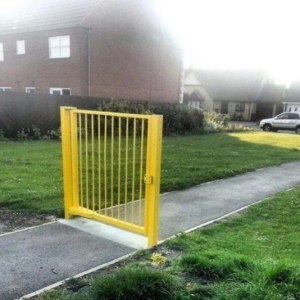
Have you seen security controls being implemented just to comply with legal and regulatory requirements? Just like this fence. I’m sure it will pass all the audits: it is functioning as designed, it blocks the path (at least on paper) and it has a bright yellow colour just as specified in the documentation. But is it fit for purpose?

It turns out that many security problems arise from this eager drive to comply: if the regulator needs a fence – it will be added!

Sometimes controls are introduced later, when the project is well passed the design stage. It might be the case that they just don’t align with the real world anymore.

n0saycKzykM

Safety measures, unfortunately, are no exception. The solution may be poorly designed, but more often, safety requirements are included later on with the implementation not fit for purpose.

IbHF452Usk0tuLB7kjBazs

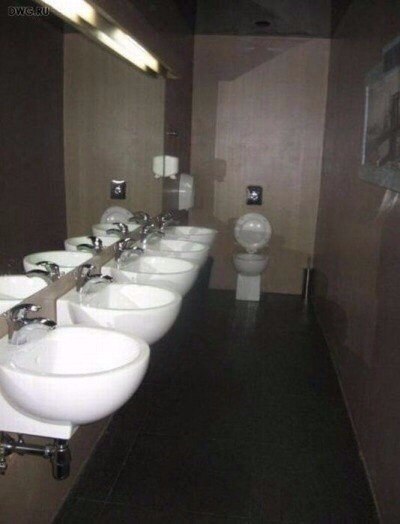
Same holds for privacy as well. Privacy professionals encourage to adopt the Privacy by Design principle. Is it considered on the image below?

2Tx1qKFQzfoB5nli4NoEG4

Global Industrial Cyber Security Professional (GICSP)

I’ve recently passed my GICSP exam. This certification is deigned to bridge together IT, engineering and cyber security to achieve security for industrial control systems from design through retirement.

This unique vendor-neutral, practitioner focused industrial control system certification is a collaborative effort between GIAC and representatives from a global industry consortium involving organisations that design, deploy, operate and/or maintain industrial automation and control system infrastructure.

GICSP assesses a base level of knowledge and understanding across a diverse set of professionals who engineer or support control systems and share responsibility for the security of these environments.

Here are some useful links for those of you who are interested in sitting the exam:

Exam FAQ

Flashcards

Certification Handbook

Sherwood Applied Business Security Architecture

SABSA

I completed my SABSA Foundation training, passed the exam and earned the.SABSA Chartered Security Architect credential.

SABSA is a proven methodology for developing business-driven, risk and opportunity focused Security Architectures at both enterprise and solutions level that traceably support business objectives. It is also widely used for Information Assurance Architectures, Risk Management Frameworks, and to align and seamlessly integrate security and risk management into IT Architecture methods and frameworks.
SABSA is comprised of a series of integrated frameworks, models, methods and processes, used independently or as an holistic integrated enterprise solution, including:

  • Business Requirements Engineering Framework (known as Attributes Profiling)
  • Risk and Opportunity Management Framework
  • Policy Architecture Framework
  • Security Services-Oriented Architecture Framework
  • Governance Framework
  • Security Domain Framework
  • Through-life Security Service Management & Performance Management Framework