How to adopt NIST CSF 2.0

CSF 2.0 Functions. Source: NIST

NIST released a new version of the Cybersecurity Framework with a few key changes:

  • It now can be applied beyond critical infrastructure, making it more versatile and straightforward to adopt.
  • It introduces a new core “Govern” function that includes categories from other sections, with increased focus on supply chain risk management and accountability.
  • It highlights synergies with the NIST Privacy Framework.

I often use this framework to develop and deliver information security strategy. Although, other methodologies exist, I find its layout and functions facilitate effective communication with various stakeholder groups, including the Board.
More

Systems thinking in cyber security

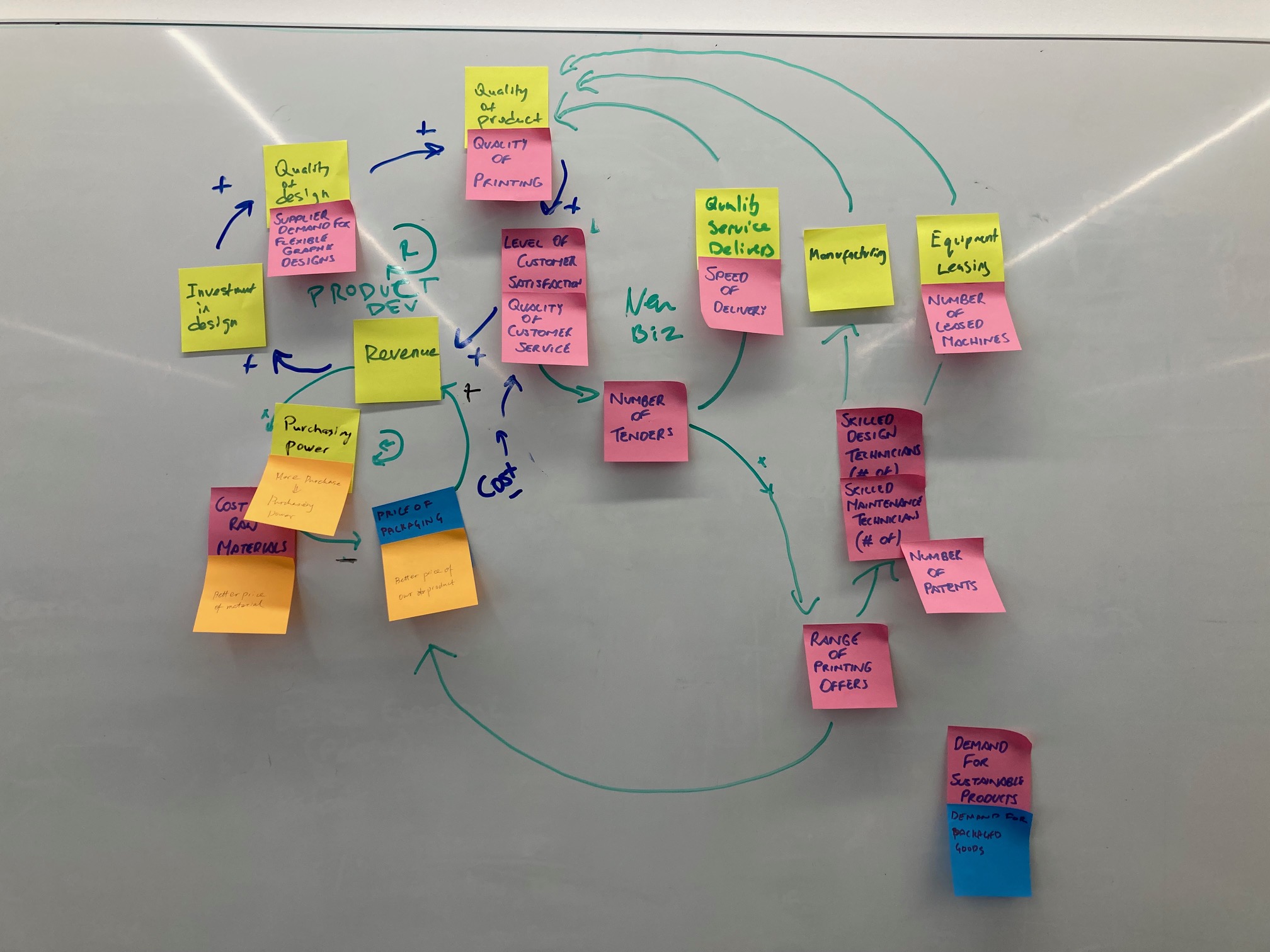
Cyber security leaders deal with complex problems all the time, but only a few are well equipped to deal with such challenges effectively. Systems thinking is a discipline that can help CISOs improve their ability to see the bigger picture and move beyond simplistic linear cause-effect relationships and point-in-time snapshots.

Systems thinking is a mindset that encourages you to see interdependencies, processes and patterns of complex systems. Complex systems contain multiple interacting feedback loops and it is this feature that make them so challenging to understand, diagnose and improve.

In this blog I outline some examples of complex systems, recommend tools to begin to understand and influence them and demonstrate how these techniques can be applied to improve digital safety and security.

More

How to maximise the return on security investment

Not every conversation a CISO is having with the Board should be about asking for a budget increase or FTE uplift. On the contrary, with the squeeze on security budgets, it can be an opportunity to demonstrate how you do more with less.

To demonstrate business value and achieve desired impact, a CISO’s cyber security strategy should go beyond cyber capability uplift and risk reduction and also improve cost performance.

Security leaders don’t have unlimited resources. Significant security transformation, however, can be achieved leveraging existing investment and security resource levels.

More

Applying MBA concepts to cyber security

Source: adapted from Grewal et al (2021)

Following-up on my recent update on starting an Executive MBA, I wanted to share that I’ve reached a milestone in my learning journey; I’m half-way through with six modules completed.

I already wrote about Data Analytics and Decision Making and in this blog I’ll briefly summarise a few other courses I’ve completed and how some of the learnings can be applied to cyber security leadership.

More

Implementing cyber security strategy

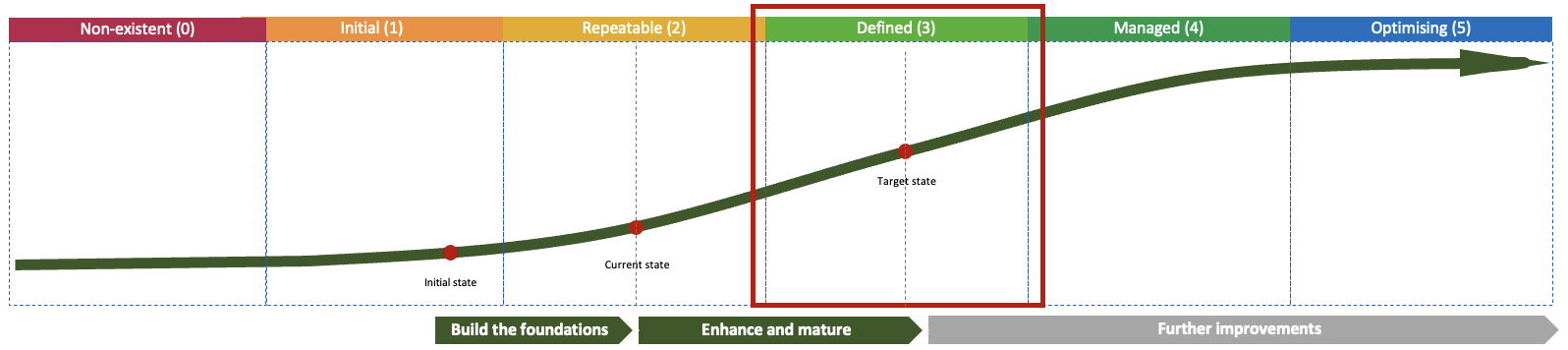
Illustrative example: cyber roadmap

CISOs and security leaders are often called upon to develop a security strategy. It’s an important step to understand what your current state is, in what direction you’re going and the roadmap to get there. It’s also an opportunity to demonstrate how cyber security activities and programs align to business objectives.

There is more to the CISO role than just setting the direction, however. It’s also about execution. As a security leader, it’s key to take ownership of the strategy and deliver on its promise. It’s useful, therefore, to be able to track progress against your objectives and demonstrate to the executive leadership team and the Board the impact the security team is making in enabling the business.

More

Cyber security operating model

Designing a target operating model for an organisation is a complex activity. It is important, therefore, to keep it simple initially. At a very high, level, I suggest CISOs start with three key capabilities:

  • Governance, Risk and Compliance
  • Security Architecture
  • Security Operations

These can then be decomposed further, tailoring to the needs of your particular organisation. Understand how each domain interacts with and supports the others, capturing key outcomes and dependencies for each function.

Key security capabilities are supported by Leadership and Governance streams, including Security Strategy, Business Alignment, Integration, Oversight, Optimization, Finance, Security Culture, Program Management, Stakeholder Management and Reporting.

Business as usual activities required to keep the lights on are often neglected when capability uplift is prioritized. For this reason, I placed it in the centre of the diagram, emphasising the ongoing importance of providing consistent security service to your organisation.

The NIST Cybersecurity Framework functions at the intersections of domains aim to illustrate the collaborative nature of the security teams. It’s important to go beyond silos , ensuring frequent interaction with the business as well as within the security department.

Cybersecurity Board reporting – CISO Executive Network

I had a pleasure to participate in the keynote panel discussion on cyber security Board reporting at the CISO Executive Network event in Sydney. It was an insightful discussion where I had a chance to share my views on aligning on Board expectations, developing relationships and tailoring your message for maximum impact.

We also covered common challenges and strategies for winning the Board over as well as good practices for reporting. It was a great opportunity to contribute to the community and learn from my peers in the industry.