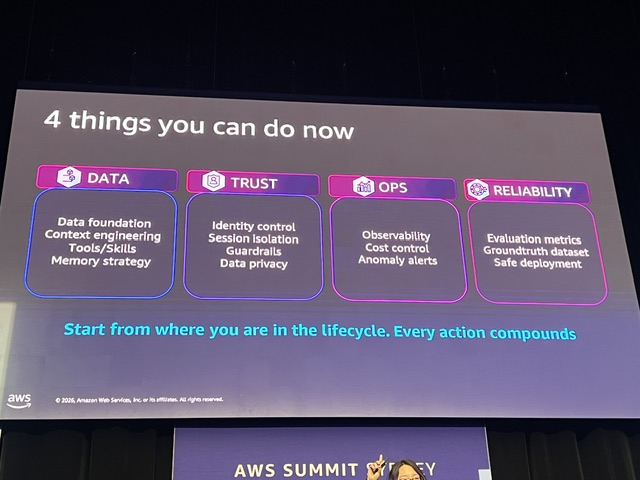
There is a shift happening in how the industry talks about agentic AI security. A year ago the conversation was speculative – what might go wrong, what we might do about it. Now it is specific. The platforms, primitives and patterns for operating agents safely exist as named things you can point at on a slide. The vocabulary is converging across vendors. The reference architectures are documented.
In this blog I explore the themes that mattered most, and what they mean for security teams.
Today, organisations are caught between two opposing forces. On one side is the drive for operational efficiency through digital transformation and AI adoption. On the other is an asymmetric cyber threat landscape.
As adversaries leverage AI to increase the scale and sophistication of attacks overwhelming already stretched cyber teams, defenders must do the same by using AI to strengthen security.
The traditional security model is reactive. When a threat is detected, a human must review, validate and remediate. In the time it takes an analyst to finish their first coffee, an AI-driven adversary can exfiltrate sensitive data.
For organisations that depend on customer trust and regulatory compliance, “responding as fast as we can” is no longer within risk appetite. Humans cannot scale to match the speed of automated code.
AI is becoming central to the future of cyber defence. While much of the industry focuses on automating security operations triage, the true power of AI lies in automating complex, proactive security and compliance functions that previously required thousands of human hours.
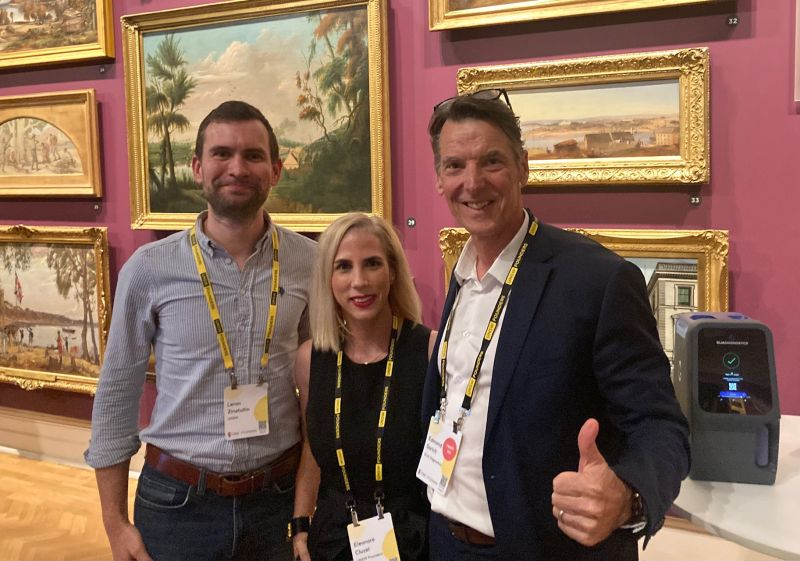
A big moment at the 10x Demo Day with Edmond Sorich and Eléonore Cluzel.
Health 10x, in collaboration with The George Institute for Global Health, is a unique national program accelerating the business growth of startups building affordable and scalable solutions for major health challenges.
It was a privilege to support GLIA Diagnostics developing the first portable, accurate brain injury diagnostic device over the past twelve weeks as an advisor and mentor.
Adapted from Kotter, J. 2007, ‘Leading change: Why transformation efforts fail’, Harvard Business Review, vol. 73, no. 2, pp. 1–10.
Cyber security leaders have to be effective change agents to be successful. Cyber capability uplift and risk reduction initiatives often require significant transformation in the organisation. In this blog, I’ll introduce a tried and tested change management framework and demonstrate its application to cyber security in an illustrative case study.
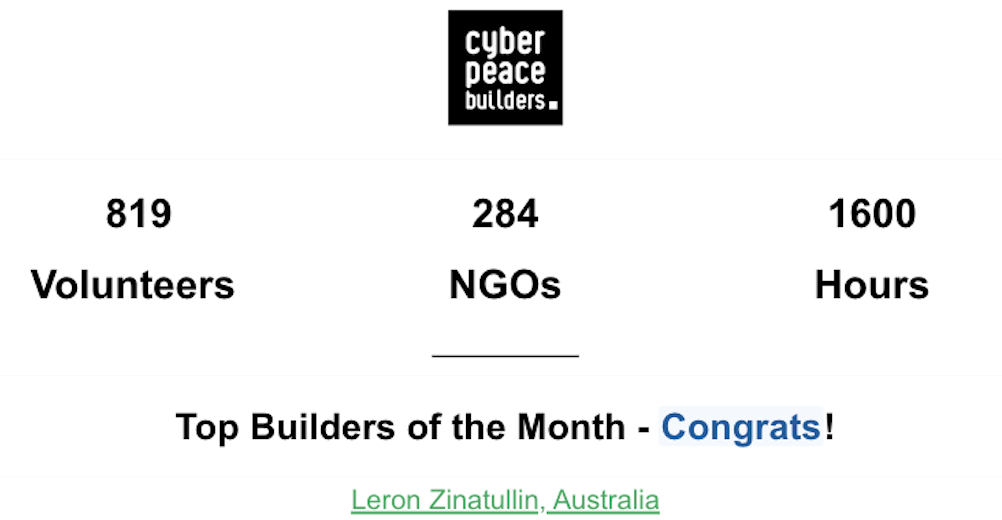
A big shoutout to CyberPeace for this awesome recognition! It’s been such a rewarding experience to help them in their mission to make the digital world safer for everyone.
The CyberPeace Institute is a non-profit focused on reducing the harm caused by cyberattacks to individuals and communities. Through their CyberPeace Builders program, they offer free cybersecurity support to organisations that need it most, especially those where cyber threats can have a serious impact.
As a volunteer, I’ve had the chance to help for-purpose organisations respond to cyber attacks, develop incident response plans, run security awareness training, perform dark web monitoring and craft essential policies and procedures. Plus, I’ve provided general cyber advice along the way. It’s been an incredible journey being part of a team that’s making a real difference.
I’m thrilled to join an exclusive cybersecurity investment community – Cyber Club London . CCL is a group of cybersecurity experts and leaders who have access to new and innovative early-stage startups, the opportunity to invest in them privately, and use their expertise and connections to help these startups succeed.
The community was established to provide a platform where cybersecurity leaders, executives, startups, and venture capitalists can share knowledge and work together to invest in promising early-stage companies. This closely aligns to my goals of contributing to the community and helping ventures thrive in the cyber space, serving as a Board Advisor and Non-Executive Director.
In the DevSecOps paradigm, the need for manual testing and review is minimised in favour of speed and agility. Security input should be provided as early as possible, and at every stage of the process. Automation, therefore, becomes key. Responsibility for quality and security as well as decision-making power should also shift to the local teams delivering working software. Appropriate security training must be provided to these teams to reduce the reliance on dedicated security resources.
I created a diagram illustrating a simplified software development lifecycle to show where security-enhancing practices, input and tests are useful. The process should be understood as a continuous cycle but is represented in a straight line for the ease of reading.
There will, of course, be variations in this process – the one used in your organisation might be different. The principles presented here, however, can be applied to any development lifecycle, your specific pipeline and tooling.
I deliberately kept this representation tool and vendor agnostic. For some example tools and techniques at every stage, feel free to check out the DevSecOps tag on this site.
There is a strong correlation between code quality and security: more bugs lead to more security vulnerabilities. Simple coding mistakes can cause serious security problems, like in the case of Apple’s ‘goto fail’ and OpenSSL’s ‘Heartbleed‘, highlighting the need for disciplined engineering and testing culture.
An open source tool that is gaining a lot of momentum in this space is Semgrep. It supports multiple languages and integrates well in the CI/CD pipeline. You can run Semgrep out of a Docker container and the test results are conveniently displayed in the command line interface.
The rule set is still relatively limited compared to other established players and it might find fewer issues. You can write your own rules, however, and things are bound to improve as the tool continues to develop with contributions from the community.
A more well-known tool in this space is SonarQube. You can still use a free Community Edition for basic testing but advanced enterprise-level features would require a paid subscription. CI/CD integration is possible, inter plugins (like the one for ESLint) are also available.
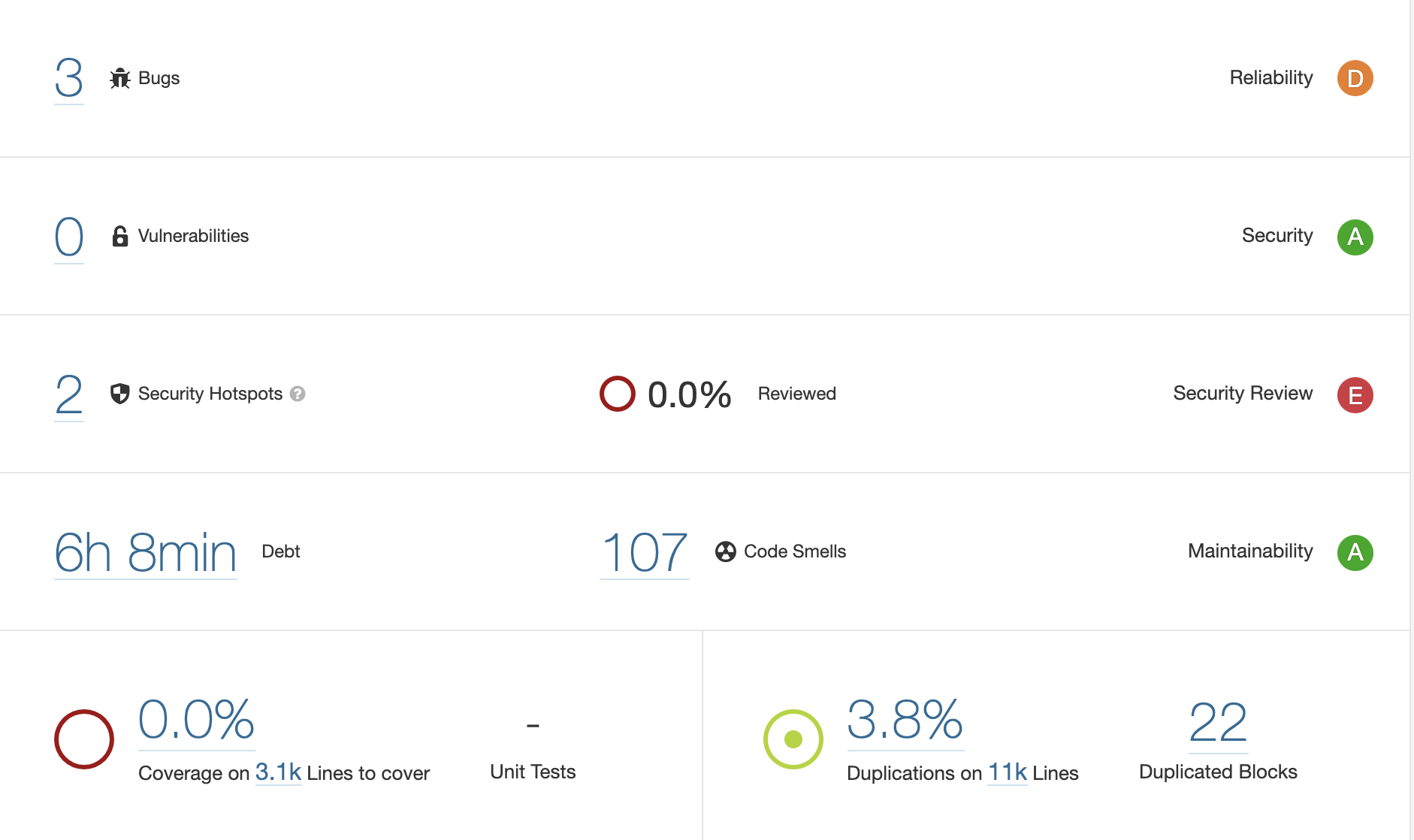
SonarQube has a dashboard view which scores your code across reliability, security, maintainability and other metrics.
As with any tool of this type, to get the best use out of it, some initial configuration is required to reduce the number of false positives, so don’t be discouraged by the high number of bugs or “code smells” being discovered initially.
Keeping in mind the fact that no amount of automation can guarantee finding all the vulnerabilities, I found SonarQube’s analysis around Security Hotspots particularly interesting. It also estimates a time required to pay down the tech debt which can serve as a good indicator of maintainability of your codebase.
It is important to remember that static code analysis tools are not a substitute for the testing culture, code reviews, threat modelling and secure software engineering. They can, however, be a useful set of guardrails for engineers and act as an additional layer in your defence in depth strategy. Although these tools are unlikely to catch all the issues, they can certainly help raise awareness among software developers about quality and security improvements, alert about potential vulnerabilities before they become a problem and prevent the accumulation of tech and security debt in your company.
Building on my previous blogs on CISO responsibilities, initial priorities and developing information security strategy, I wanted to share an example of what a security dashboard might look like. It is important to communicate regularly with your stakeholders and sharing a status update like this might be one way of doing it. The dashboard incorporates a high-level view of a threat landscape, top risks and security capabilities to address these risks (with maturity and projected progression for each). Feel free to use this as a starting point and adjust to your needs.
The dashboard above aligns to the NIST Cybersecurity Framework functions as structuring your security programme activities in this way, in my experience, allows for better communication with business stakeholders. However, capabilities can be adjusted to align with any other framework or your control set of choice. Some of the elements can be deliberately simplified further depending on your target audience.
Who needs to buy e-learning modules for employee security awareness programmes when NCSC kindly made available their training for free?
NCSC’s Top Tips For Staff includes online videos (that can be also included in your own learning management system), knowledge check and an infographic.
It’s a quick and easy way to get you started on the journey of building security culture in your company and meet some of the compliance requirements. This can be especially helpful for startups and non-profits with limited budgets.