Privacy and data protection considerations

If people entrust your company with their personal data, it is your responsibility to protect it. GDPR provides a good framework even if it doesn’t apply in your geography.

Below is a list of things you can do in no particular order which I use as a cheat sheet when I start up a data protection programme in a company.

Inventory

Make an inventory of all personal data you hold. Know (and document) what and how you collect, why you collect it, who you share it with and where and how long it is being stored.

Honour the rights of individuals

Develop comprehensive processes to support data subject access requests (right to be informed through consent and notice, right to access and data portability, right to erasure, etc.).

Privacy and security by design

Make privacy, compliance and data protection considerations during product development with regular review and testing. Minimise and don’t store beyond necessary.

Technical security measures

Implement technical controls to protect customer data, for example access control, encryption, logging and monitoring.

Processes for breach response

Establish an end-to-end incident identification and response process to handle security and privacy incidents as part of the broader security strategy.

Awareness and training

Provide data protection and privacy training for staff. Extra points for regular bespoke education and awareness sessions addressing topical issues.

Data Protection Officer

Appoint a data protection officer and get legal support. Perform data identification and classification. Make conducting privacy impact assessments on new projects a habit. Involve relevant stakeholders.

Legal framework

Get on top of data protection addendums to agreements, vendor management, client consent management and cross-border transfer agreements.

Time for something new

IMG-6141

After six years with KPMG’s Cyber Security practice I decided it was time to take on a new challenge. It was a great pleasure helping clients from various industry sectors solve their security issues and I certainly learned a lot and met many fantastic people.

A digital venture incubation firm has partnered with a world leader in visas and identity management to found a new London-based venture that is creating a frictionless travel experience. 

I joined this tech startup as the Head of Information Security and couldn’t pass on this opportunity to be one of the early members of the leadership team. 

I’ll be driving the security and compliance agenda, adjusting to the needs of the dynamic and growing business. I can’t wait to put the skills I learned in consulting into practice and contribute to this company.

I’ll have an opportunity to help create a trusted, seamless, user centred visa application process for consumers and businesses alike, through automation and a cutting edge technology. And that’s exciting!

ISACA young professionals

I’ve been interviewed for the launch of the ISACA Young Professionals portal that contains a wealth of information for starting and accelerating your career in IT audit and cybersecurity.

I decided to contribute because ISACA played a role in my career development too.

I started attending ISACA London chapter events while I was studying for my Master’s degree in London. Although the university provided a great theoretical foundation on information security, I wanted to know about the real-world challenges that practitioners in the industry were facing.

At the time I had just finished writing my thesis after doing some great research at the university and I wanted to share my findings and the research of my colleagues with the community. The organisers were supportive, so we agreed a day and I delivered a talk on resolving conflicts between security compliance and human behaviour.

It was a rewarding experience as the participants provided some valuable insights and feedback; they helped to bridge the gap between academia and real practical experience. I already had a solid foundation from my postgraduate degree but I was missing was some anecdotes and real life stories about how this could apply in practice. This laid the foundation for my book The Psychology of Information Security.

It worked out for me, but should you get involved in broader activities beyond developing your technical skills? I would say yes.

The value of technical skills and knowledge can’t be overestimated. But there’s another side to this story. Prospective employers are not only looking for technical experts, they want people who are good team players, who can collaborate and communicate effectively with others, who can organise and get things done, who can lead. Getting involved with the community and volunteering gives you the chance to develop and demonstrate these non-technical skills and grow your professional network.

Regardless of where you are on your journey, ISACA provides great opportunities to advance your career through courses, networking and certification programmes, so I highly recommend getting involved!

Read my story on ISACA Blog.

Developing an information security strategy

I wrote previously on how to assess your threat landscape and what your priorities should be when you start developing a security programme in a new company.

In this blog, I would like to dig deeper and talk about how you actually develop a security strategy with some illustrative examples. You can then use these to further refine your security architecture.

As always, we would start with a Why. Why is security important for your business? Well, you will need to help your stakeholders understand that security can help build customer trust and become a brand differentiator.

And how can this be achieved? To keep this simple, let’s zoom in on three priorities:

  • Support the business. Embed security into the business by ensuring alignment to business strategy
  • Risk-based approach. Pragmatic and prioritised security controls, advice, guidance and information security expertise for the business
  • Focus. Centre on protecting the most important assets and understanding the threats

The aim could be to arrive to a state where security underpins all products and services to offer customers a frictionless experience.

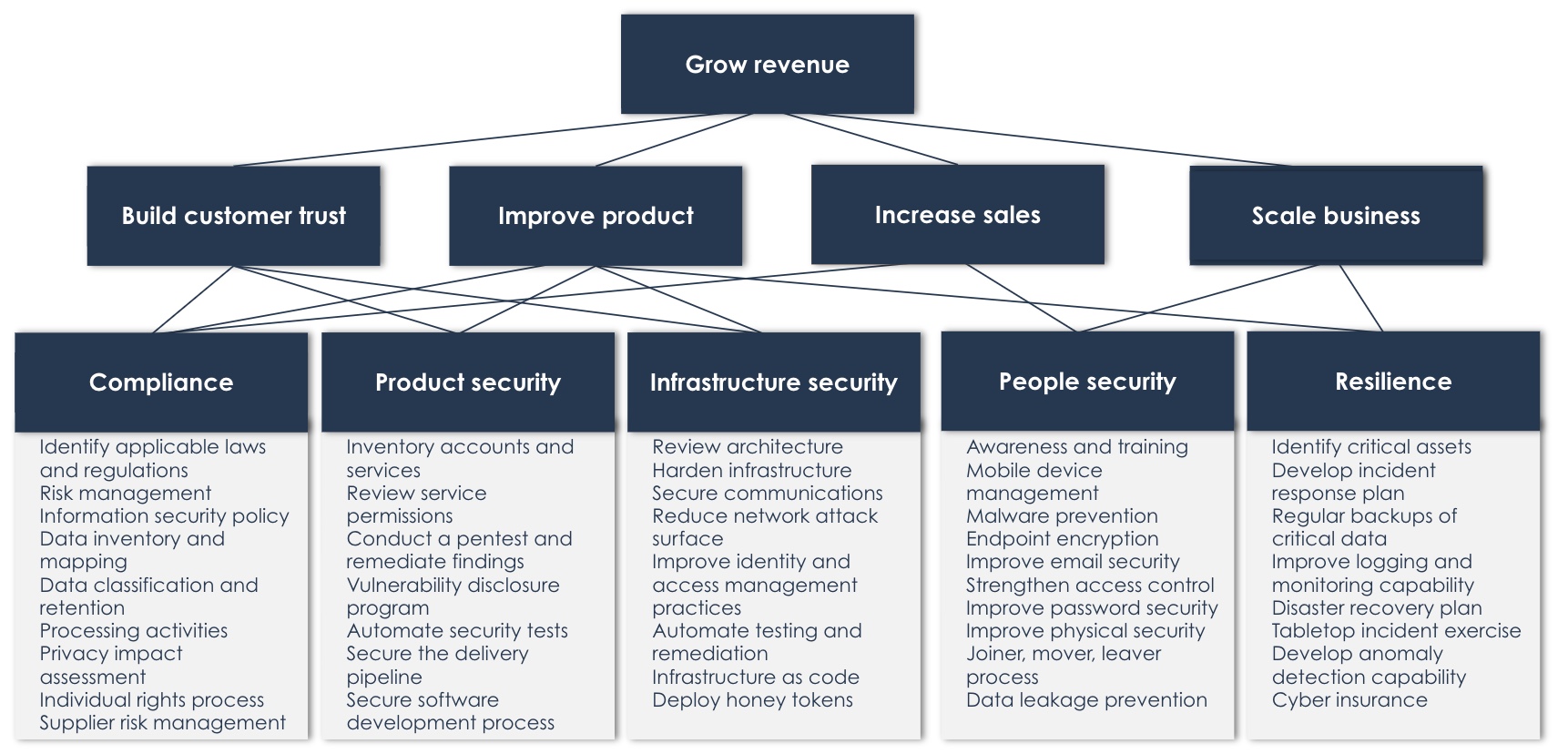
Talking to your business stakeholders will help you understand your company’s wider goals and strategy. Let’s imagine for a second that these conversations revealed that your organisation, like many others, ultimately want to grow their revenue. They also identified that the way they are going to grow their revenue is through increasing sales, building customer trust, improving products and services and scaling operations to better meet customers’ needs.

Vulnerable product, misconfigured infrastructure, insecure operations, inadequate compliance regime and inability to withstand incidents all prevent the business from achieving its objectives.

Strategy

You can now prioritise your security activities to align with these objectives, for example by grouping them into product, infrastructure and people security, as well as wider compliance and resilience objectives.

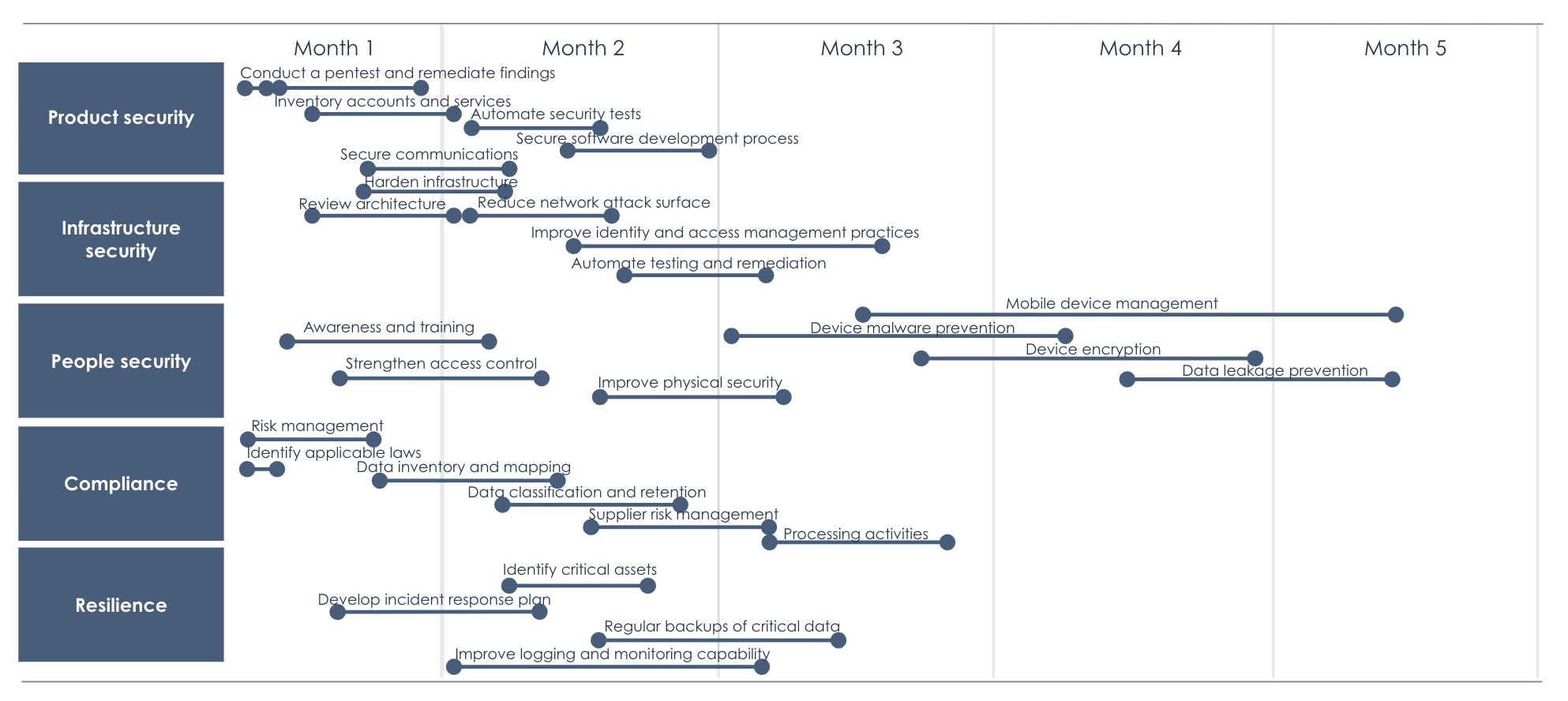
Timeline

Remember, the above is just an indicative timeline. The reality will very much depend on your organisation’s priorities, maturity and resource availability.

The first 100 days as a CISO

Lifecycle

What should you do in your 100 days in a new company? In short, you should find a way to support the business and present it in a way that is understood and accepted. Communicate broadly and often to ensure constant alignment. Measure your progress in a meaningful way to demonstrate the value to the business.

Roadmap

  • Get buy in

Validate top assets, threats and risks. Obtain leadership support on next steps.

  • Baseline where you are

Understand business requirements, technological and regulatory landscape. Perform interviews and review existing product and documentation.

  • Work out what needs to be done

Recommend security improvements to address risks and align with business strategic priorities.

  • Make it happen

Preparing people, establishing good practice and implementing the right technologies and processes.

Timeline.jpeg

Vulnerability scanning gone bad

4197732260_60306abecf_z

Security teams often have good intentions when they want to improve the security posture of a company by introducing new tools.

In one organisation, for example, they might want to mitigate the risk of exploiting application vulnerabilities and decide to deploy a code-scanning tool. This would make sure that applications are tested for exploits before they are released. Great idea but the uptake on the use of this tool was surprisingly low and created a lot of friction.

After closer examination, it turns out that this was primarily due to challenges with communication with the development teams that would need to use the tool. The impacted teams weren’t sufficiently trained on the use of it and there wasn’t enough support from the management to adopt it.

Development teams have tight timelines and budgets to work to in order to meet the business objectives. Anything that could disrupt these aspects is viewed with caution.

As a result, applications that should have had their code scanned either hadn’t, or had to be scanned at a much later stage of the development cycle. It was not incorporated in the DevOps pipeline– the scans were run as part of a manual check before release in production. Not only the risk of having applications with flaws in them remain largely unchanged, the whole process of delivering working software was prolonged.

These new applications were being delivered to facilitate revenue growth or streamline exiting processes to reduce cost and complexity. The impact on the business was that the new functionality they were expecting took longer to materialise, resulting in users’ frustration.

What can you do to prevent such situations from happening? Here are a few recommendations:

  1. Communicate frequently and at the right level. Communication must start at the top of an organisation and work its way down, so that priorities and expectations can be aligned. A person may need to hear the same message multiple times before they take action.
  2. Articulate the benefits. Security and risk teams need to ensure they position any new processes or tools in a way that highlights the benefits to each stakeholder group.
  3. Provide clear steps. In order to ensure the change is successful, security professionals should clearly outline the steps for how to start realising these benefits.

Communicating and providing support on new security policies, tools and practices to impacted teams is absolutely critical. This is especially important in large organisations with many stakeholder groups spread across multiple geographies. Always keep the people in mind when introducing a change, even if it’s the one for the better.

Image by Hugo Chinaglia

Transparency in security

Transparent

I was asked to deliver a keynote in Germany at the Security Transparent conference. Of course, I agreed. Transparency in security is one of the topics that is very close to my heart and I wish professionals in the industry not only talked about it more, but also applied it in practice.

Back in the old days, security through obscurity was one of the many defence layers security professionals were employing to protect against attackers. On the surface, it’s hard to argue with such a logic: the less the adversary knows about our systems, the less likely they are to find a vulnerability that can be exploited.

There are some disadvantages to this approach, however. For one, you now need to tightly control the access to the restricted information about the system to limit the possibility of leaking sensitive information about its design. But this also limits the scope for testing: if only a handful of people are allowed to inspect the system for security flaws, the chances of actually discovering them are greatly reduced, especially when it comes to complex systems. Cryptographers were among the first to realise this. One of Kerckhoff’s principles states that “a cryptosystem should be secure even if everything about the system, except the key, is public knowledge”.

Modern encryption algorithms are not only completely open to public, exposing them to intense scrutiny, but they have often been developed by the public, as is the case, for example, with Advanced Encryption Standard (AES). If a vendor is boasting using their own proprietary encryption algorithm, I suggest giving them a wide berth.

Cryptography aside, you can approach transparency from many different angles: the way you handle personal data, respond to a security incident or work with your partners and suppliers. All of these and many more deserve attention of the security community. We need to move away from ambiguous privacy policies and the desire to save face by not disclosing a security breach affecting our customers or downplaying its impact.

The way you communicate internally and externally while enacting these changes within an organisation matters a lot, which is why I focused on this communication element while presenting at Security Transparent 2019. I also talked about friction between security and productivity and the need for better alignment between security and the business.

I shared some stories from behavioural economics, criminology and social psychology to demonstrate that challenges we are facing in information security are not always unique – we can often look at other seemingly unrelated fields to borrow and adjust what works for them. Applying lessons learned from other disciplines when it comes to transparency and understanding people is essential when designing security that works, especially if your aim is to move beyond compliance and be an enabler to the business.

Remember, people are employed to do a particular job: unless you’re hired as an information security specialist, your job is not to be an expert in security. In fact, badly designed and implemented security controls can prevent you from doing your job effectively by reducing your productivity.

After all, even Kerckhoff recognised the importance of context and fatigue that security can place on people. One of his lesser known principles states that “given the circumstances in which it is to be used, the system must be easy to use and should not be stressful to use or require its users to know and comply with a long list of rules”. He was a wise man indeed.

Understanding your threat landscape

Identifying applicable threats is a good step to take before defining security controls your organisation should put in place. There are various techniques to help you with threat modelling but I wanted to give you some high-level pointers in this blog to get you started. Of course, all of these should be tailored to your specific business.

I find it useful to think about potential attacks as three broad categories:

1. Commoditised attacks. Usually not targeted and involve off-the-shelf-malware. Examples include:

2. Tailored attacks. As the name suggests, these are tailored and can vary in degree of sophistication. Examples include:

3. Accidental. Not every data breach is triggered by a malicious actor. Therefore, it is important to recognise that mistakes happen. Unfortunately sometimes they lead to undesired consequences, like the below:

Information security professionals can use the above examples in communications with their business stakeholders not to spread fear, but to present certain security challenges in context.

It’s often helpful to make it a bit more personal, defining specific threat actors, their target, motivation and impact on the business. Again, the below table serves as an example and can be used as a starting point for you define your own.

Threat actor Description Motivation Target Impact on business
Organised crime International hacking groups Financial gain Commercial data, personal data for identity fraud Reputational damage, regulatory fines, loss of customer trust
Insider Intentional or unintentional Human error, grudge, financial gain Intellectual property, commercial data Destruction or alteration of information, theft of information, reputational damage, regulatory fines
Competitors Espionage and sabotage Competitive advantage Intellectual property, commercial information Disruption or destruction, theft of information, reputational damage, loss of customer
State-sponsored Espionage Political Intellectual property, commercial data, personal data Theft of information, reputational damage

You can then use your understanding of assets and threats relevant to your company to identify security risks. For instance:

  • Failure to comply with relevant regulation – revenue loss and reputational damage due to fines and unwanted media attention as a result of non-compliance with GDPR, PCI DSS, etc.
  • Breach of personal data – regulatory fines, potential litigation and loss of customer trust due to accidental mishandling, external system compromise or insider threat leading to exposure of personal data of customers
  • Disruption of operations – decreased productivity or inability to trade due to compromise of IT systems by malicious actor, denial of service attacks, sabotage or employee error

Again, feel free to use these as examples, but always tailor them based on what’s important you your business. It’s also worth remembering that this is not a one-off exercise. Tracking your assets, threats and risks should be part of your security management function and be incorporated in operational risk management and continuous improvement cycles.

This will allow you to demonstrate the value of security through pragmatic and prioritised security controls, focusing on protecting the most important assets, ensuring alignment to business strategy and embedding security into the business.

Learn software engineering

Python_logo_and_wordmark.svg

I’ve recently decided to brush up on my programming skills with one of the courses on Udemy. Despite completing a degree in Computer Science back in the day, my recent focus has been away from software development and a lot has changed since I graduated.

At university I studied mathematics and algorithms but actual programming was performed on archaic languages – such as Pascal for high-level and Assembly for low-level programming.

Although they provide a solid foundation, I was looking for something more practical and because of this I ended up taking up Python because of its versatility. Python is not only widely used, but can also be applied to a variety of projects, including data analysis and machine learning.

The course has been very good and Jupyter notebooks with extensive comments and exercises are available for free on GitHub.

You can start applying it in practice straight away or just have some fun with your own pet projects.

If you’re an experienced developer or just want to have some extra practice, I found the below brain teasers quite entertaining:

On the other hand, if you are just starting up and would like some more grounding in computer science, check out Harvard University’s CS50’s Introduction to Computer Science. It’s completely free, online and self-paced. It starts with some basic principles and lets you put them into practice straight away through Scratch, a graphical programming language developed by MIT.  You then go on to learn more advanced concepts and apply them using C, Python, JavaScript and more.

The course also has a great community, so I highly recommend checking it out.

Startup security

14188692143_8ed6740a1d_z

In the past year I had a pleasure working with a number of startups on improving their security posture. I would like to share some common pain points here and what to do about them.

Advising startups on security is not easy, as it tends to be a ‘wicked’ problem for a cash-strapped company – we often don’t want to spend money on security but can’t afford not to because of the potential devastating impact of security breaches. Business models of some of them depend on customer trust and the entire value of a company can be wiped out in a single incident.

On a plus side, security can actually increase the value of a startup through elevating trust and amplifying the brand message, which in turn leads to happier customers. It can also increase company valuation through demonstrating a mature attitude towards security and governance, which is especially useful in fundraising and acquisition scenarios.

Security is there to support the business, so start with understanding the product who uses it.  Creating personas is quite a useful tool when trying to understand your customers. The same approach can be applied to security. Think through the threat model – who’s after the company and why? At what stage of a customer journey are we likely to get exposed?

Are we trying to protect our intellectual property from competitors or sensitive customer data from organised crime? Develop a prioritised plan and risk management approach to fit the answers. You can’t secure everything – focus on what’s truly important.

A risk based approach is key. Remember that the company is still relatively small and you need to be realistic what threats we are trying to protect against. Blindly picking your favourite NIST Cybersecurity Framework and applying all the controls might prove counterproductive.

Yes, the challenges are different compared to securing a large enterprise, but there some upsides too. In a startup, more often than not, you’re in a privileged position to build in security and privacy by design and deal with much less technical debt. You can embed yourself in the product development and engineering from day one. This will save time and effort trying to retrofit security later – the unfortunate reality of many large corporations.

Be wary, however, of imposing too much security on the business. At the end of the day, the company is here to innovate, albeit securely. Your aim should be to educate the people in the company about security risks and help them make the right decisions. Communicate often, showing that security is not only important to keep the company afloat but that it can also be an enabler. Changing behaviours around security will create a positive security culture and protect the business value.

How do you apply this in practice? Let’s say we established that we need to guard the company’s reputation, customer data and intellectual property all the while avoiding data breaches and regulatory fines. What should we focus on when it comes to countermeasures?

I recommend an approach that combines process and technology and focuses on three main areas: your product, your people and your platform.

  1. Product

Think of your product and your website as a front of your physical store. Thant’s what customers see and interact with. It generates sales, so protecting it is often your top priority. Make sure your developers are aware of OWASP vulnerabilities and secure coding practices. Do it from the start, hire a DevOps security expert if you must. Pentest your product regularly. Perform code reviews, use automated code analysis tools. Make sure you thought through DDoS attack prevention. Look into Web Application Firewalls and encryption. API security is the name of the game here. Monitor your APIs for abuse and unusual activity. Harden them, think though authentication.

  1. People

I talked about building security culture above, but in a startup you go beyond raising awareness of security risks. You develop processes around reporting incidents, documenting your assets, defining standard builds and encryption mechanisms for endpoints, thinking through 2FA and password managers, locking down admin accounts, securing colleagues’ laptops and phones through mobile device management solutions and generally do anything else that will help people do their job better and more securely.

  1. Platform

Some years ago I would’ve talked about network perimeter, firewalls and DMZs here. Today it’s all about the cloud. Know your shared responsibility model. Check out good practices of your cloud service provider. Main areas to consider here are: data governance, logging and monitoring, identity and access management, disaster recovery and business continuity. Separate your development and production environments. Resist the temptation to use sensitive (including customer) data in your test systems, minimise it as much as possible. Architect it well from the beginning and it will save you precious time and money down the road.

Every section above deserves its own blog and I have deliberately kept it high-level. The intention here is to provide a framework for you to think through the challenges most startups I encountered face today.

If the majority of your experience comes from the corporate environment, there are certainly skills you can leverage in the startup world too but be mindful of variances. The risks these companies face are different which leads to the need for a different response. Startups are known to be flexible, nimble and agile, so you should be too.

Image by Ryan Brooks.