


This is one of these blog posts with no content. I just really wanted to share some pics from one of the coolest cities I had a privilege to live and work in for the past few months.
A practical approach
This is one of these blog posts with no content. I just really wanted to share some pics from one of the coolest cities I had a privilege to live and work in for the past few months.

Cyber security is a manpower constrained market – therefore the opportunities for AI automation are vast. Frequently, AI is used to make certain defensive aspects of cyber security more wide reaching and effective: combating spam and detecting malware are prime examples. On the opposite side there are many incentives to use AI when attempting to attack vulnerable systems belonging to others. These incentives could include the speed of attack, low costs and difficulties attracting skilled staff in an already constrained environment.
Current research in the public domain is limited to white hat hackers employing machine learning to identify vulnerabilities and suggest fixes. At the speed AI is developing, however, it won’t be long before we see attackers using these capabilities on mass scale, if they don’t already.
How do we know for sure? The fact is, it is quite hard to attribute a botnet or a phishing campaign to AI rather than a human. Industry practitioners, however, believe that we will see an AI-powered cyber-attack within a year: 62% of surveyed Black Hat conference participants seem to be convinced in such a possibility.
Many believe that AI is already being deployed for malicious purposes by highly motivated and sophisticated attackers. It’s not at all surprising given the fact that AI systems make an adversary’s job much easier. Why? Resource efficiency point aside, they introduce psychological distance between an attacker and their victim. Indeed, many offensive techniques traditionally involved engaging with others and being present, which in turn limited attacker’s anonymity. AI increases the anonymity and distance. Autonomous weapons is the case in point; attackers are no longer required to pull the trigger and observe the impact of their actions.
It doesn’t have to be about human life either. Let’s explore some of the less severe applications of AI for malicious purposes: cybercrime.
Social engineering remains one of the most common attack vectors. How often is malware introduced in systems when someone just clicks on an innocent-looking link?
The fact is, in order to entice the victim to click on that link, quite a bit of effort is required. Historically it’s been labour-intensive to craft a believable phishing email. Days and sometimes weeks of research and the right opportunity were required to successfully carry out such an attack. Things are changing with the advent of AI in cyber.
Analysing large data sets helps attackers prioritise their victims based on online behaviour and estimated wealth. Predictive models can go further and determine the willingness to pay the ransom based on historical data and even adjust the size of pay-out to maximise the chances and therefore revenue for cyber criminals.
Imagine all the data available in the public domain as well as previously leaked secrets through various data breaches are now combined for the ultimate victim profiling in a matter of seconds with no human effort.
When the victim is selected, AI can be used to create and tailor emails and sites that would be most likely clicked on based on crunched data. Trust is built by engaging people in longer dialogues over extensive periods of time on social media which require no human effort – chatbots are now capable of maintaining such interaction and even impersonate the real contacts by mimicking their writing style.
Machine learning used for victim identification and reconnaissance greatly reduces attacker’s resource investments. Indeed, there is even no need to speak the same language anymore! This inevitably leads to an increase in scale and frequency of highly targeted spear phishing attacks.
Sophistication of such attacks can also go up. Exceeding human capabilities of deception, AI can mimic voice thanks to the rapid development in speech synthesis. These systems can create realistic voice recordings based on existing data and elevate social engineering to the next level through impersonation. This, combined with other techniques discussed above, paints a rather grim picture.
So what do we do?
Let’s outline some potential defence strategies that we should be thinking about already.
Firstly and rather obviously, increasing the use of AI for cyber defence is not such a bad option. A combination of supervised and unsupervised learning approaches is already being employed to predict new threats and malware based on existing patterns.
Behaviour analytics is another avenue to explore. Machine learning techniques can be used to monitor system and human activity to detect potential malicious deviations.
Importantly though, when using AI for defence, we should assume that attackers anticipate it. We must also keep track of AI development and its application in cyber to be able to credibly predict malicious applications.
In order to achieve this, a collaboration between industry practitioners, academic researchers and policymakers is essential. Legislators must account for potential use of AI and refresh some of the definitions of ‘hacking’. Researchers should carefully consider malicious application of their work. Patching and vulnerability management programs should be given due attention in the corporate world.
Finally, awareness should be raised among users on preventing social engineering attacks, discouraging password re-use and advocating for two-factor-authentication where possible.
References
The Malicious Use of Artificial Intelligence: Forecasting, Prevention, and Mitigation 2018
Cummings, M. L. 2004. “Creating Moral Buffers in Weapon Control Interface Design.” IEEE Technology and Society Magazine (Fall 2004), 29–30.
Seymour, J. and Tully, P. 2016. “Weaponizing data science for social engineering: Automated E2E spear phishing on Twitter,” Black Hat conference
Allen, G. and Chan, T. 2017. “Artificial Intelligence and National Security,” Harvard Kennedy School Belfer Center for Science and International Affairs,
Yampolskiy, R. 2017. “AI Is the Future of Cybersecurity, for Better and for Worse,” Harvard Business Review, May 8, 2017.
Image by fdecomite.
Let’s talk about applying the SABSA framework to design an architecture that would solve a specific business problem. In this blog post I’ll be using a fictitious example of a public sector entity aiming to roll-out an accommodation booking service for tourists visiting the country.
To ensure that security meets the needs of the business we’re going to go through the layers of the SABSA architecture from top to bottom.
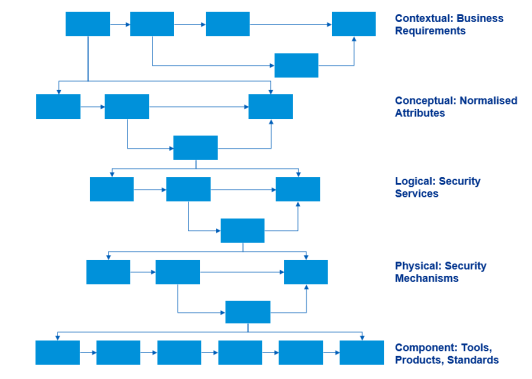
Start by reading your company’s business strategy, goals and values, have a look at the annual report. Getting the business level attributes from these documents should be straightforward. There’s no need to invent anything new – business stakeholders have already defined what’s important to them.
Contextual architecture
Every single word in these documents has been reviewed and changed potentially hundreds of times. Therefore, there’s usually a good level of buy-in on the vision. Simply use the same language for your business level attributes.
After analysing the strategy of my fictitious public sector client I’m going to settle for the following attributes: Stable, Respected, Trusted, Reputable, Sustainable, Competitive. Detailed definitions for these attributes are agreed with the business stakeholders.
Conceptual architecture
Next step is to link these to the broader objectives for technology. Your CIO or CTO might be able to assist with these. In my example, the Technology department has already done the hard job of translating high-level business requirements into a set of IT objectives. Your task is just distill these into attributes:
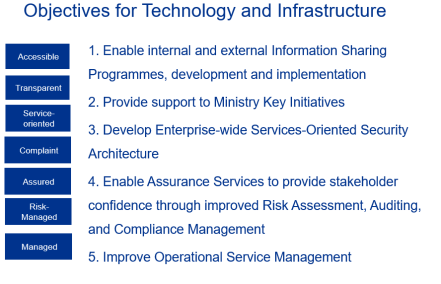
Now it’s up to you to define security attributes based on the Technology and Infrastructure attributes above. The examples might be attributes like Available, Confidential, Access-Controlled and so on.
Requirements traceability
The next step would be to highlight or define relationships between attributes on each level:
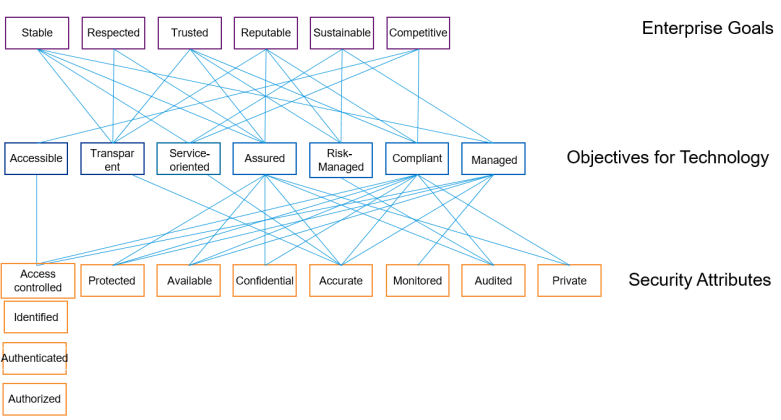
These attributes show how security supports the business and allows for two-way traceability of requirements. It can be used for risk management, assurance and architecture projects.
Back to our case study. Let’s consider a specific example of developing a hotel booking application for a public sector client we’ve started out with. To simplify the scenario, we will limit the application functionality requirements to the following list:
| ID | Name | Purpose |
| P001 | Register Accommodation | Enable the registration of temporary accommodations available |
| P002 | Update Availability | Enable accommodation managers to update availability status |
| P003 | Search Availability | Allow international travellers to search and identify available accommodation |
| P004 | Book Accommodation | Allow international travellers to book accommodation |
| P005 | Link to other departments | Allow international travellers to link to other departments and agencies such as the immigration or security services (re-direct) |
And here is how the process map would look like:
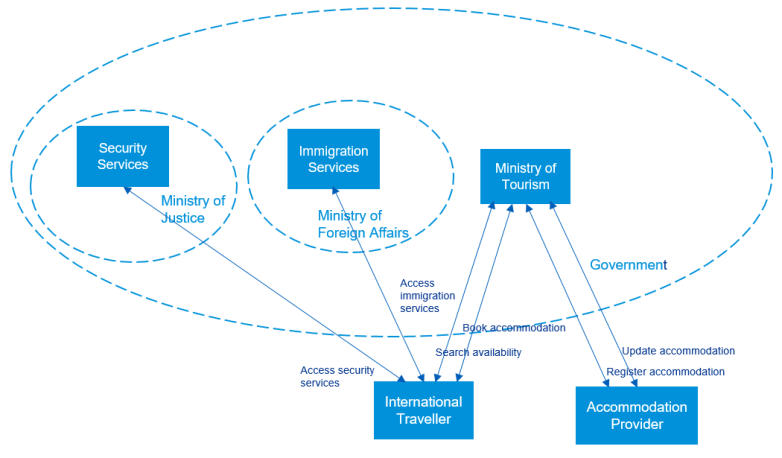
There are a number of stakeholders involved within the government serving international travellers’ requests. Tourists can access Immigration Services to get information on visa requirements and Security Services for safety advice. The application itself is owned by the Ministry of Tourism which acts as the “face” of this interaction and provides access to Tourist Board approved options. External accommodation (e.g. hotel chains) register and update their offers on the government’s website.
The infrastructure is outsourced to an external cloud service provider and there are mobile applications available, but these details are irrelevant for the current abstraction level.
Trust modelling
From the Trust Modelling perspective, the relationship will look like this:
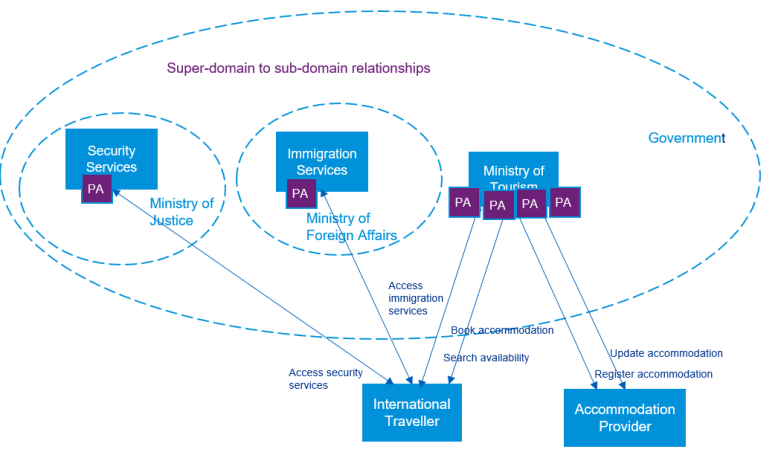
Subdomain policy is derived from, and compliant with, super domain but has specialised local interpretation authorised by super domain authority. The government bodies act as Policy Authorities (PA) owning the overall risk of the interaction.
At this stage we might want to re-visit some of the attributes we defined previously to potentially narrow them down to only the ones applicable to the process flows in scope. We will focus on making sure the transactions are trusted:
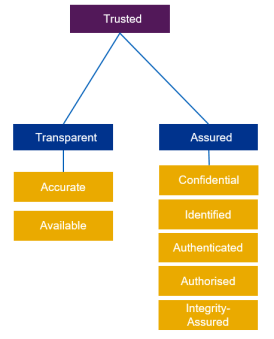
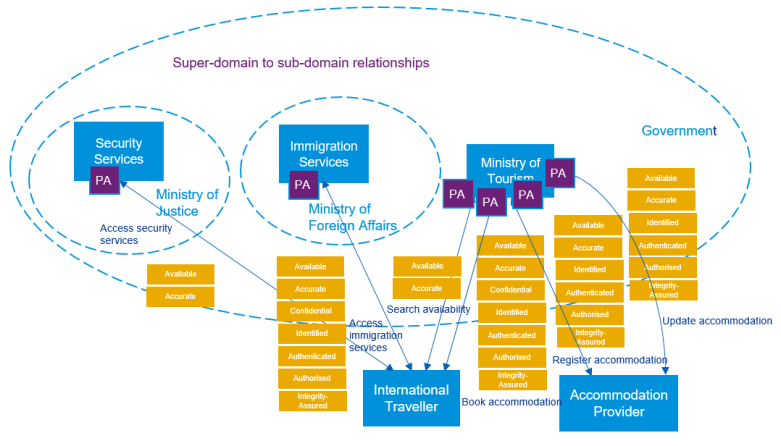
Let’s overlay applicable attributes over process flows to understand requirements for security:
Logical Architecture
Now it’s time to go down a level and step into more detailed Designer’s View. Remember requirement “P004 – Book Accommodation” I’ve mentioned above? Below is the information flow for this transaction. In most cases, someone else would’ve drawn these for you.
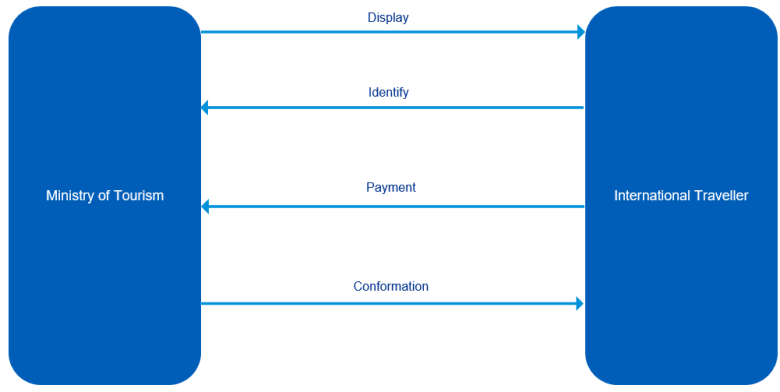
With security attributes applied (the direction of orange arrows define the expectation of a particular attribute being met):
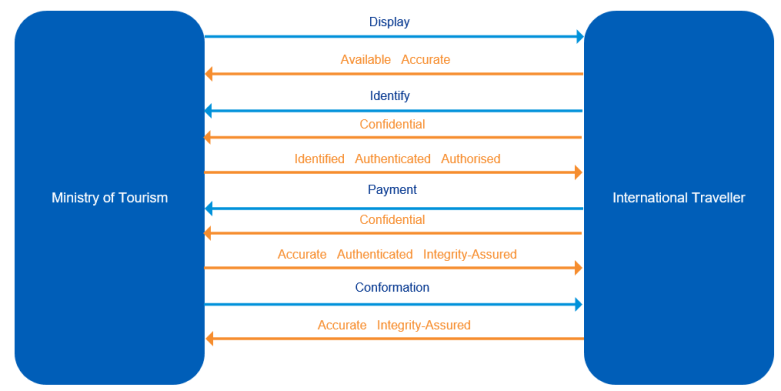
These are the exact attributes we identified as relevant for this transaction on the business process map above. It’s ok if you uncover additional security attributes at this stage. If that’s the case, feel free to add them retrospectively to your business process map at the Conceptual Architecture level.
Physical architecture
After the exercise above is completed for each interaction, it’s time to go down to the Physical Architecture level and define specific security services for each attribute for every transaction:
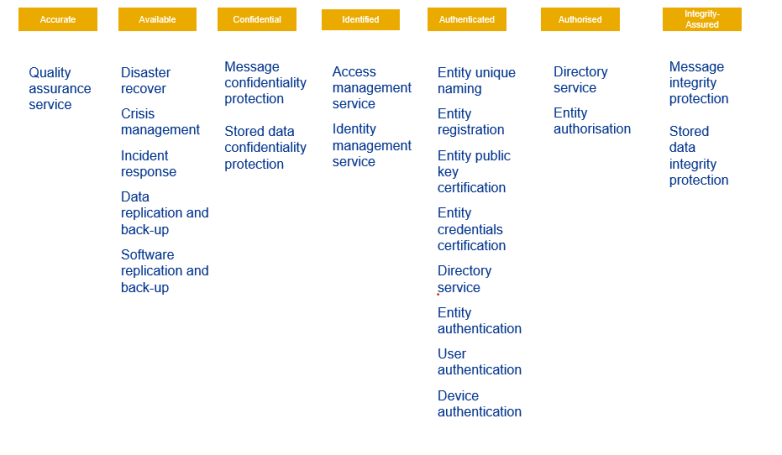
Component architecture
At the Component Architecture level, it’s important to define solution-specific mechanisms, components and activities for each security service above. Here is a simplified example for confidentiality and integrity protection for data at rest and in-transit:
| Service | Physical mechanism | Component brands, tools, products or technical standards | Service Management activities required to manage the solution through-life |
| Message confidentiality protection | Message encryption | IPSec VPN | Key management, Configuration Management, Change management |
| Stored data confidentiality protection | Data encryption | AES 256 Disk Encryption | Key management, Configuration Management, Change management |
| Message integrity protection | Checksum | SHA 256 Hash | Key management, Configuration Management, Change management |
| Stored data integrity protection | Checksum | SHA 256 Hash | Key management, Configuration Management, Change management |
As you can see, every specific security mechanism and component is now directly and traceable linked to business requirements. And that’s one of the ways you demonstrate the value of security using the SABSA framework.
A security department may sometimes be referred to by executives as the ‘Business Prevention Department’. Cyber security professionals, eager to minimise potential risks, can put controls in place that may stifle productivity and innovation.
Cyber security professionals are often too aware of what the business shouldn’t do and forget to mention what it should be doing instead. Ok, USB ports are now blocked, but have we provided people with an alternative to share files securely? Yes, we might’ve mitigated the risk of introducing malware through a flash drive, but have we considered a wider impact on the ability of employees to perform their core business activities, and, in turn, on overall profitability of the company.
Instead of saying ‘No’ to everything, let’s try to understand the business context of what we are trying to protect and why. Because that’s what actually matters and is absolutely key when designing security solutions that work.
People often think that security is the opposite of usability. In reality, the reverse is true. Design and security can coexist by defining constructive and destructive behaviours: what people should and shouldn’t do. Effective design, therefore, streamlines constructive behaviours while making risky ones harder to accomplish.
To do this effectively, security has to be a vocal influence in the design process, and not an afterthought. But it can only regain this influence if the value to the people and business is first demonstrated.
Wondering why your security policies don’t work? Ask your staff! Empathy, communication and collaboration are vital to build a culture of security. Security professionals need to shift their role from that of policeman enforcing policy from the top-down through sanctions to someone who is empathetic to the business needs and takes time to understand them.
Security mechanisms should be shaped around the day-to-day working lives of employees, and not the other way around. The best way to do this is to engage with employees and to factor in their unique experiences and insights into the design process. The aim should be to correct the misconceptions, misunderstandings and faulty decision-making processes that result in non-compliant behaviour.
Changing culture is not easy and will take time; but it is possible. Check out my book to find out more about developing an effective business-oriented security programme and improving security culture in your organisation.

Governments across Europe recognised that with increased interconnectiveness a cyber incident can affect multiple entities spanning across a number of countries. Moreover, impact and frequency of cyber attacks is at all-time high with recent examples including:
In order to manage cyber risk, the European Union introduced the Network and Information Systems (NIS) Directive which requires all Member States to protect their critical national infrastructure by implementing cyber security legislation.
Each Member State is required to set their own rules on financial penalties and must take the necessary measures to ensure that they are implemented. For example, in the UK fines, can be up to £17 million.
And yes, in case you are wondering, the UK government has confirmed that the Directive will apply irrespective of Brexit (the NIS Regulations come into effect before the UK leaves the EU).
Who does the NIS Directive apply to?
The law applies to:
The sectors affected by the NIS Directive are:
NIS Directive objectives
In the UK the NIS Regulations will be implemented in the form of outcome-focused principles rather than prescriptive rules.
National Cyber Security Centre (NCSC) is the UK single point of contact for the legislation. They published top level objectives with underlying security principles.
Objective A – Managing security risk
Objective B – Protecting against cyber attack
Objective C – Detecting cyber security events
Objective D – Minimising the impact of cyber security incidents
Table view of principles and related guidance is also available on the NCSC website.
Cyber Assessment Framework
The implementation of the NIS Directive can only be successful if Competent Authorities can adequately assess the cyber security of organisations is scope. To assist with this, NCSC developed the Cyber Assessment Framework (CAF).
The Framework is based on the 14 outcomes-based principles of the NIS Regulations outlined above. Adherence to each principle is determined based on how well associated outcomes are met. See below for an example:
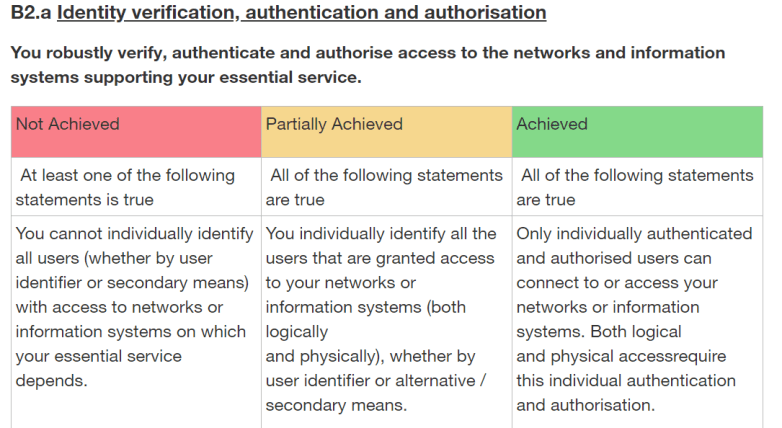
Each outcome is assessed based upon Indicators of Good Practice (IGPs), which are statements that can either be true or false for a particular organisation.
Whats’s next?
If your organisation is in the scope of the NIS Directive, it is useful to conduct an initial self-assessment using the CAF described above as an starting point of reference. Remember, formal self-assessment will be required by your Competent Authority, so it is better not to delay this crucial step.
Establishing an early dialogue with the Competent Authority is essential as this will not only help you establish the scope of the assessment (critical assets), but also allow you to receive additional guidance from them.
Initial self-assessment will most probably highlight some gaps. It is important to outline a plan to address these gaps and share it with your Competent Authority. Make sure you keep incident response in mind at all times. The process has to be well-defined to allow you report NIS-specific incidents to your Competent Authority within 72 hours.
Remediate the findings in the agreed time frames and monitor on-going compliance and potential changes in requirements, maintaining the dialogue with the Competent Authority.

I’ve spend last week in Vienna at the annual intergovernmental conference focused on protecting critical energy infrastructure.
The first two days were dedicated to the issues of security and diplomacy.
A number of panel discussions, talks and workshops covered the following topics:
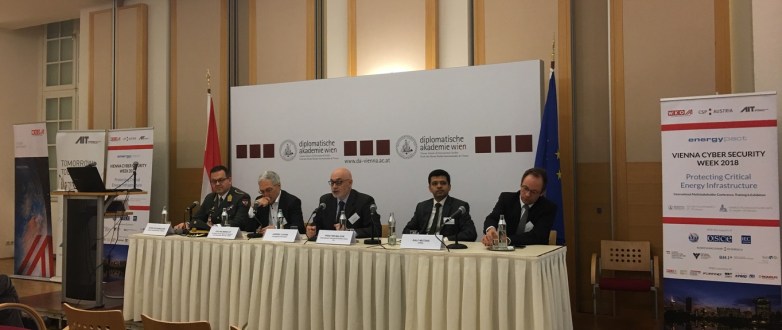
For the rest of the conference we moved from the Diplomatic Academy of Vienna to Tech Gate, a science and technology park and home to a number of local cyber startups.
We’ve discussed trends in technology and cyber security, participated in Cyber Range simulation tutorial and a scenario-based exercise on policy development to address the growing cyber-threat to the energy sector.
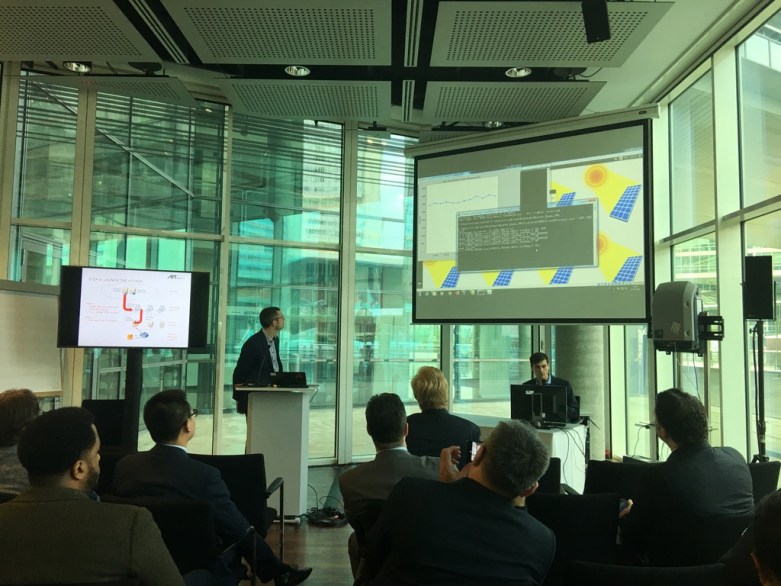
AIT Austrian Institute of Technology together with WKO Austrian Economic Chambers, ASW Austrian Defence and Security Industry, and the Austrian Cyber Security Cluster hosted a technology exhibition of latest solutions and products as well as R&D projects.
Participants had an opportunity to see state-of-the-art of next generation solutions and meet key experts in the field of cyber security for protecting critical infrastructures to fight against cyber-crime and terrorism.
Talks continued throughout the week with topics covering:
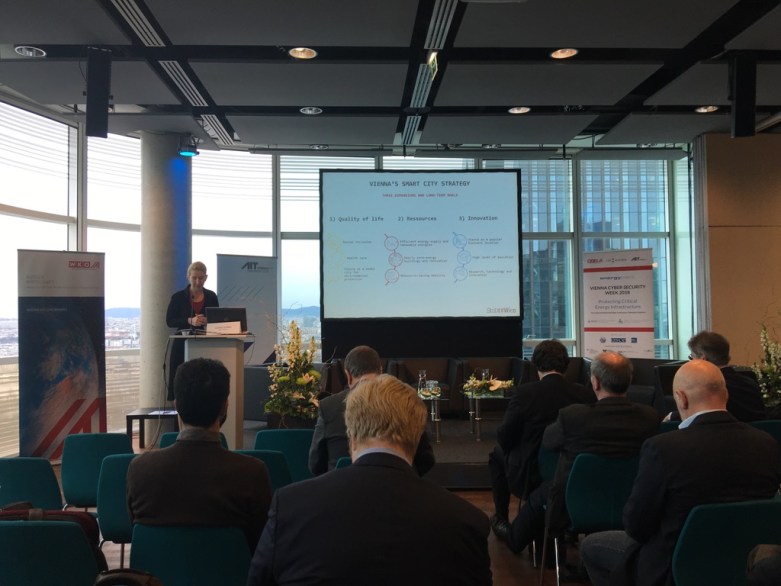
The last day focused on innovation and securing the emerging technologies. The CIO of City of Vienna delivered an insightful presentation about on cities and security implications of digitalisation. A closing panel discussed projected trends and emerging areas of technology, approaches and methods for verifying and securing new technologies and the future of the cyber threat.

What makes a cyber startup successful? From my working with a number of companies, there are four key areas cyber entrepreneurs should consider:
Idea
Credibility
Client-focus
Learning
The key here, as you can see, is clients. There is really no way around understanding them, pleasing them and focusing on what they want. This feedback will allow you to pivot where required. Above all, stay focused and avoid premature scaling – don’t do too much too soon.

HutZero, an early-stage entrepreneur bootcamp, kindly prepared a list of books and websites recommended for aspiring cyber startup founders.
Books:
The Lean Startup, Eric Reis
Business Model Generation, Alexander Osterwalder, Yves Pigneur
The Mom Test, Rob Fitzpatrick
Lean Analytics, Alistair Croll, Benjamin Yoskovitz
To Sell Is Human, Daniel H. Pink
Start with Why, Simon Sinek
The Purple Cow, Seth Godin
Lean UX, Jeff Gothelf, Josh Seiden
Made to Stick, Chip Heath, Dan Heath
The Four Steps to the Epiphany, Steve Blank
Do More Faster: Lessons from TechStars, Brad Feld, David Cohen
Fundraising Field Guide, Carlos Espinal
Blogs:
Wired Threat Level
Dark Reading
Krebs On Security
TechCrunch Europe
The Next Web
Tech.eu
Tech City News
Buffer Blog (marketing)
Steve Blank
Fred Wilson’s Blog, A VC
Brad Feld’s Blog (Techstars)
KissMetrics Blog (marketing)
Both Sides of the Table
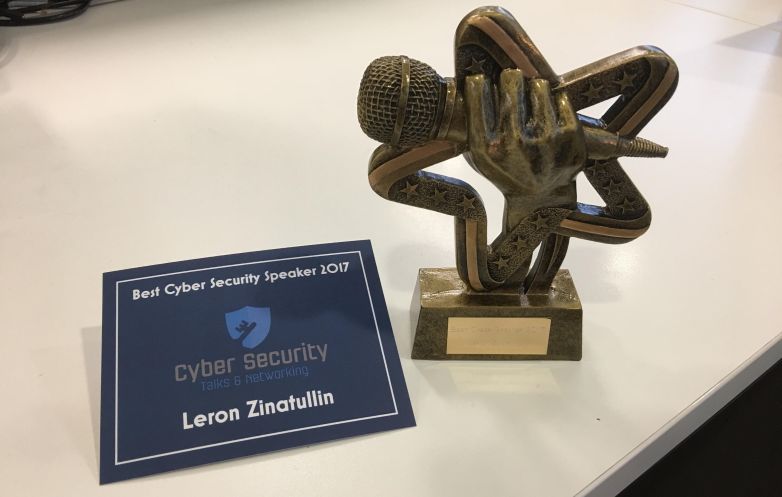
I am pleased, honoured and humbled to receive the “Best Cyber Security Speaker 2017” award.


I’ve recently passed my AWS Certified Solutions Architect – Associate exam. In this blog I would like to share some preparation tips that would help you ace it.
Not only practice makes perfect, some hands-on experience is also a prerequisite for the exam. So there is really no way around that! But what if you didn’t have a chance to use your skills on a real-world project yet? No problem! AWS gives you a opportunity to learn how their cloud components work through AWS Free Tier. For one year, you can use Amazon EC2 , Amazon S3, Amazon RDS, AWS IoT and many more free of charge,
You want more guidance? Qwiklabs developed a set of labs that specifically designed to help you prepare for this exam. For a small price, you can complete exercises without even requiring an AWS account or signing up for Free Tier.
I recommend studying AWS Whitepapers to broaden your technical understanding. If you are short on time, focus on these:
AWS developed a free self-paced Cloud Practitioner Essential course, to help you develop an overall understanding of the AWS Cloud. You will learn basic cloud concepts and AWS services, security, architecture, pricing, and support.
There is also a YouTube channel with free introductory videos and other noteworthy material.
Exam sample questions can help you check your knowledge and highlight areas requiring more study.
Remember, the best preparation for the exam is practical experience: AWS recommend 1+ years of hands-on experience with their technologies.
When you’re ready, go ahead and schedule an exam here.
Good luck!
 Cyber Security Leadership