Navigating the ISO 27001:2022 transition

ISO/IEC 27001:2022 Summary of key changes

ISO 27001 is a widely adopted international standard that sets out systematic and adaptable approach to managing information security. It enables organisations to establish a culture of continuous improvement, staying ahead of emerging threats, and ensuring business resilience in the face of evolving cybersecurity challenges.

A new version of this standard – ISO 27001:2022 – was published on 24 October 2022. I recently led the transition to this version and wanted to share my key takeaways.

More

Generative AI acceptable use policy

Encouraging the use of Generative AI technology at work can enhance productivity and streamline tasks. Generative AI can provide valuable support in various areas, from customer service and problem-solving to research and data analysis.

By leveraging the power of Generative AI, we can improve our workflows, reduce time spent on manual tasks, and ultimately achieve better results. However, we should also recognise the importance of using Generative AI responsibly and in accordance with company policies and guidelines. By doing so, we can maximise the benefits of Generative AI while protecting sensitive information and intellectual property. 

More

Financial benefits of cyber security

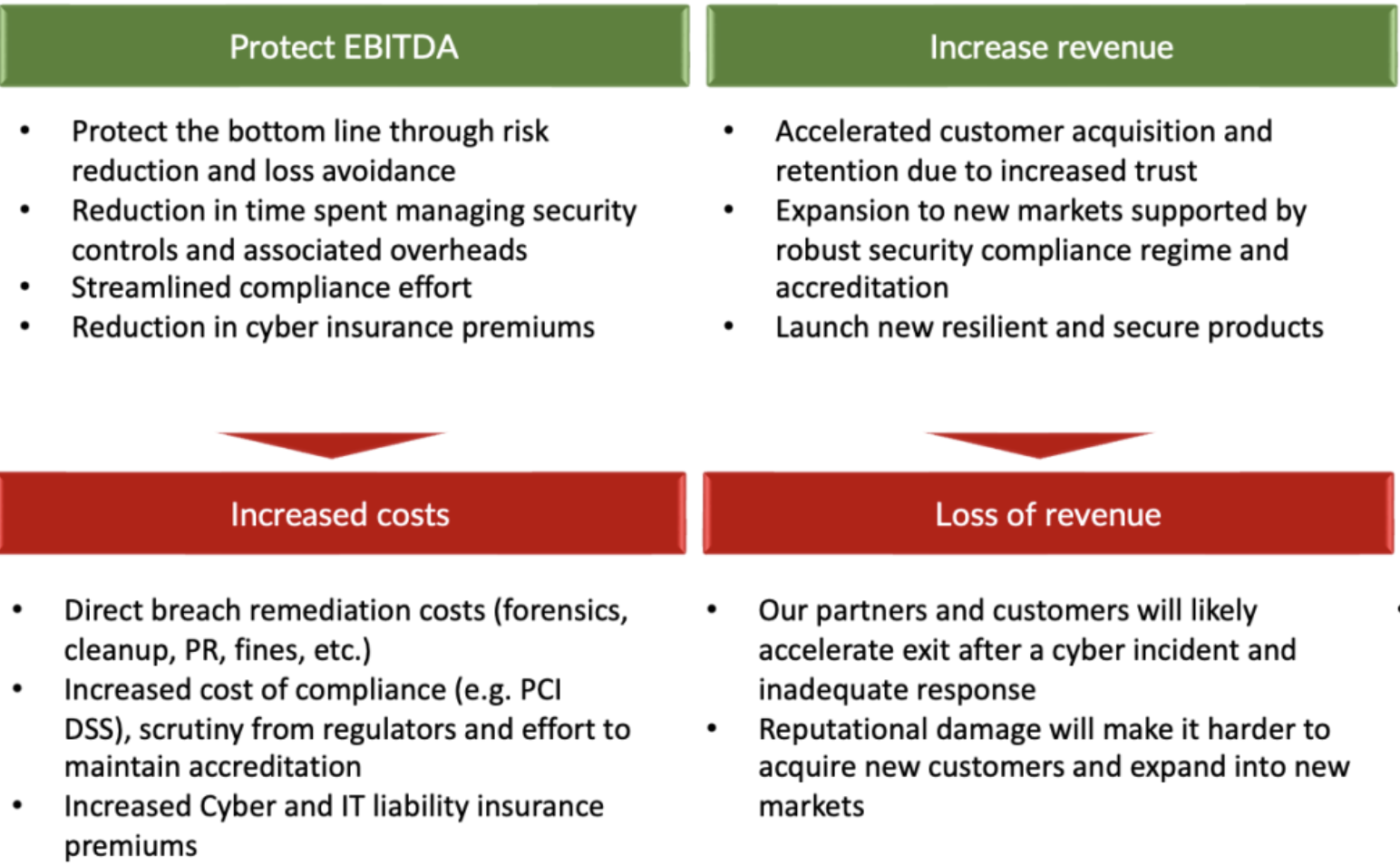
How can security support the business? To answer this question in financial terms, I outline two sides of the story. On one hand, CISOs can demonstrate positive impact on the EBITDA through elevating security capabilities. On the other hand, we can list potential downsides of poor security practices from both revenue and cost perspectives.

It’s not about carrots and sticks, it’s about seeing the full picture of opportunity and risk.

More

What is the best security framework for your business?

I’m often asked what security control framework is the best. Spoiler alert – I don’t think there is one! No single framework is a silver bullet – they all have pros and cons. Some frameworks are highly-prescriptive and have a narrow scope – cardholder and account data for PCI DSS, for example.

SOC 2, on the other hand is more principled-based and doesn’t mandate specific controls but rather a Trust Services Criteria.

ISO 27001 is another popular choice: it’s a risk-based framework, although also has a set of example controls in the standard that many people chose to adopt.

NIST Cybersecurity Framework and its functions (Identify, Protect, Detect, Respond and Recover) can aid communication with business stakeholders but it has its limitations too.

Your particular industry may have other specialised sets of requirements, like NERC CIP for electric power grid in North America. The list goes on.

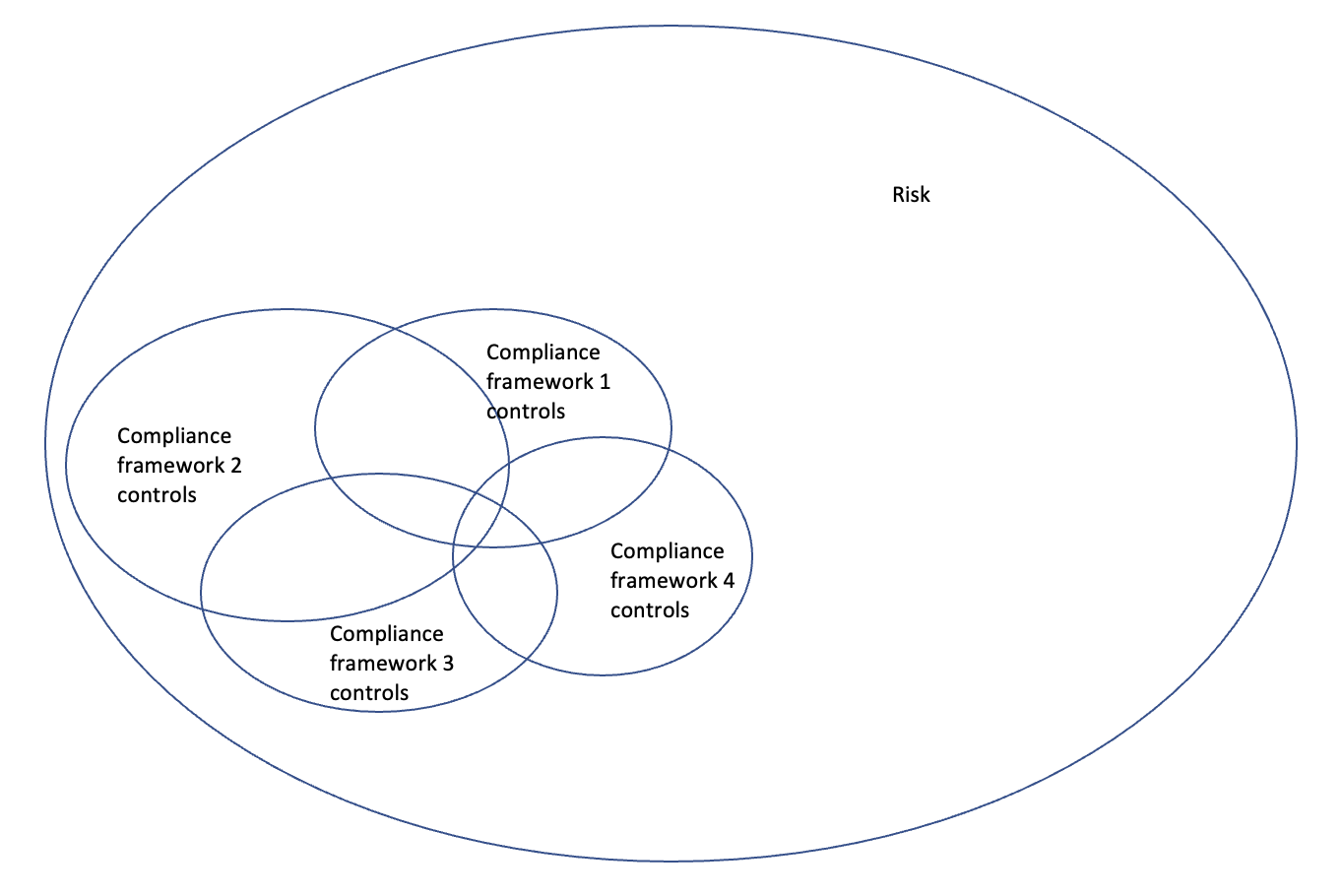
Many organisations are subject to multiple regulation and legislation simultaneously, having to adopt multiple frameworks and compliance regimes. If not managed appropriately, this can be labour-intensive to maintain and demonstrate compliance. It helps to recognise that often, although worded differently, controls from different frameworks aim to achieve the same objective, so it pays to maintain cross-framework control mapping to streamline your compliance program.

While achieving compliance with a security framework is often a necessary step in establishing a baseline level of security, it’s often not sufficient to mitigate modern threats.

Compliance frameworks were developed with a specific objective in mind – to reduce risk. And they can get you part of the way there, just not all the way. An organisation can be compliant but still insecure. Security leaders should go beyond compliance and move towards actively identifying and managing risks, focusing on the overall security posture and risk reduction to survive and thrive in the digital world.

Supply chain security

Asset management is often regarded as the foundation of a security programme. You can’t protect something that you don’t know you have. This extends beyond internal systems to your organisation’s partners. Depending on the line of business, supply chains can get increasingly complex. They include vendors, manufacturers, retailers and distributors in multiple geographies and regulatory regimes. Securing such a network is no easy task and should start with visibility and careful risk management.

More

Continuous control monitoring

NISTIR 7756 Contextual Description of the CAESARS System

Knowing your existing assets, threats and countermeasures is a necessary step in establishing a starting point to begin prioritising cyber risk management activities. Indeed, when driving the improvement of the security posture in an organisation, security leaders often begin with getting a view of the effectiveness of security controls.

A common approach is to perform a security assessment that involves interviewing stakeholders and reviewing policies in line with a security framework (e.g. NIST CSF).

A report is then produced presenting the current state and highlighting the gaps. It can then be used to gain wider leadership support for a remediation programme, justifying the investment for security uplift initiatives. I wrote a number of these reports myself while working as a consultant and also internally in the first few weeks of being a CISO.

These reports have a lot of merits but they also have limitations. They are, by definition, point-in-time: the document is out of date the day after it’s produced, or even sooner. The threat landscape has already shifted, state of assets and controls changed and business context and priorities are no longer the same.

More

Free security awareness training for your staff

NCSC Stay Safe Online

Who needs to buy e-learning modules for employee security awareness programmes when NCSC kindly made available their training for free?

NCSC’s Top Tips For Staff includes online videos (that can be also included in your own learning management system), knowledge check and an infographic.

It’s a quick and easy way to get you started on the journey of building security culture in your company and meet some of the compliance requirements. This can be especially helpful for startups and non-profits with limited budgets.

The role of a CISO

I’m often asked what the responsibilities of a CISO or Head of Information Security are. Regardless of the title, the remit of a security leadership role varies from organisation to organisation. At its core, however, they have one thing in common – they enable the businesses to operate securely. Protecting the company brand, managing risk and building customer trust through safeguarding the data they entrusted you with are key.

There are various frameworks out there that can help structure a security programme but it is a job of a security leader to understand the business context and prioritise activities accordingly. I put the below diagram together (inspired by Rafeeq Rehman) to give an idea of some of the key initiatives and responsibilities you could consider. Feel free to adapt and tailor to the needs of your organisation.

You might also find my previous blogs on the first 100 days as a CISO and developing an information security strategy useful.

More

How to secure a business in decline

Many business have felt the economic impact of the Covid pandemic. Depending on the industry, some managed to adapt and pivot to new models and ways of working, but not all were successful.

As a result, some companies were unable to continue to operate profitably and entered administration. The cause of financial troubles, however, doesn’t have to be pandemic-related to pose new security challenges.

In this blog I would like to share some of the priority areas for a security leader in a business in, sometimes rapid, decline.

As the business is failing, the leadership might not treat cyber security as their top priority. However, the organisation still has obligations to its customers who entrusted the company with their data and comply with relevant laws and regulations. It goes without saying that previously identified cyber security threats and risks are unlikely to disappear either.

If there is a chance of survival, a poorly managed security incident can be the last straw.

How should security teams adapt? What should they focus on?

Broadly speaking, there are two main areas a CISO can support the business: securing a potential rescue deal and managing the decline.

There are investors specialising in distressed businesses and part of the administration process might involve looking for a capital injection or an acquisition of a failing company.

Potential investors would understandably need to know what they might be buying which normally involves conducting due diligence on the target. Although circumstances are different, the process itself is very similar to an M&A scenario or a startup acquisition.

As a security leader, it’s your job to provide transparency on the matters related to data protection, past breaches and existing security controls and processes. If done right, it presents the business in a favourable light as a well-governed enterprise, increasing investors’ confidence and therefore chances of a successful rescue deal.

In many ways, this is comparable to overseeing a divestment. A lot of such conversations are confidential, so raising awareness of what can and can’t be shared externally (including on social media), and maintaining appropriate need-to-know access controls is paramount.

Some things, however, are outside of our control and sometimes all we can do is to make the best out of a bad situation.

There are a few key areas to pay attention to when it comes to embedding security for a business in downturn.

People. There will naturally be a lot of leavers, so having a robust joiner-mover-leaver process is key. All access permissions should be timely revoked when no longer required. In addition, data loss prevention controls and broader insider risks should be considered as the morale in the company worsens. On a positive note, people and a culture of security can significantly contribute to the company’s security posture, especially in the conditions of scarce resources (see next point).

Resources. Investment in security is going to understandably diminish. Some of the top talent will leave, so you will have to learn to do more with less. If your desired control to mitigate a particular risk is no longer affordable, what is the next best thing? Can this be done cheaper, or better still, for free? Business leadership should be made aware of the potential consequences of risk acceptances, and there will likely be a higher than usual number of these.

Data. There also might not be enough money to pay for non business critical systems and services. These should be decommissioned in the way that ensures that sensitive (including personal) data is destroyed securely in line with company’s retention policies. Having data maps and asset inventories is invaluable to maintain visibility.

Sustaining operational resilience in the face of cost pressure is challenging but not impossible. For many, it’s a unique learning experience regardless of the outcome.