Internet of Toys Security

NSPCC

To support my firm’s corporate and social responsibility efforts, I volunteered to help NSPCC, a charity working in child protection, understand the Internet of Toys and its security and privacy implications.

I hope the efforts in this area will result in better policymaking and raise awareness among children and parents about the risks and threats posed by connected devices.

Toys are different from other connected devices not only because how they are normally used, but also who uses them.

For example, children may tell secrets to their toys, sharing particularly sensitive information with them. This, combined with often insufficient security considerations by the manufacturers, may be a cause for concern.

Apart from helping NSPCC in creating campaign materials and educating the staff on the threat landscape, we were able to suggest a high-level framework to assess the security of a connected toy, consisting of parental control, privacy and technology security considerations.

More

Passed my AWS Certified Solutions Architect exam – here’s how you can too


Solutions badge

I’ve recently passed my AWS Certified Solutions Architect – Associate exam. In this blog I would like to share some preparation tips that would help you ace it.

  1. Practice

Not only practice makes perfect, some hands-on experience is also a prerequisite for the exam. So there is really no way around that! But what if you didn’t have a chance to use your skills on a real-world project yet? No problem! AWS gives you a opportunity to learn how their cloud components work through AWS Free Tier.  For one year, you can use Amazon EC2 , Amazon S3, Amazon RDS, AWS IoT and many more free of charge,

You want more guidance? Qwiklabs developed a set of labs that specifically designed to help you prepare for this exam. For a small price, you can complete exercises without  even requiring an AWS account or signing up for Free Tier.

  1. Read

I recommend studying AWS Whitepapers to broaden your technical understanding. If you are short on time, focus on these:

  1. Watch

AWS developed a free self-paced Cloud Practitioner Essential course, to help you develop an overall understanding of the AWS Cloud. You will learn basic cloud concepts and AWS services, security, architecture, pricing, and support.

There is also a YouTube channel with free introductory videos and other noteworthy material.

Exam sample questions can help you check your knowledge and highlight areas requiring more study.

Remember, the best preparation for the exam is practical experience: AWS recommend 1+  years of hands-on experience with their technologies.

When you’re ready, go ahead and schedule an exam here.

Good luck!

Developing Global Cyber Services

UNADJUSTEDNONRAW_thumb_3078

Over the past year I’ve worked as a core part of the KPMG’s Global Cyber Strategic Growth Initiative as the lead for service development activities, with a focus on working with member firms to deploy capabilities in order to ensure consistent delivery and quality across key growth areas.

I was responsible for the roll-out of cyber security services that included developing sales and delivery accelerators, accreditation requirements, learning pathways, vendor ecosystem and quality and risk management principles across EMEA, APAC and Americas.

To achieve this, I created a service development framework and worked with numerous stakeholders across the firm’s network: global deployment, service development leads, acquisition leads, risk management and key member firm cyber representatives and regional leads.

I also developed a method for the in-country adoption of deployed capabilities and supported both global and in-country risk team members in the evaluation of risk when taking services for client use.

I ensured the sustainability of deployed capabilities through the implementation and use of delivery frameworks and tools, and assigned ownership for the upkeep of deployed capabilities. I worked with member firms to promote the adoption of prioritised services; developed adoption timelines and targets for deployed service.

One of the existing aspects of the role was alliance, acquisition and investment integration support where I collaborated with the relevant stakeholders to deploy and embed offerings obtained through alliances to member firms while monitoring progress against agreed budgets, milestones, deliverables and benefits for capabilities being deployed.

By the end of the programme, I deployed Cyber Maturity Assessment, Identity and Access Management, Industrial Internet of Things Cyber Security, Privacy and Cyber Incident Response services to 19 countries around the world.

This resulted in achieving significant revenue and market share growth for cyber security services of my firm globally. KPMG International was also named a leader in information security consulting services in 2016 and 2017 according to Forrester Research.

cq5dam.web.512.99999

Augusta University’s Cyber Institute adopts my book

jsacacalog

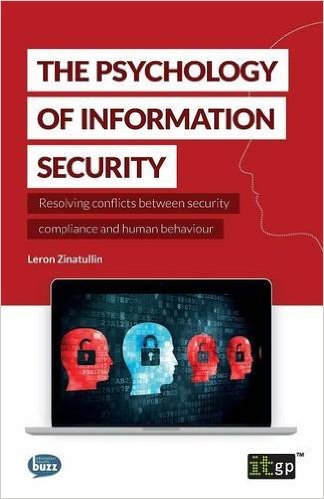
Just received some great news from my publisher.  My book has been accepted for use on a course at Augusta University. Here’s some feedback from the course director:

Augusta University’s Cyber Institute adopted the book “The Psychology of Information Security” as part of our Masters in Information Security Management program because we feel that the human factor plays an important role in securing and defending an organisation. Understanding behavioural aspects of the human element is important for many information security managerial functions, such as developing security policies and awareness training. Therefore, we want our students to not only understand technical and managerial aspects of security, but psychological aspects as well.

I’ve been interviewed by Javvad Malik about my career in InfoSec

I’ve been interviewed by Javvad Malik about my career in Information Security. He published the interview on his website

The difference between Leron and anyone else that has ever asked for advice is his willingness to learn and take on board as much knowledge as possible and then apply it. In a few short years, not only was Leron able to complete his MSc, but he landed a job (while turning down other offers), spoke at events, and wrote a book. Achieving more in 3 years than most people do in 10.

So, the roles are now reversed. I needed to catch up with Leron and pick his brains about his journey and see what I could learn from him.
Read the full story

Is consulting changing?

As David Maister famously puts in his timeless book The Trusted Advisor, “it’s not enough to be right, you must also be helpful”. You first need to earn your client’s trust, and with it, right to offer advice and be critical of the way things are right now.

What do clients want? You need to demonstrate that you understand them and you are transparent with them. It’s unhelpful to try and bamboozle your clients with jargon and numbers, instead tell what these numbers mean for them.

Consulting has traditionally thrived on information asymmetry: consultants used to know more than clients but this is going away. Not only do we need to shift to provide insight rather than just information, we need to disrupt our own industry to remain relevant. I’m talking, of course, about automation.

Yes, there will always be cases were clients hire consultants when they have already made up their mind and just want to rubber stamp their agenda. But these situations are becoming rare.

From my experience, clients are increasingly reluctant to pay for glossy PowerPoint decks. Managed services and post-implementation support might be some viable options to remain relevant and, therefore, profitable.

The Psychology of Information Security book reviews

51enjkmw1ll-_sx322_bo1204203200_

I wrote about my book  in the previous post. Here I would like to share what others have to say about it.

“So often information security is viewed as a technical discipline – a world of firewalls, anti-virus software, access controls and encryption. An opaque and enigmatic discipline which defies understanding, with a priesthood who often protect their profession with complex concepts, language and most of all secrecy.

Leron takes a practical, pragmatic and no-holds barred approach to demystifying the topic. He reminds us that ultimately security depends on people – and that we all act in what we see as our rational self-interest – sometimes ill-informed, ill-judged, even downright perverse.

No approach to security can ever succeed without considering people – and as a profession we need to look beyond our computers to understand the business, the culture of the organisation – and most of all, how we can create a security environment which helps people feel free to actually do their job.”
David Ferbrache OBE, FBCS
Technical Director, Cyber Security
KPMG UK

“This is an easy-to-read, accessible and simple introduction to information security.  The style is straightforward, and calls on a range of anecdotes to help the reader through what is often a complicated and hard to penetrate subject.  Leron approaches the subject from a psychological angle and will be appealing to both those of a non-technical and a technical background.”
Dr David King
Visiting Fellow of Kellogg College
University of Oxford

More

Talking to PhD students about cyber security

presentI recently had the pleasure to help organise and host PhD students from Royal Holloway, University of London (RHUL), who spent a day at my company interacting with the team in order to gain industry insights.

This day-long event included presentations by the students, their lecturers, our partners and consultants.

During one of these presentations, I shared some of my own experiences as an information security consultant, in which I talked about my role and area of expertise. I also discussed current security challenges and provided some career advice.

Several round table discussions provided everybody with much needed food for thought. We covered topics like security monitoring, threat intelligence, information protection in digital health and the role of the C-suite.

We received positive responses from the professors – the students enjoyed the presentations and learned a lot from the interactions during the day.