CISOs and security leaders are often called upon to develop a security strategy. It’s an important step to understand what your current state is, in what direction you’re going and the roadmap to get there. It’s also an opportunity to demonstrate how cyber security activities and programs align to business objectives.
There is more to the CISO role than just setting the direction, however. It’s also about execution. As a security leader, it’s key to take ownership of the strategy and deliver on its promise. It’s useful, therefore, to be able to track progress against your objectives and demonstrate to the executive leadership team and the Board the impact the security team is making in enabling the business.
Designing a target operating model for an organisation is a complex activity. It is important, therefore, to keep it simple initially. At a very high, level, I suggest CISOs start with three key capabilities:
Governance, Risk and Compliance
Security Architecture
Security Operations
These can then be decomposed further, tailoring to the needs of your particular organisation. Understand how each domain interacts with and supports the others, capturing key outcomes and dependencies for each function.
Key security capabilities are supported by Leadership and Governance streams, including Security Strategy, Business Alignment, Integration, Oversight, Optimization, Finance, Security Culture, Program Management, Stakeholder Management and Reporting.
Business as usual activities required to keep the lights on are often neglected when capability uplift is prioritized. For this reason, I placed it in the centre of the diagram, emphasising the ongoing importance of providing consistent security service to your organisation.
The NIST Cybersecurity Framework functions at the intersections of domains aim to illustrate the collaborative nature of the security teams. It’s important to go beyond silos , ensuring frequent interaction with the business as well as within the security department.
I had a pleasure to participate in the keynote panel discussion on cyber security Board reporting at the CISO Executive Network event in Sydney. It was an insightful discussion where I had a chance to share my views on aligning on Board expectations, developing relationships and tailoring your message for maximum impact.
We also covered common challenges and strategies for winning the Board over as well as good practices for reporting. It was a great opportunity to contribute to the community and learn from my peers in the industry.
Cyber security strategy and execution is one of the top priorities for a CISO. It helps articulate the value of security, provide clarity on short and long term goals and outline a cyber security uplift roadmap.
In this blog I recommend a proven step-by-step guide for developing a cyber strategy.
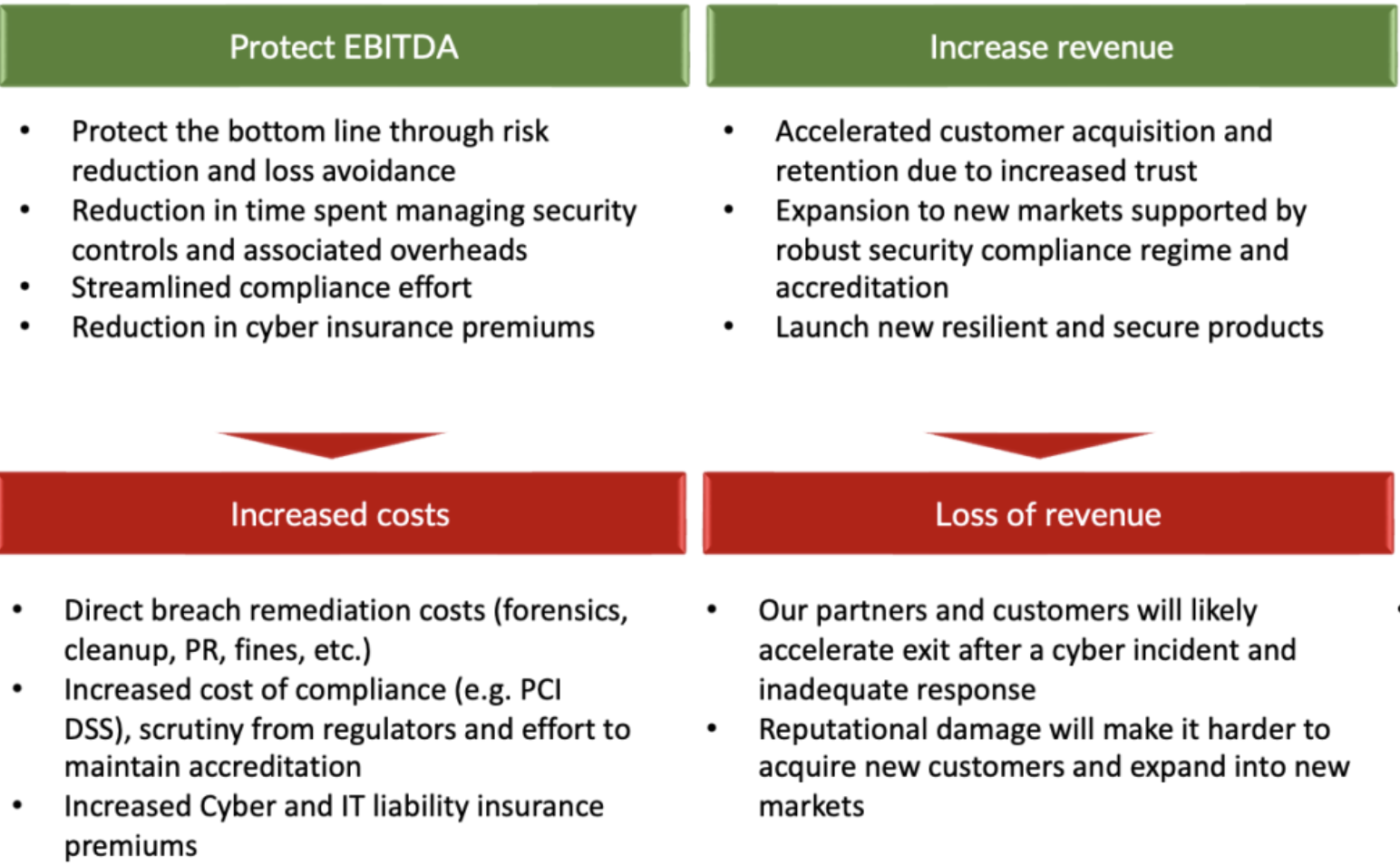
How can security support the business? To answer this question in financial terms, I outline two sides of the story. On one hand, CISOs can demonstrate positive impact on the EBITDA through elevating security capabilities. On the other hand, we can list potential downsides of poor security practices from both revenue and cost perspectives.
It’s not about carrots and sticks, it’s about seeing the full picture of opportunity and risk.
It’s widely understood that cybersecurity should support the business – it’s a common theme of this blog. However, it’s often difficult to achieve true alignment without understanding the business context, priorities and challenges and being able to communicate in the language of business stakeholders.
I decided to enrol to the Master of Business Administration (Executive) degree to broaden my knowledge and enhance my strategic thinking to better serve organisations. Developing my skills in finance, leadership, strategy and innovation will help equip me to better understand current challenges and make a positive, lasting impact. The Australian Graduate School of Management (AGSM) program at the University of New South Wales will help me learn about the latest business practices and how to effectively apply them to add value to the business.
I have a strong technical background and analytical skills and I look to build on this foundation to enhance my contribution to the C-Suite. Throughout my career I’ve worked in consulting, corporate and startup organisations; my understanding of challenges and opportunities of both large corporations and nimble startups globally will bring a unique perspective to the AGSM community. I can also leverage my extensive professional network around the world to support fellow Executive MBA candidates and alumni.
I’ll be writing about my experience and learning in this blog, so stay tuned for more updates on how cybersecurity practices can be aligned to wider business strategy and objectives.
I’m often asked what security control framework is the best. Spoiler alert – I don’t think there is one! No single framework is a silver bullet – they all have pros and cons. Some frameworks are highly-prescriptive and have a narrow scope – cardholder and account data for PCI DSS, for example.
SOC 2, on the other hand is more principled-based and doesn’t mandate specific controls but rather a Trust Services Criteria.
ISO 27001 is another popular choice: it’s a risk-based framework, although also has a set of example controls in the standard that many people chose to adopt.
NIST Cybersecurity Framework and its functions (Identify, Protect, Detect, Respond and Recover) can aid communication with business stakeholders but it has its limitations too.
Your particular industry may have other specialised sets of requirements, like NERC CIP for electric power grid in North America. The list goes on.
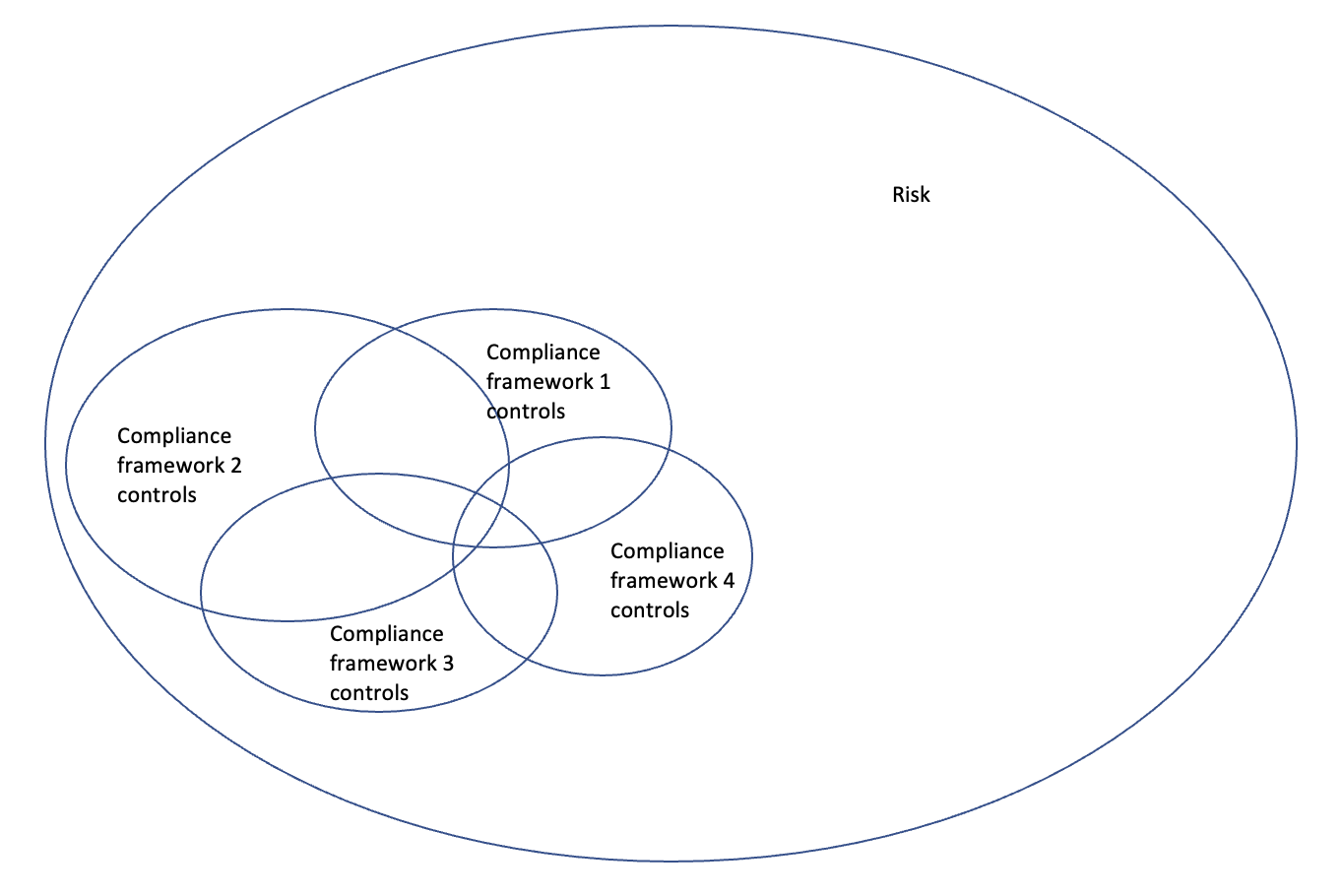
Many organisations are subject to multiple regulation and legislation simultaneously, having to adopt multiple frameworks and compliance regimes. If not managed appropriately, this can be labour-intensive to maintain and demonstrate compliance. It helps to recognise that often, although worded differently, controls from different frameworks aim to achieve the same objective, so it pays to maintain cross-framework control mapping to streamline your compliance program.
While achieving compliance with a security framework is often a necessary step in establishing a baseline level of security, it’s often not sufficient to mitigate modern threats.
Compliance frameworks were developed with a specific objective in mind – to reduce risk. And they can get you part of the way there, just not all the way. An organisation can be compliant but still insecure. Security leaders should go beyond compliance and move towards actively identifying and managing risks, focusing on the overall security posture and risk reduction to survive and thrive in the digital world.
Asset management is often regarded as the foundation of a security programme. You can’t protect something that you don’t know you have. This extends beyond internal systems to your organisation’s partners. Depending on the line of business, supply chains can get increasingly complex. They include vendors, manufacturers, retailers and distributors in multiple geographies and regulatory regimes. Securing such a network is no easy task and should start with visibility and careful risk management.
I previously wrote about the complexity of communication and the multi-faceted nature of the CISO role. Combining these perspectives, I would like to give an overview of what a communication strategy might look like for a security leader.
NISTIR 7756 Contextual Description of the CAESARS System
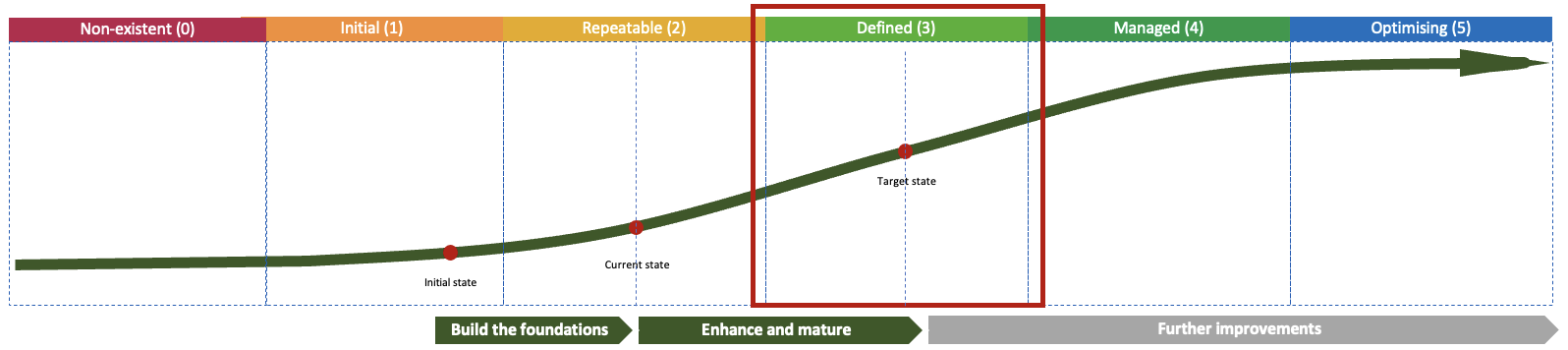
Knowing your existing assets, threats and countermeasures is a necessary step in establishing a starting point to begin prioritising cyber risk management activities. Indeed, when driving the improvement of the security posture in an organisation, security leaders often begin with getting a view of the effectiveness of security controls.
A common approach is to perform a security assessment that involves interviewing stakeholders and reviewing policies in line with a security framework (e.g. NIST CSF).
A report is then produced presenting the current state and highlighting the gaps. It can then be used to gain wider leadership support for a remediation programme, justifying the investment for security uplift initiatives. I wrote a number of these reports myself while working as a consultant and also internally in the first few weeks of being a CISO.
These reports have a lot of merits but they also have limitations. They are, by definition, point-in-time: the document is out of date the day after it’s produced, or even sooner. The threat landscape has already shifted, state of assets and controls changed and business context and priorities are no longer the same.