Productive Security

500995147_5f56493a1e_z

The majority of employees within an organisation are hired to execute specific jobs, such as marketing, managing projects, manufacturing goods or overseeing financial investment. Their main – sometimes only – priority will be to efficiently complete their core business activity, so information security will usually only be a secondary consideration. Consequently, employees will be reluctant to invest more than a limited amount of effort and time on such a secondary task that they rarely understand, and from which they perceive no benefit.

Research[1] suggests that when security mechanisms cause additional work, employees will favour non-compliant behaviour in order to complete their primary tasks quickly.

There is a lack of awareness among security managers[2] about the burden that security mechanisms impose on employees, because it is assumed that the users can easily accommodate the effort that security compliance requires. In reality, employees tend to experience a negative impact on their performance because they feel that these cumbersome security mechanisms drain both their time and their effort. The risk mitigation achieved through compliance, from their perspective, is not worth the disruption to their productivity. In extreme cases, the more urgent the delivery of the primary task is, the more appealing and justifiable non-compliance becomes, regardless of employees’ awareness of the risks.

When security mechanisms hinder or significantly slow down employees’ performance, they will cut corners, and reorganise and adjust their primary tasks in order to avoid them. This seems to be particularly prevalent in file sharing, especially when users are restricted by permissions, by data storage or transfer allowance, and by time-consuming protocols. People will usually work around the security mechanisms and resort to the readily available commercial alternatives, which may be insecure. From the employee’s perspective, the consequences of not completing a primary task are severe, as opposed to the ‘potential’ consequences of the risk associated with breaching security policies.

If organisations continue to set equally high goals for both security and business productivity, they are essentially leaving it up to their employees to resolve potential conflicts between them. Employees will focus most of their time and effort on carrying out their primary tasks efficiently and in a timely manner, which means that their target will be to maximise their own benefit, as opposed to the company’s. It is therefore vital for organisations to find a balance between both security and productivity, because when they fail to do so, they lead – or even force – their employees to resort to non-compliant behaviour. When companies are unable to recognise and correct security mechanisms and policies that affect performance and when they exclusively reward their employees for productivity, not for security, they are effectively enabling and reinforcing non-compliant decision-making on behalf of the employees.

Employees will only comply with security policies if they are motivated to do so: they must have the perception that compliant behaviour results in personal gain. People must be given the tools and the means to understand the potential risks associated with their roles, as well as the benefits of compliant behaviour, both to themselves and to the organisation. Once they are equipped with this information and awareness, they must be trusted to make their own decisions that can serve to mitigate risks at the organisational level.

References:

[1] Iacovos Kirlappos, Adam Beautement and M. Angela Sasse, “‘Comply or Die’ Is Dead: Long Live Security-Aware Principal Agents”, in Financial Cryptography and Data Security, Springer, 2013, 70–82.

[2] Leron Zinatullin, “The Psychology of Information Security.”, IT Governance Publishing, 2016.

Photo by Nick Carter https://www.flickr.com/photos/8323834@N07/500995147/
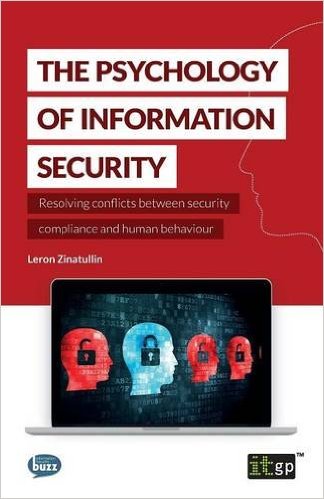
The Psychology of Information Security – Resolving conflicts between security compliance and human behaviour

ITGP

In today’s corporations, information security professionals have a lot on their plate. In the face of constantly evolving cyber threats they must comply with numerous laws and regulations, protect their company’s assets and mitigate risks to the furthest extent possible.

Security professionals can often be ignorant of the impact that implementing security policies in a vacuum can have on the end users’ core business activities. These end users are, in turn, often unaware of the risk they are exposing the organisation to. They may even feel justified in finding workarounds because they believe that the organisation values productivity over security. The end result is a conflict between the security team and the rest of the business, and increased, rather than reduced, risk.

This can be addressed by factoring in an individual’s perspective, knowledge and awareness, and a modern, flexible and adaptable information security approach. The aim of the security practice should be to correct employee misconceptions by understanding their motivations and working with the users rather than against them – after all, people are a company’s best assets.

I just finished writing a book with IT Governance Publishing on this topic. This book draws on the experience of industry experts and related academic research to:

  • Gain insight into information security issues related to human behaviour, from both end users’ and security professionals’ perspectives.
  • Provide a set of recommendations to support the security professional’s decision-making process, and to improve the culture and find the balance between security and productivity.
  • Give advice on aligning a security programme with wider organisational objectives.
  • Manage and communicate these changes within an organisation.

Based on insights gained from academic research as well as interviews with UK-based security professionals from various sectors, The Psychology of Information Security – Resolving conflicts between security compliance and human behaviour explains the importance of careful risk management and how to align a security programme with wider business objectives, providing methods and techniques to engage stakeholders and encourage buy-in.

The Psychology of Information Security redresses the balance by considering information security from both viewpoints in order to gain insight into security issues relating to human behaviour , helping security professionals understand how a security culture that puts risk into context promotes compliance.

It’s now available for pre-order on the UK, EU or US websites.

Online Safety and Security

ID-100356086

We live in the developed world where it is now finally safe to walk on the city streets. Police and security guards are there to protect us in the physical world. But who is watching out for us when we are online?

Issues:

  1. Cyber crime and state-sponsored attacks are becoming more and more common. Hackers are now shifting their focus form companies to the individuals. Cars, airplanes, smart homes and other connected devices along with personal phones can be exploited by malicious attackers.
  2. Online reputation is becoming increasingly more important. Potential business partners conduct thorough research prior to signing deals. Bad reputation online dramatically decreases chances to succeed in business and other areas of your life.
  3. Children’s safety online is at risk. Cyber-bullying, identity theft; with a rapid development of mobile technology and geolocation, tracking the whereabouts of your children is as easy as ever, opening opportunities for kidnappers or worse.

Solution:

A one-stop-shop for end-to-end protection of online identity and reputation for you and your children.

A platform of personalised and continuous online threat monitoring secures you, your connections, applications and devices and ensures safety and security online.

Image courtesy ofwinnond / FreeDigitalPhotos.net

Cyber Wargaming Workshop

ID-10071890

I was recently asked to develop a two-day tabletop cyber wargaming exercise. Here’s the agenda.
Please get in touch if you would like to know more.

Day 1
Introduction
Course Objectives
Module 1: What is Business Wargaming?
How Does Business Wargaming Work?

  •         Teams
  •         Interaction
  •         Moves

Module 2 Cyber Fundamentals

  •         Practical Risk Management
  •         Problems with risk management
  •         Human aspects of security
  •         Conversion of physical and information security
  •         Attacker types and motivations
  •         Security Incident management
  •         Security incident handling and response
  •         Crisis management and business continuity
  •         Cyber security trends to consider

Module 3: Introducing a Case Study

  •         Company and organisational structure
  •         Processes and architecture
  •         Issues

Module 4 Case study exercises

  •         Case study exercise 1: Risk Management
  •         Case study exercise 2: Infrastructure and Application Security

Day 2
Introducing a wagaming scenario
Roles and responsibilities
Simulated exercise to stress response capabilities
The scenario will be testing:

  •         How organisations responded from a business perspective
  •         How organisations responded to the attacks technically
  •         How affected organisations were by the scenario
  •         How they shared information amongst relevant parties

Feedback to the participants
Course wrap up

Image courtesy zirconicusso / FreeDigitalPhotos.net

Giving a talk on information security

Met

I delivered a talk at the London Metropolitan University today where I was invited to share my story and participate in the university’s mentoring scheme. Although there were many students from different fields present, I focused on the computer science and information security area.

I elaborated on the possible and the transferable skills that young students can develop and apply during their undergraduate and postgraduate programmes. We also talked about job search, the general application process and the various career paths available to students in the information security and computer science areas.

Giving a lecture at the Royal Holloway University of London

IMG_20141202_205219

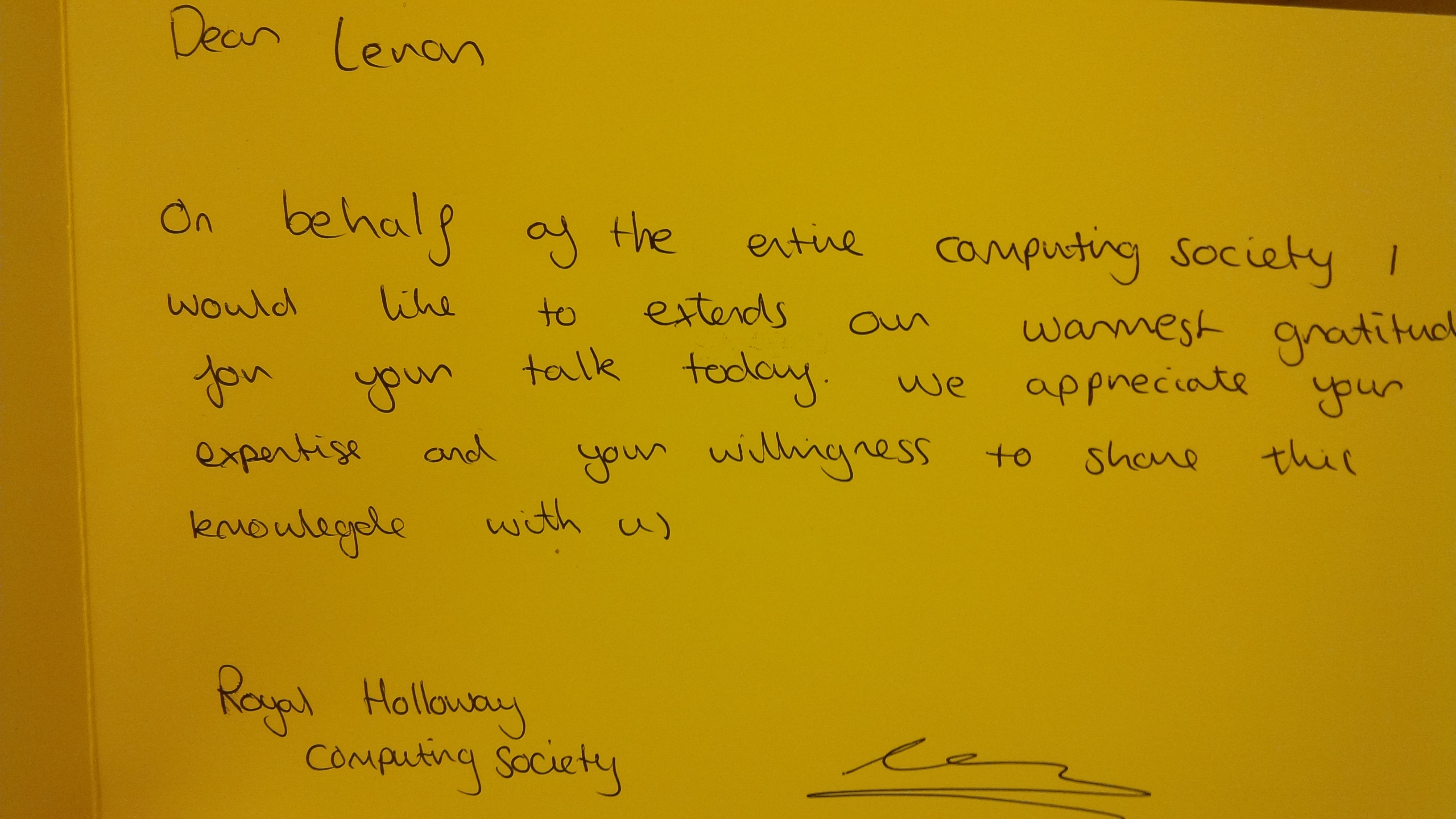
I was invited by the RHUL Computing Society to give a lecture on human aspects of security.

After my presentation, I gave the students an exercise to help them understand the different perspectives on information security policies. As a result, they learned the importance of the role of information security in an organisation and it’s important enabling function.

It was really nice to get such an active participation on their behalf. After the talk we had an interesting conversations on current security research trends and opportunities.

IMG_20141202_205259

Presenting at the ISACA London Chapter event

Goal

I shared some research findings with the ISACA London Chapter members at the November event. We discussed resolving conflicts between security compliance and human behaviour. The talk was followed by a panel discussion with other presenters, where I answered questions regarding human aspects of information security.

During the networking session after the presentation I’ve had many other interesting conversations with the participants. People were sharing their stories and experiences implementing and auditing security controls.

The video of the talk is available on the ISACA London Chapter website.

The Analogies Project

The-Analogies-Project-Presnetation-Logo

I’m passionate about helping people understand security better. In my experience, using analogies has proved to be one of the best tools to help them learn. People have a far better and long-lasting understanding when they can relate to an experience that illustrates the concept they are to comprehend. Describing situations and possible outcomes can be just as easily done by telling stories: They are not only pleasant to read, hear or imagine, but they also transfer knowledge in the most effective way.

That’s why I decided to contribute to The Analogies Project.

Here’s what their website say about about the project:

Mission
The aim of the Analogies Project is to help spread the message of information security, and its importance in the modern world.
By drawing parallels between what people already know, or find interesting (such as politics, art, history, theatre, sport, science, music and every day life experiences) and how these relates to information security, we can increase understanding and support across the whole of society.

Why use analogies?
Many aspects of information security are highly technical and require a deep specialist knowledge. However, we know that all security depends ultimately on the awareness and preparedness of non-specialists.
Information security professionals cannot rely solely on technology to protect their organisations. They must engage with senior management and users in a way that their message is understood, fully appreciated and implemented. In this way they can drive changes in attitude and behaviour that will make the organisation more secure.
To do that, they must find a new language to get their points across to the non-specialist. And this is where the Analogies Project comes in….
Our past is littered with examples of how the prosperity or decline of individuals, enterprises, governments and nation states has depended to a greater or lesser extent, on the confidentiality, integrity and availability of information. By using storytelling, analogies and metaphor we can transform these real life events into powerful tools for engagement.

Please feel free to check out my profile and read my analogies.

Find out how security controls affect productivity in your company


speedometer

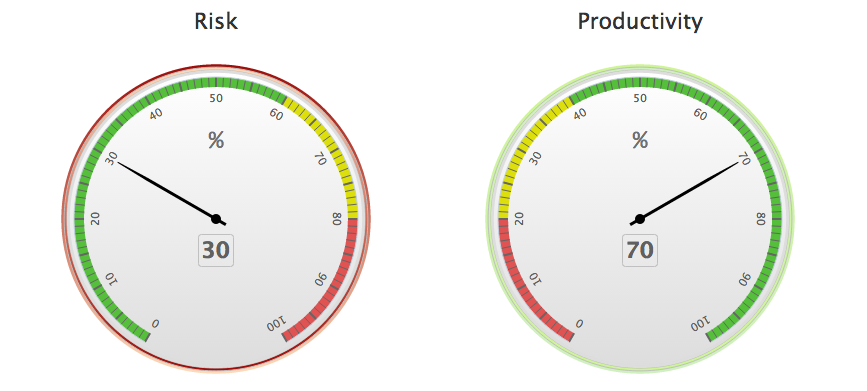
To expand on my research on the human aspect of security, I created a simplified model to highlight the relationship between productivity and security. The main hypothesis, is that there is a productivity cost associated with the security controls.

The interactive simulation was created to allow users to implement their own security policies and observe the relationship between risk reduction and impact on productivity cost. Easy to understand visual feedback is available immediately for the users. This helps to understand security managers’ perspective when implementing security controls in a company.

The creation of the model was inspired by research conducted by Angela Sasse and her colleagues at the University College London.

Please get in touch if you have any feedback or would like to discuss the underlying research findings.

Discussing Human Aspects of Information Security

June 11 (1)

I delivered a seminar on the human aspects of information security at the University of West London. We discussed conflicts between security and productivity in companies and possible solutions. Research students with different backgrounds helped to drive the debates around usability, awareness and policy design.

We also talked about the practical applications of behavioural theories, where I shared my views on user monitoring and trust in organisations within the context of security culture.

Daniel, one of the participants, summarised his experience in his blog.

Image courtesy of Vlado / FreeDigitalPhotos.net