Book signing

I’ve been asked to sign a large order of my book The Psychology of Information Security and hope that people who receive a copy will appreciate the personal touch!

I wrote this book to help security professionals and people who are interested in a career in cyber security to do their job better. Not only do we need to help manage cyber security risks, but also communicate effectively in order to be successful. To achieve this, I suggest starting by understanding the wider organisational context of what we are protecting and why.

Communicating often and across functions is essential when developing and implementing a security programme to mitigate identified risks. In the book, I discuss how to engage with colleagues to factor in their experiences and insights to shape security mechanisms around their daily roles and responsibilities. I also recommend orienting security education activities towards the goals and values of individual team members, as well as the values of the organisation.

I also warn against imposing too much security on the business. At the end of the day, the company needs to achieve its business objectives and innovate, albeit securely. The aim should be to educate people about security risks and help colleagues make the right decisions, showing that security is not only important to keep the company afloat or meet a compliance requirement but that it can also be a business enabler. This helps demonstrate to the Board that security contributes to the overall success of the organisation by elevating trust and amplifying the brand message, which in turn leads to happier customers.

Cyber security: a global perspective

While in the lockdown in the UK, I was reflecting on the many countries I had a chance to work and travel to in my career so far.

Following-up from my previous blog on lessons I learned from working in cyber security across multiple sectors, geography is another lens I can apply when thinking about the diversity of cyber security projects I had a chance to contribute to and people to work with.

It was a pleasure to serve clients and collaborate with colleagues from all over the world and this really gave me a global perspective on cyber security challenges across continents.

I was fortunate to visit more places than mentioned on this map, however, the ones I selected here were the most memorable and challenging from a project perspective. 

There are still plenty of countries I have yet to explore, so I’m eagerly awaiting the time when it’s safe to travel again.

Cyber security lessons from across the industries

I have been fortunate to help and collaborate with a wide variety of organisations during my cyber security career to date. These companies range from large multinationals that are household names to small tech startups that you probably haven’t even heard of.

Although the regulatory landscape, security maturity and key risks often vary dramatically between industries, there are common themes that both an upstart FinTech and an energy giant can benefit from.

Being able to see what works, for example, in the world of Operational Technology and apply some of the learnings to an insurance company and vice versa can bring a fresh perspective and result in unique solutions that can be easily overlooked in traditional sector-specific paradigms. Identifying these synergies and collaboration opportunities between organisations of different sizes, industries, cultures and technological stacks has allowed me to better understand specific issues, challenge the conventional thinking and tailor my advice to fit the overall strategy of a given organisation for best results.

How to be a trusted advisor

Being a security leader is first and foremost acting as a trusted advisor to the business. This includes understanding its objectives and aligning your efforts to support and enable delivery on the wider strategy.

It is also about articulating cyber risks and opportunities and working with the executive team on managing them. This doesn’t mean, however, that your role is to highlight security weaknesses and leave it to the board to figure it all out. Instead, being someone they can turn to for advice is the best way to influence the direction and make the organisation more resilient in combating cyber threats.

For your advice to be effective, you first need to earn the right to offer it. One of the best books I’ve read on the subject is The Trusted Advisor by David H. Maister. It’s not a new book and it’s written from the perspective of a professional services firm but that doesn’t mean the lessons from it can’t be applied in the security context. It covers the mindset, attributes and principles of a trusted advisor.

Unsurprisingly, the major focus of this work is on developing trust. The author summarises his views on this subject in the trust equation:

Trust = (Credibility + Reliability + Intimacy) / Self-Orientation

It’s a simple yet powerful representation of what contributes to and hinders the trust building process.

It’s hard to trust someone’s recommendations when they don’t put our interests first and instead are preoccupied with being right or jump to solutions without fully understanding the problem.

Equally, as important credibility is, the long list of your professional qualifications and previous experience on its own is not sufficient to be trustworthy. Having courage and integrity, following through on your promises and active listening, among other things are key. In the words of Maister, “it is not enough to be right, you must also be helpful”.

How to pass the Azure Fundamentals exam

Microsoft Certified Azure Fundamentals (AZ-900) is an entry-level qualification focusing on core cloud concepts and Azure services. It doesn’t have any prerequisites so it’s a natural first step on your journey of mastering Azure cloud.

If you have experience with cloud technologies from other providers, you might be already familiar with the basics of cloud computing but that doesn’t mean you should skip this certification. GCP, AWS and Azure have their own peculiarities and despite having seemingly similar offerings, there are significant differences in how their services are provisioned and configured.

Studying for this exam will give you a good overview of Azure-specific terminology and services, and will be useful regardless of your previous skill level.

I recommend the following free resources to help with your preparation:

How to apply FBI’s behavioural change stairway to security

Unlike the FBI’s Hostage Negotiation Team, cyber security professionals are rarely involved in high-stakes negotiations involving human life. But that doesn’t mean they can’t use some of the techniques developed by them to apply it to improve security culture, overcome resistance and guide organisational change.

Behind the apparent simplicity, this model is a tried and tested way to influence human behaviour over time. The crux of it is that you can’t skip any steps as consecutive efforts build on the previous ones. The common mistake many cyber security professionals make is they jump straight to Influence or Behavioral change with phishing simulations or security awareness campaigns but this can be counterproductive. 

As explained in the original paper, it is recommended to invest time in active listening, empathy and establishing rapport first. In the security context, this might mean working with the business stakeholders to understand their objectives and concerns, rather than sowing fear of security breaches and regulatory fines.

All of this doesn’t mean you have to treat every interaction like a hostile negotiation or treat your business executives as violent felons. The aim is to build trust to be able to best support the business not manipulate your way into getting your increased budget signed off.I cover some techniques in The Psychology of Information Security – feel free to check it out if you would like to learn more.

Business alignment framework for security

In my previous blogs on the role of the CISO, CISO’s first 100 days and developing security strategy and architecture, I described some of the points a security leader should consider initially while formulating an approach to supporting an organisation. I wanted to build on this and summarise some of the business parameters in a high-level framework that can be used as a guide to learn about the company in order to tailor a security strategy accordingly.

This framework can also be used as a due diligence cheat sheet while deciding on or prioritising potential opportunities – feel free to adapt it to your needs.

More

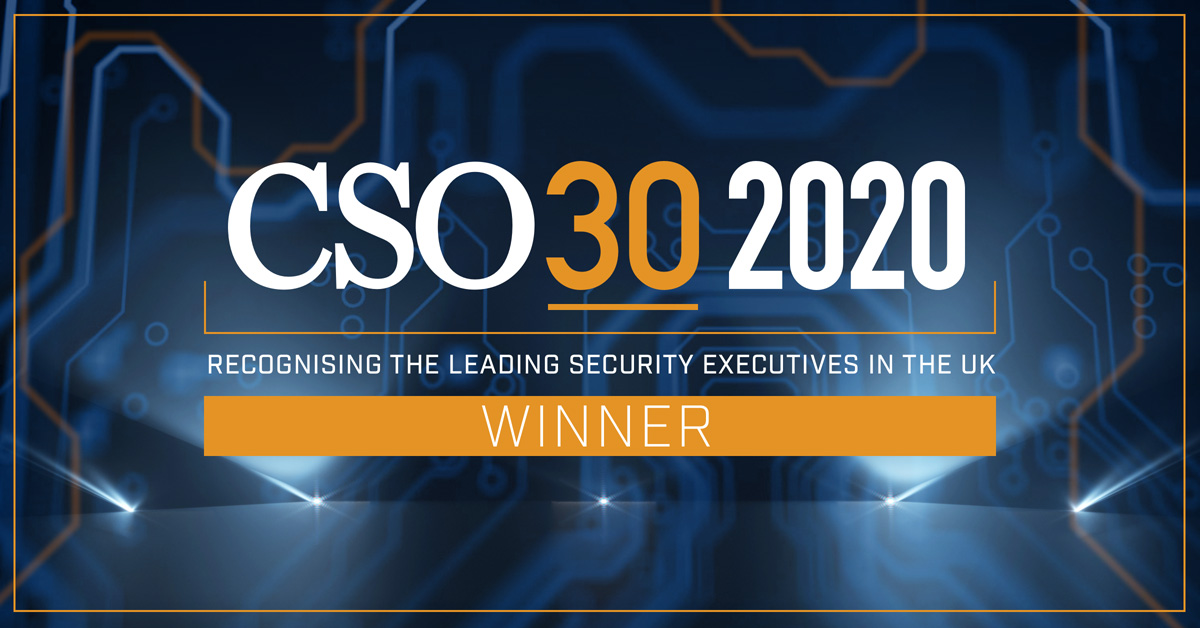
I’ve been named a CSO30 Awards 2020 winner

I am excited to be recognised as one of the top security executives who have demonstrated outstanding thought leadership and business value.

The winners of the CSO30 Award “demonstrated risk and security excellence in helping guide their organisations through the challenges of COVID19, worked to secure digital transformation initiatives, strengthen security awareness and education efforts, utilize new security technologies, engage with the wider security community to share learnings, and much more.”

It’s a team effort and I’m proud to be working with great professionals helping businesses innovate while managing risks.

The role of a CISO

I’m often asked what the responsibilities of a CISO or Head of Information Security are. Regardless of the title, the remit of a security leadership role varies from organisation to organisation. At its core, however, they have one thing in common – they enable the businesses to operate securely. Protecting the company brand, managing risk and building customer trust through safeguarding the data they entrusted you with are key.

There are various frameworks out there that can help structure a security programme but it is a job of a security leader to understand the business context and prioritise activities accordingly. I put the below diagram together (inspired by Rafeeq Rehman) to give an idea of some of the key initiatives and responsibilities you could consider. Feel free to adapt and tailor to the needs of your organisation.

You might also find my previous blogs on the first 100 days as a CISO and developing an information security strategy useful.

More